
History has a strange habit of forgetting its own brilliance. Civilizations rose, fell, and took entire libraries of knowledge with them – engineering secrets, chemical formulas, mechanical wonders that modern science would only manage to rediscover, sometimes thousands of years later. It’s both humbling and a little unsettling, honestly.
Some of these inventions were so far ahead of their time that even today, with electron microscopes and supercomputers, scientists struggle to fully replicate what ancient hands built with basic tools. So what exactly did we lose – and find again? Let’s dive in.
1. The Antikythera Mechanism – The World’s First Computer
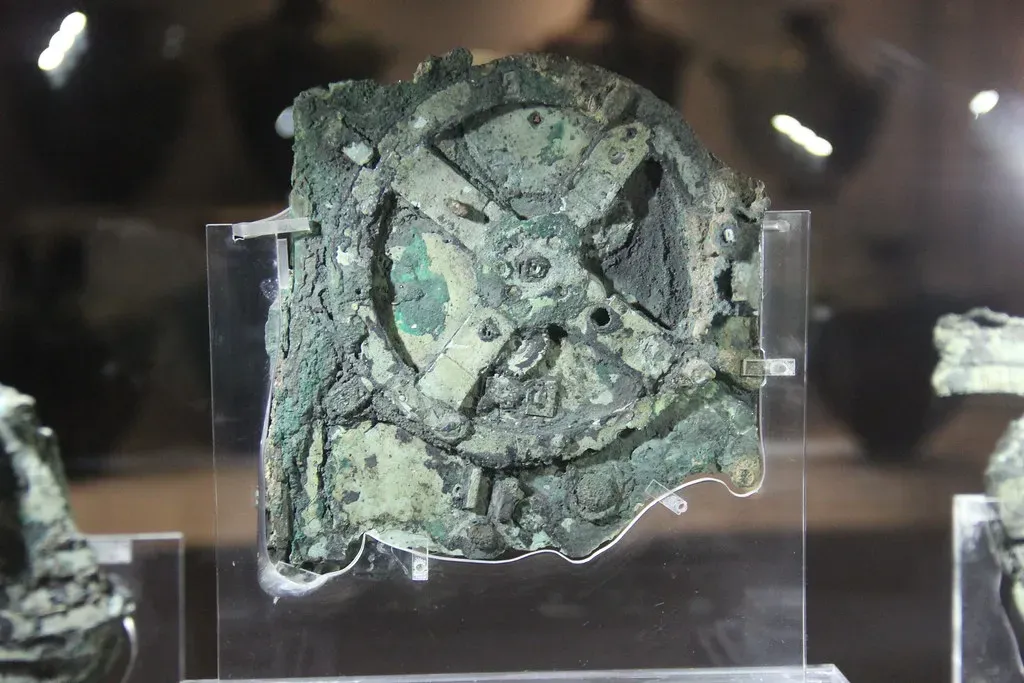
The artifact was among wreckage retrieved from a shipwreck off the coast of the Greek island Antikythera in 1901. For decades, no one truly understood what they were looking at. It just looked like a corroded bronze lump.
The Antikythera mechanism is an ancient Greek hand-powered orrery – a model of the Solar System – and it is the oldest known example of an analogue computer. It could be used to predict astronomical positions and eclipses decades in advance. Think about that for a second. Eclipses predicted decades ahead, with gears, over two thousand years ago.
The sophistication and precision evident in the design suggests it was not the only device of its kind, and many scientists have speculated that its use might have been widespread. Still, the existence of other devices like the Antikythera Mechanism doesn’t appear on the historical record until the 14th century, which would mean that the technology was lost for nearly 1,400 years.
In March 2021, the Antikythera Research Team at University College London published a new proposed reconstruction of the entire mechanism. They were able to find gears that could be shared among the gear-trains for the different planets, by using rational approximations for the synodic cycles. And the research hasn’t stopped – in 2025, one research team concluded that manufacture error in the original mechanism’s gears is too great for the mechanism to have ever worked, though they emphasized that the scans they used could be incorrect about the extent of imperfections.
2. Roman Self-Healing Concrete – The Material That Gets Stronger Over Time

Here’s a fact that should make every modern engineer slightly uncomfortable: the Pantheon’s dome, still the largest unreinforced concrete dome in the world, has stood for nearly 2,000 years. Roman harbors submerged in seawater for millennia remain structurally intact. Aqueducts stretch across landscapes, cracked yet uncollapsed, scarred yet standing. By contrast, modern concrete infrastructure often deteriorates in 50 to 100 years.
Research in 2023 has shown that the incorporation of mixtures of different types of lime, forming conglomerate “clasts,” allowed the concrete to self-repair cracks. Roman concrete was in widespread use from about 150 BC. The self-healing secret comes down to chemistry: the strength and longevity of Roman marine concrete is understood to benefit from a reaction of seawater with a mixture of volcanic ash and quicklime to create a rare crystal called tobermorite, which may resist fracturing. As seawater percolated within the tiny cracks, it reacted with phillipsite naturally found in the volcanic rock and created aluminous tobermorite crystals.
In 2023, a team led by MIT Professor Admir Masic described a “hot-mixing” process in which Roman builders mixed lime fragments with volcanic ash and other dry ingredients before adding water. Recent excavations at Pompeii’s Regio IX uncovered an intact ancient construction site, offering insights into Roman building techniques at the time of the eruption of Mount Vesuvius in 79 CE. That discovery was a game changer – a snapshot of history literally frozen mid-build.
3. Greek Fire – The Ancient Napalm Nobody Can Recreate

Greek Fire was an incendiary weapon first used in Byzantine warfare in 678 CE. The napalm of ancient warfare, the highly flammable liquid was made of secret ingredients and used both in catapulted incendiary bombs and sprayed under pressure so as to launch flames at enemy ships and fortifications. Water didn’t stop it. In some accounts, water made it worse.
The recipe was such a closely guarded secret of the Empire that eventually the Byzantines realized that no one remembered how to make it. Soon after, the Byzantine Empire collapsed since its formerly invincible navy lost their most potent weapon. To this day, no one knows exactly how Greek Fire was made, although some of Kallinikos’s partially-complete notes have been found.
Yet to this day, scholars are unsure of the exact composition of Greek Fire. Suggestions made over the years regarding the additions to the secret recipe included resin, pine tar, animal fat, tar, sulfur, lime, bitumen, and more. According to some researchers, it can be assumed that it was composed of petroleum, tar, and sulfur, mixed with quicklime and other substances. Modern chemists still can’t perfectly replicate something that medieval sailors deployed from bronze nozzles on wooden ships. That’s either astonishing or deeply humbling, depending on your mood.
4. Damascus Steel – The Blade That Shamed the Industrial Age

Damascus steel was the forged steel comprising the blades of swords smithed in the Middle East from ingots of wootz steel imported from India and Sri Lanka. These swords are characterized by distinctive patterns of banding and mottling reminiscent of flowing water. They weren’t just beautiful – they were frighteningly functional.
The secret of making Damascus steel has only reemerged under the inspection of scanning electron microscopes in modern laboratories. It was first used around 300 BC and the knowledge seems to have been inexplicably lost around the mid-18th century. By 1750, production of Damascus swords gradually declined because firearms replaced swords and there was less demand for metal. Eventually, the knowledge and the process were lost to metalsmiths.
Nanotechnology was involved in the production of Damascus steel, in the sense that materials were added during the steel’s production to create chemical reactions at the quantum level, explained archaeology expert K. Kris Hirst. Hirst cited a study led by Peter Paufler at the University of Dresden and published in the journal Nature in 2006. To think that ancient smiths were working at the nanoscale – without knowing it – is genuinely mind-bending.
5. The Aeolipile – Hero’s Steam Engine That Arrived 1,600 Years Too Early

Long before the age of locomotives and factories, Hero of Alexandria invented a primitive steam engine in the 1st century AD known as the Aeolipile. This device worked by heating water in a sealed vessel, producing steam that escaped through bent tubes and caused a sphere to spin rapidly. It was real. It worked. Nobody bothered to use it for anything industrial.
While the Aeolipile didn’t lead to an industrial revolution in its time, its design demonstrated an understanding of steam power that wouldn’t be harnessed for practical use until 1,600 years later. The rediscovery of Hero’s work has fascinated engineers and historians alike. Some scholars have speculated that, had the Aeolipile been used for more than temple entertainment, the course of technological history might have changed dramatically.
Let’s be real – this is one of history’s most tantalizing “what ifs.” Had ancient Greek engineers pushed the Aeolipile into workshops and farms instead of temples, we might have had an industrial revolution in the Roman era. Often, society simply isn’t ready. A tool without a problem is quickly abandoned. But once the world changes, the invention returns, suddenly useful, as if it had been waiting all along.
6. The Archimedean Screw – Lost, Then Reborn Across Centuries

Archimedes, one of history’s greatest inventors, created a simple yet ingenious water-lifting device known as the Archimedes’ Screw. Designed in the 3rd century BC, this spiral-shaped tool could move water uphill, revolutionizing irrigation and drainage. Simple in concept, extraordinary in impact.
The Archimedean screw, designed to raise water in ancient Egypt and Greece, disappeared from European use for centuries before being rediscovered in the Renaissance. Today, it’s used not only for irrigation but in modern machinery like snowblowers and even spacecraft fuel systems. Spacecraft fuel systems. A 2,300-year-old design is literally helping us go to space.
It’s a reminder that not all “rediscovery” is dramatic. Sometimes the knowledge doesn’t vanish entirely – it just gets shelved. The Renaissance scholars who stumbled back onto Archimedes’ writings probably had no idea they were firing up a design that would still be useful in the age of rockets. That’s the thing about genuinely elegant engineering: it doesn’t expire.
7. The Baghdad Battery – Ancient Electricity Nobody Can Explain

In 1936, archaeologists discovered clay jars in Iraq containing copper cylinders and iron rods that could theoretically generate electricity when filled with an acidic solution. These “Baghdad Batteries,” dating to around 250 BCE, have sparked intense debate about whether ancient peoples understood electrical principles.
When replicated, these devices do produce about 1.5 volts of electricity – enough to electroplate metals or power small devices. Some researchers suggest they were used for electroplating gold onto silver jewelry, a process that would have seemed magical to ancient observers. However, skeptics argue they might have been simple storage containers, leaving the true purpose shrouded in mystery.
The Baghdad Battery, or Parthian Battery, discovered in 1938 in what is now modern Khujut Rabu, Iraq, is a ceramic pot, a copper tube, and an iron rod. Its origin and purpose remain unclear, and further evidence is needed to explain its purpose. Some researchers hypothesized that the object functioned as a galvanic cell, possibly used for electroplating or some electrotherapy, but there is no electro-gilded object known from this period. It’s hard to say for sure, but the debate itself tells you something profound: our understanding of ancient capabilities is far from complete.
8. Greek Automata – Ancient Robotics Nobody Remembers
In the workshops of ancient Greece, inventors created astonishing automata – mechanical birds that could sing, statues that poured wine, and even coin-operated holy water dispensers. These programmable machines, described in texts by Hero of Alexandria and others, represented an early form of robotics and automation. Coin-operated dispensers. In ancient Greece. Let that sink in.
After the decline of Greek civilization, the secrets of automata were lost for centuries, only to be revived during the Renaissance and later in the modern era. The rediscovery of these devices has fascinated engineers and historians, highlighting the advanced understanding of mechanics and pneumatics in antiquity.
Greek automata have inspired a new appreciation for the creativity and inventiveness of the ancient world, echoing in today’s robots and automated systems. Honestly, the gap between Hero of Alexandria’s mechanical birds and today’s Boston Dynamics robots is smaller conceptually than most people realize. The dream of building moving, responding machines is ancient. Only the materials changed.
9. The Lycurgus Cup – Ancient Nanotechnology in Glass
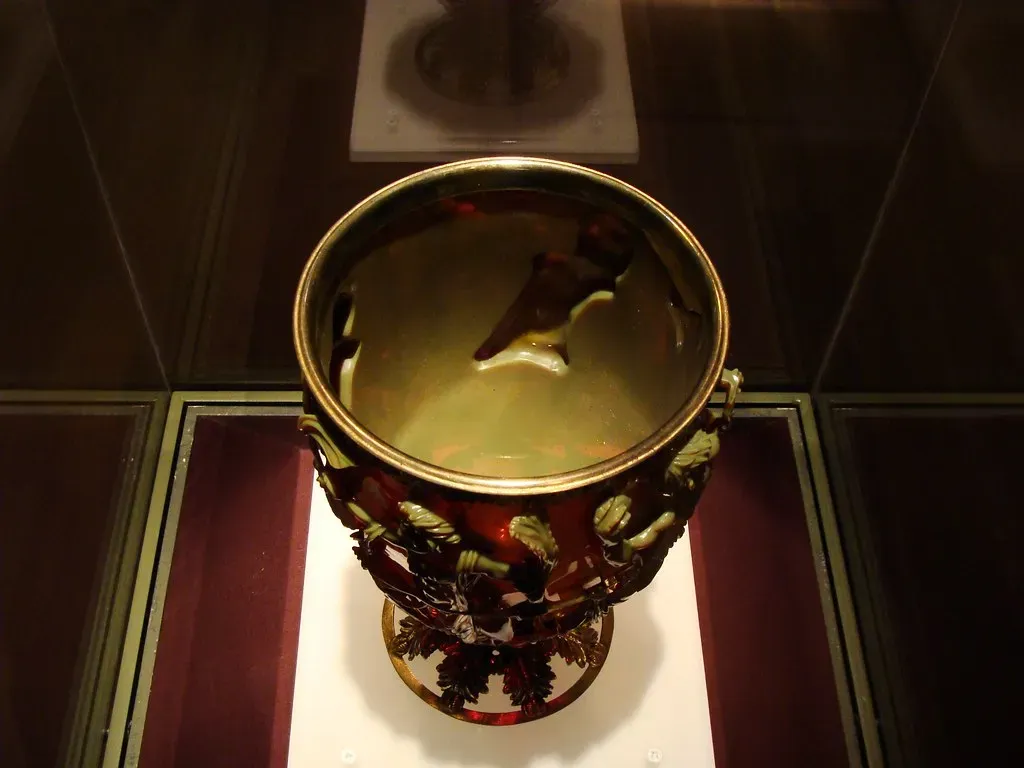
The Romans made a cup that changes color depending on whether light shines through it or reflects off it. Green in reflected light. Red when held up to the sun. And they did it – entirely by accident – using nanotechnology. The change in color is due to the presence of minute quantities of gold and silver nanoparticles in the glass – a technique whose complexity astounded scientists upon its rediscovery in modern times. The production of the cup demonstrates not just the artistry of Roman craftsmen but their inadvertent use of nanotechnology. The Lycurgus Cup stands as evidence of the ancients’ ability to manipulate materials at the microscopic level, a feat that parallels modern scientific endeavors.
The cup dates to the 4th century AD and sat in museum collections for generations before scientists in the 20th century realized what they were actually looking at. Modern labs can now reproduce the color-shifting effect deliberately, using precisely engineered nanoparticles. The Romans achieved it by grinding metal dust so finely that quantum optical effects kicked in. They had no idea why it worked. It worked anyway.
This one genuinely floors me every time I think about it. Ancient glassmakers stumbled onto a principle that modern physics only formally described in the 20th century. We’ve lost the secret to making some of history’s most useful inventions, and for all of our ingenuity and discoveries, our ancestors of thousands of years ago are still able to baffle us. We have developed the modern equivalent of some of these inventions, but only very recently.
10. The Viking Ulfberht Sword – Steel That Defied Its Era

Crafted between the 9th and 11th centuries, these swords were made from steel of such purity that it wouldn’t be replicated until the Industrial Revolution. Metallurgical analysis has revealed that the Ulfberht swords contained far fewer impurities and much higher carbon content than anything else produced in medieval Europe. The secret of their manufacture disappeared for centuries, leaving historians puzzled as to how the Vikings acquired or created such superior metal.
The rediscovery of these swords has sparked new debates about early trade networks, with some evidence suggesting raw materials may have come from as far as Persia or India. Today, Ulfberht swords are celebrated as symbols of Viking ingenuity and the mysterious leaps in ancient technology.
The puzzle here isn’t just how they made the steel – it’s how they sourced the raw materials. The idea that Viking smiths were plugged into a trade network reaching all the way to Persia or the Indian subcontinent rewrites what many people think they know about the so-called “Dark Ages.” It wasn’t dark everywhere. Some people were quietly building extraordinary things while the rest of the world wasn’t paying attention.
11. Roman Underfloor Heating (Hypocaust) – A Comfort Lost for Over a Millennium

The Romans enjoyed a level of comfort in their homes and public baths that wouldn’t be seen again for centuries, thanks to their invention of the hypocaust. This underfloor heating system worked by circulating hot air from a furnace through empty spaces beneath floors and behind walls, warming rooms from below. After the fall of the Roman Empire, the technology was lost to Europe, and people relied on open fires for warmth.
Think about how long that gap was. Underfloor heating vanished from Europe for over a thousand years. Medieval castles were cold, draughty, and smoky. Yet two thousand years ago, a Roman bath visitor could walk across a warm marble floor above a carefully engineered air-heating system. That’s a loss so basic, so practical, that it’s almost painful to consider.
Many of the technologies, inventions, and manufacturing processes of antiquity have simply disappeared with the passage of time, while others are still not fully understood by modern day scientists. Some have since been rediscovered, like indoor plumbing and road building, but many of the more mysterious lost technologies have gone on to become the stuff of legend. The hypocaust is a perfect example of something so practical it should never have been lost – and yet it was, swallowed whole by the collapse of the civilization that built it.
Conclusion: What History Keeps Trying to Tell Us

The recurring theme across all eleven of these inventions is both simple and unsettling: progress is not guaranteed, and it’s not linear. Knowledge can vanish. Entire engineering traditions can be buried under rubble, burned in libraries, or simply forgotten when the last person who held the secret died without passing it on.
The story of lost and found inventions is a reminder that progress is not a straight line but a labyrinth. Knowledge can be born, buried, and reborn. And it suggests something humbling: perhaps the future already exists, scattered in forgotten notebooks, neglected prototypes, or ideas dismissed as curiosities.
What’s most striking is how many of these rediscoveries are still happening right now, in 2025 and 2026 – researchers at MIT and Pompeii, teams at University College London, scientists with electron microscopes and CT scanners, all chasing secrets that were already solved two millennia ago. The ancients were not primitive. They were simply first. What else might we be on the verge of rediscovering? What would you have guessed was possible, two thousand years ago?