Some years just happen to be loaded. Back in 2001, a strange mix of children’s fantasy, YA fiction, adult epic, and Japanese manga all landed on shelves within months of each other, and none of the authors involved had any idea how far their stories would travel. Twenty five years later, those same books are still being handed down, recommended in forums, and adapted for new formats, proof that a good story doesn’t really age the way we expect it to.
Artemis Fowl by Eoin Colfer

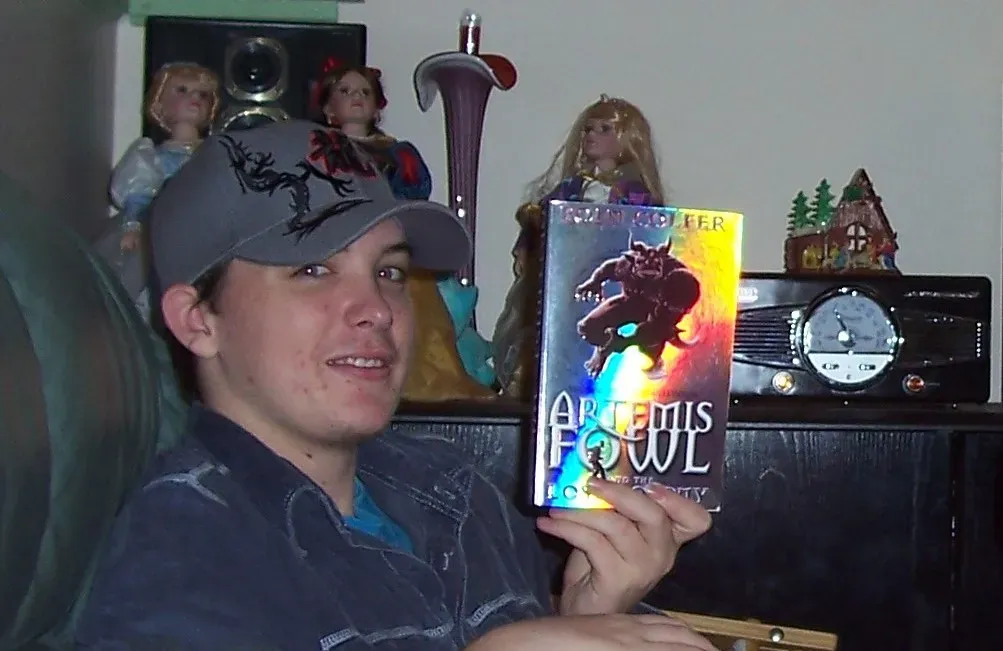
Eoin Colfer introduced the world to a twelve year old criminal mastermind in 2001, and readers had never quite seen anything like him. Artemis Fowl is a young adult fantasy novel written by Irish author Eoin Colfer. The book blended crime thriller pacing with fairy mythology, and it worked because Artemis wasn’t a hero in the traditional sense. He was a schemer, and that made him fascinating to a generation of kids who were tired of purely virtuous protagonists.
Published in 2001, it marked the debut of an eight book young adult fantasy series, blending elements of science fiction and crime thriller to create a unique world where high tech fairies clash with a child genius. The series, comprising eight main books, has sold more than 25 million copies worldwide. The Arctic Incident followed in 2002, and the sequels kept the momentum going for over a decade. A quarter century on, Colfer’s fairy police procedural still reads as inventive rather than dated, which is rarer than it sounds for early 2000s fantasy.
The Sisterhood of the Traveling Pants by Ann Brashares


Ann Brashares published her debut novel in September 2001, and it quickly became something closer to a cultural touchstone than a typical YA release. The Sisterhood of the Traveling Pants is a young adult novel by Ann Brashares published in 2001, released by Delacorte Press. The premise sounds almost too simple on paper, four friends share one pair of jeans that somehow fits all of them, yet the book turned that gimmick into a genuine meditation on friendship and growing up apart.
Brashares deftly moves from narrative to narrative, weaving together themes from the mundane to the profoundly important, from death to raging hormones, from stepfamilies to dead end minimum wage jobs. The story eventually grew into a five book series, with The Second Summer of the Sisterhood in 2003, Girls in Pants in 2005, Forever in Blue in 2007, and Sisterhood Everlasting in 2011. A 2005 film adaptation introduced the girls to an even wider audience, cementing the series as a defining piece of millennial girlhood.
Kushiel’s Dart by Jacqueline Carey

While most of 2001’s breakout series were aimed at younger readers, Jacqueline Carey’s debut went firmly in the opposite direction. Her first novel was Kushiel’s Dart, published by Tor Books in 2001, and the recipient of the 2002 Locus Award for Best First Novel. The book opened the Kushiel’s Legacy trilogy, later expanded into a broader saga, and it reshaped what adult fantasy could look like by centering a courtesan turned spy rather than a chosen one with a sword.
The first trilogy, Kushiel’s Legacy, begins with the story of Phèdre nò Delaunay, a courtesan’s flawed and unwanted daughter who is sold into indentured servitude. Reviewers at the time noted just how unusual the book felt within the genre, and one contemporary review called it “an extraordinary book in many ways” that sought “to reinvent what you might call low fantasy” while presenting sexuality in a way that felt bold rather than exploitative. Twenty five years later, it’s still cited as one of the books that expanded fantasy’s boundaries beyond the Tolkien mold, and it built a devoted readership that stuck with Carey through more than a dozen further novels in the same world.
Fullmetal Alchemist by Hiromu Arakawa


Manga doesn’t always get grouped with Western book series in these kinds of retrospectives, but Fullmetal Alchemist earned its place the hard way, through sheer scale and staying power. Hiromu Arakawa’s series debuted in 2001 in Square Enix’s monthly manga anthology Shonen Gangan and went on to become a global phenomenon. The story of two brothers trying to undo a failed attempt to resurrect their mother struck a chord that went well beyond typical shonen audiences.
It was serialized from July 2001 to June 2010 with one new chapter per issue, concluding at 108 serialized chapters with 27 tankōbon graphic novel releases. English language readers got their first taste a few years later, and the series went on to spawn two separate anime adaptations, each with its own passionate fanbase. For a lot of readers who grew up in the 2000s, Edward and Alphonse Elric were their entry point into manga as a serious storytelling medium rather than a niche curiosity.
Bleach by Tite Kubo


Just weeks after Fullmetal Alchemist began its run, another series launched that would go on to define an entire era of shonen manga. Bleach by Tite Kubo was first published on August 7, 2001, with serialization beginning in the 36th issue of Shueisha’s Weekly Shonen Jump for that year. The story followed a teenager named Ichigo Kurosaki who gains the powers of a soul reaper, and it built one of the most recognizable rosters of characters in modern manga.
Bleach was the final series of the legendary Big Three to debut, following One Piece in 1997 and Naruto in 1999. The entire story eventually spanned 74 tankōbon volumes and 686 individual chapters. Its anime adaptation arrived a few years later and helped introduce countless Western fans to Japanese pop culture, and the franchise has continued expanding with a Brotherhood style revival years after the manga wrapped, proof that the appetite for Ichigo’s world never really faded.
Looking back at these five now, it’s striking how differently they aged. Some, like the Sisterhood books, feel tied to a specific moment in early 2000s culture, while others, particularly the two manga series, still pull in new readers who weren’t even born when the first chapters ran. What ties them together isn’t genre or format. It’s the fact that each one gave readers something to hold onto long enough to become part of who they were growing up, which is really the only thing a book series ever needs to do.