Some of the world’s most celebrated artworks are not quite what they seem. Beneath layers of oil paint, inside cleverly distorted shapes, and lurking in reflected glass, artists from the Renaissance to the Surrealist era quietly embedded secret faces that most viewers walk right past. Honestly, the idea that you could stand in front of a masterpiece worth millions and completely miss a hidden portrait is both humbling and thrilling.
Art historians, conservators, and scientists equipped with X-rays, infrared imaging, and multi-spectral cameras have been pulling back the curtain on these secrets for decades. Some of what they found was expected. A lot of it was absolutely shocking. Let’s dive in.
1. The Ambassadors by Hans Holbein the Younger (1533) – The Death Nobody Sees Coming
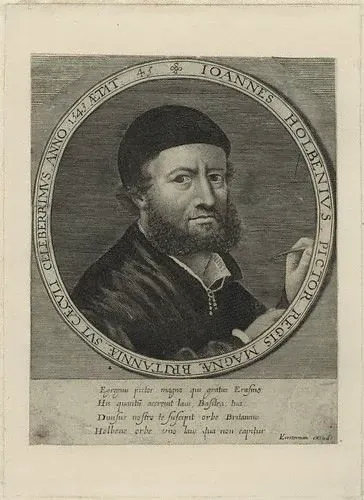
Here’s the thing about this painting. At first glance, it looks like a perfectly composed double portrait of two powerful Tudor courtiers, surrounded by globes, instruments, and symbols of worldly success. In this painting we see two men of the Tudor court surrounded by musical instruments, globes, and the most high-tech gadgets of the day. Everything feels balanced, confident, and almost a little smug.
Then you notice something strange in the foreground. This 1533 painting by German artist Hans Holbein, titled “The Ambassadors,” holds a decidedly morbid secret – that strange grey blur at the bottom of the composition is actually a carefully distorted human skull. It sits right there, in plain sight, and most people mistake it for a smudge or an odd shadow.
If you move to the right side and view the artwork from a sharp angle, the smudge suddenly becomes a clear, haunting skull – an example of a technique called anamorphosis. This skull is not just a visual trick. It is a reminder of mortality, echoing the old saying “memento mori.” Art historians are still amazed that Holbein pulled this off with such precision.
Holbein’s skull would have been no easy feat to create. He would have needed to either use a grid to figure out how to stretch it correctly, or shine light through a drawing made on translucent paper as a guide. Centuries later, this painting continues to stop visitors dead in their tracks at the National Gallery in London.
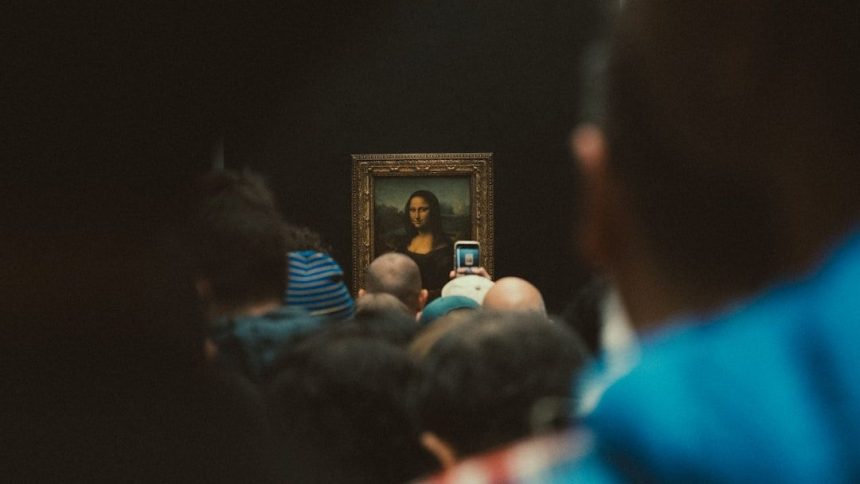
2. The Mona Lisa by Leonardo da Vinci (1503–1519) – A Face Beneath the Face
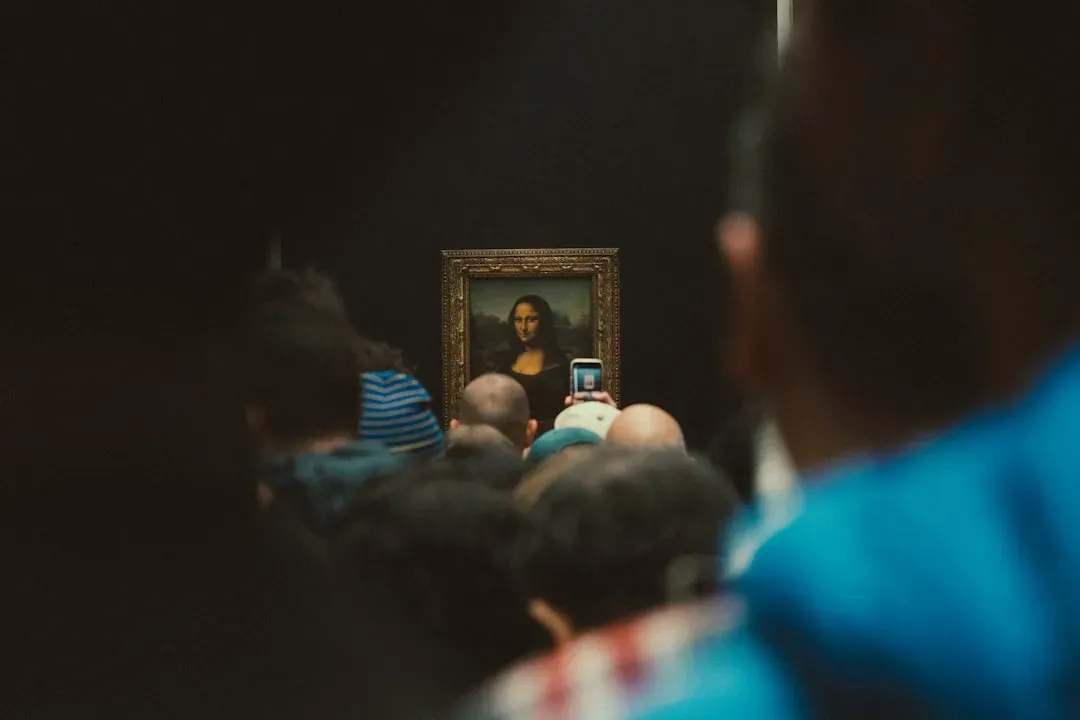
Few paintings on Earth have been studied as obsessively as this one, and yet it keeps giving up new secrets. The sketch underneath the masterpiece was discovered by scientist Pascal Cotte, who studied the Mona Lisa for more than 15 years. His quest began in 2004 when the Louvre allowed him to take photographic scans of it. That is a remarkable level of dedication for a single painting.
His findings were published in the Journal of Cultural Heritage in August 2020. The high-tech tool he built is the Lumiere Technology camera, which utilizes the layer amplification method, or LAM, to detect light reflected on 13 wavelengths. Think of it like peeling the layers of an onion – each wavelength reveals something previously invisible.
The hidden picture shows a woman looking into the distance with no trace of the characteristic smile. Cotte believes he has discovered the genuine portrait of Lisa del Giocondo, also known as Lisa Gherardini, the wife of a Florentine merchant. So the iconic smile we all know may actually be a second layer of artistic intent.
The spolvero on the forehead and on the hand betrays a complete underdrawing. This raises the extraordinary possibility that a preparatory paper drawing of the Mona Lisa by Leonardo himself may still exist somewhere in the world, still undiscovered. I think that thought alone is enough to keep art hunters up at night.
3. The Old Guitarist by Pablo Picasso (1903–1904) – A Ghost in the Blue Period
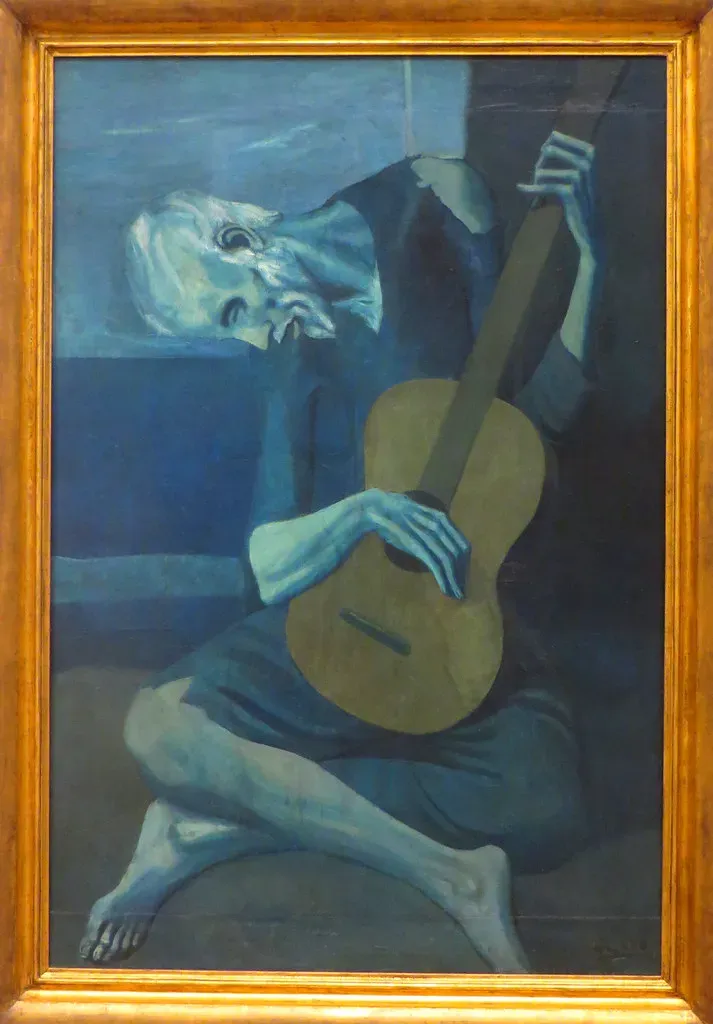
Pablo Picasso’s “The Old Guitarist,” painted in 1903 during his somber Blue Period, is famous for its lonely, melancholy mood. What most people do not realize is that there is another painting hidden beneath the visible image. It is one of those discoveries that makes you look at a familiar work completely differently.
When seeing the painting in person at the Art Institute of Chicago, you may notice what looks like another face behind the bent neck of the guitarist. X-ray imaging has revealed that the unidentified woman is nursing a small child, and appears to be in a pastoral setting accompanied by a bull and a sheep. That is an entirely different emotional universe from the gaunt, solitary musician we see on the surface.
Picasso carried this experimentation to a new level, with the revelation that there is another painting beneath the old guitarist. The contours of this first work, which centered on a seated female nude, can still be seen at points in Picasso’s Old Guitarist. The reuse was almost certainly practical as much as artistic, since Picasso was deeply poor during this period.
During lean times, some artists resorted to painting over less satisfactory or unfinished work because they could not afford new canvas. The hidden woman in this masterpiece is a tender reminder that even genius operates under real-world constraints. She is a phantom of financial hardship, preserved by accident for over a century.
4. Bacchus by Caravaggio (c. 1597) – The Miniature Self-Portrait in a Wine Jug
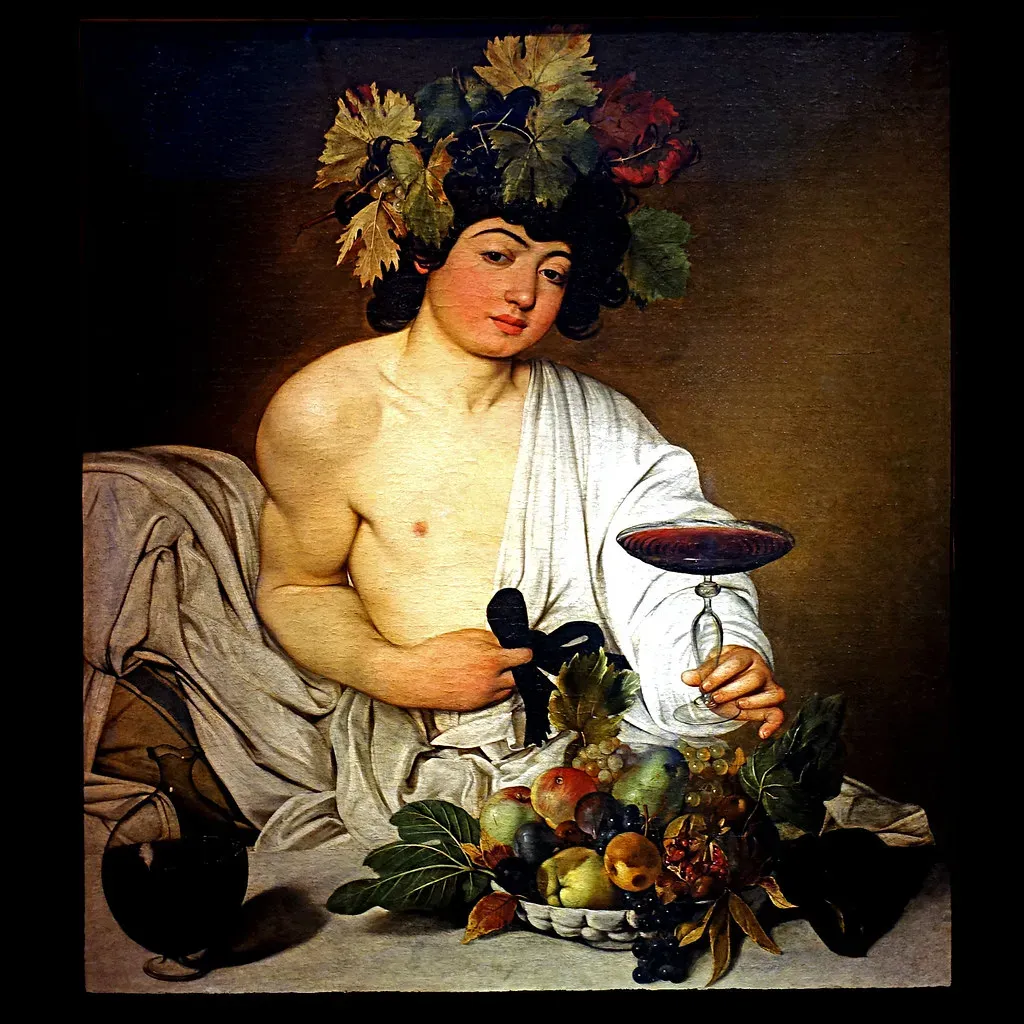
Look very closely at the carafe of wine sitting in the lower left of Caravaggio’s lush, sensuous painting of the Roman god of wine. Most gallery visitors see nothing more than a glass vessel catching the light. Art historians using a technology called reflectography discovered an image lurking under the painting in 2009. On the bottom left, they found a hidden image of a man sitting upright and trapped inside the carafe. His arm points to the canvas.
Conservators using cutting-edge technology in their quest to find evidence of underdrawings in works by Caravaggio produced the most detailed image to date of a “hidden” self-portrait by the Baroque artist. A team from Florence’s Opificio delle Pietre Dure applied the new technology to Bacchus, around 1597, in the Uffizi Gallery. The result was an image of Caravaggio reflected in the glass of the wine jug.
Although the self-portrait was discovered in 1922 when layers of dirt and discoloured varnish were removed, it was not visible to the naked eye, making this the first time scholars were able to view the portrait. That is a gap of nearly 90 years between first detection and actual viewing. It makes you wonder what else has been sitting in plain sight, waiting for the right technology to arrive.
Some experts believe it is Caravaggio aged 25, with dark curly hair. Caravaggio is known for including self-portraits in his work. In the painting “David with the Head of Goliath” (1609–10) in Rome’s Borghese Gallery, his features can be seen in the face of Goliath. The wine jug portrait is perhaps the most audacious of all his hidden cameos – literally pickling himself inside the scene.
5. An Old Man in Military Costume by Rembrandt (c. 1630–31) – The Young Man Who Was There First
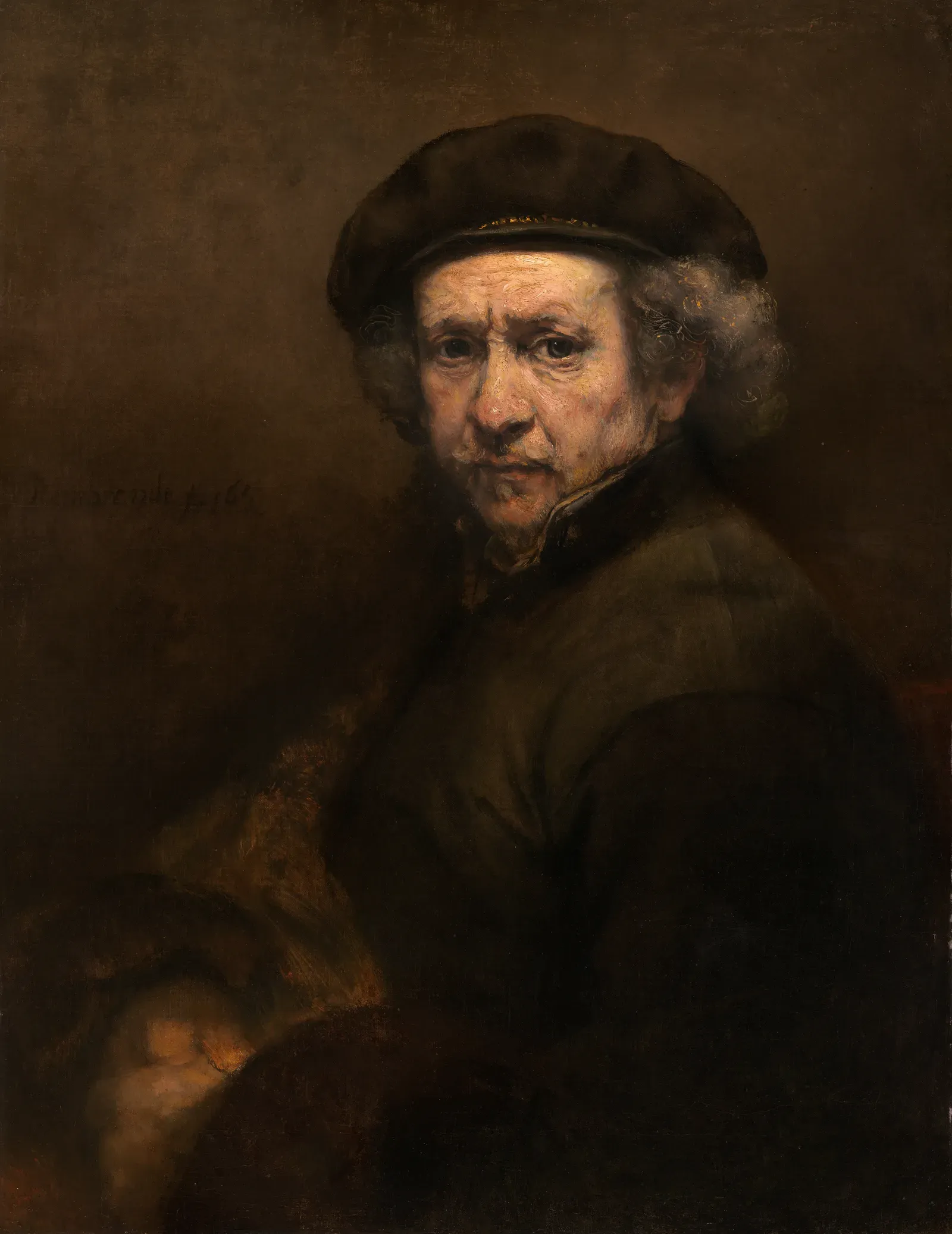
This painting, housed at the J. Paul Getty Museum in Los Angeles, has been carrying a secret since at least 1968. The figure underneath “An Old Man in Military Costume” (1630–31) has been known to scholars since 1968 when the Rembrandt Research Project X-rayed the painting and found a young man’s face upside down to the right of the old man’s face. Upside down. Think about that for a moment.
A paper published in the journal Applied Physics A reveals a color reconstruction of a painting of a young man that Rembrandt painted over centuries ago. The presence of a hidden figure has been known since 1968, when the painting was first X-rayed. But why did Rembrandt abandon the initial figure, rotate the panel 180 degrees, and start again? That question has fascinated researchers ever since.
The underlying figure’s face is richer in mercury, indicative of the pigment vermilion, than the face of the figure on the surface. Likewise, the cloak of the underlying figure is richer in copper than the surface figure. The chemistry of the paints themselves became the evidence that unlocked what lay beneath.
One possibility that will be studied further is that the underlying image is a self-portrait. Rembrandt often used his own face in his early character studies, and it is likely this young man is the artist as a young man. So the old man we see on the surface may literally be staring down at a younger version of his creator. That is genuinely poetic, even if it was never intended to be seen.
6. The Arnolfini Portrait by Jan van Eyck (1434) – The Painter Who Hid in His Own Mirror
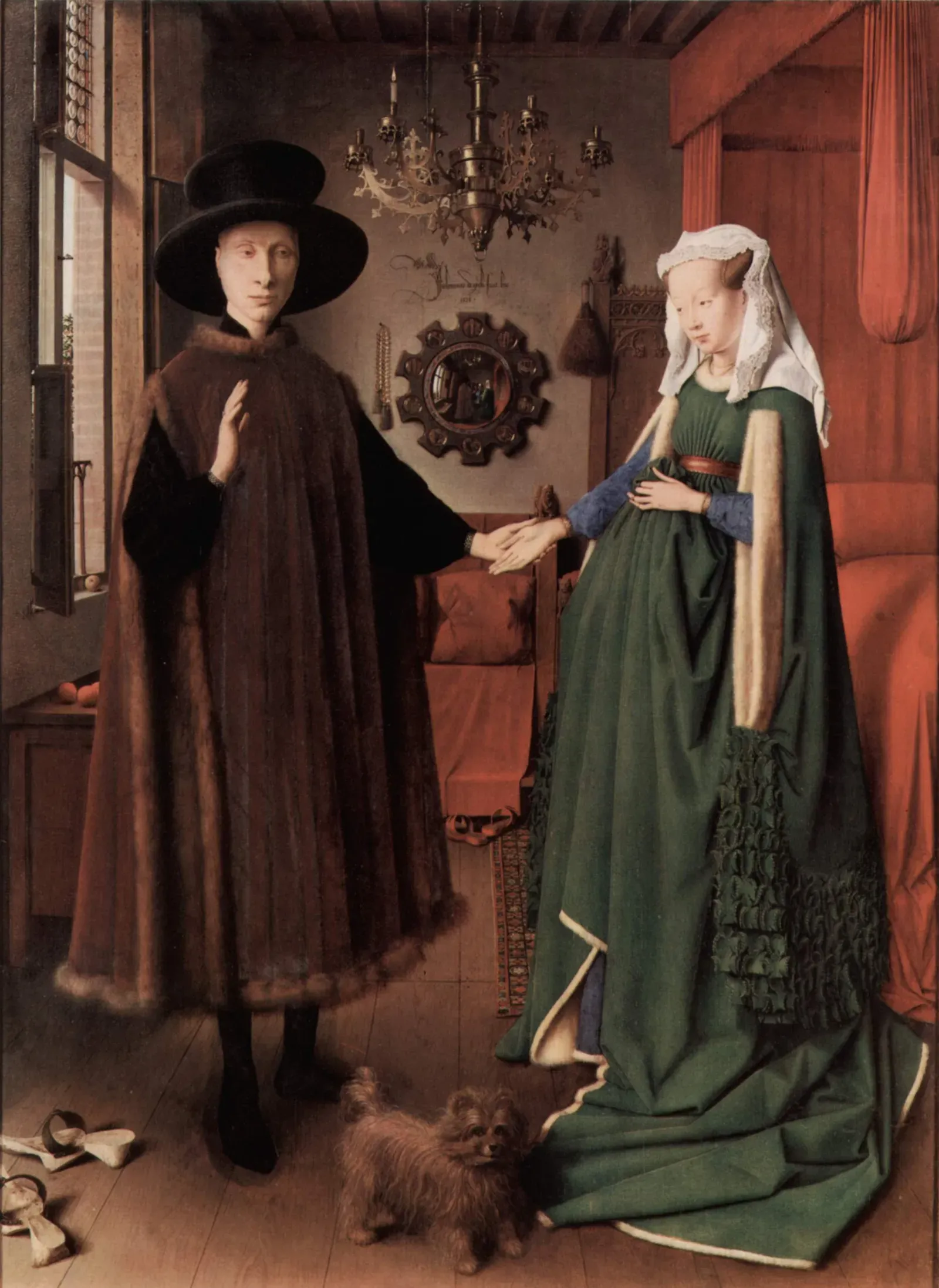
Jan van Eyck’s masterpiece is full of symbolic details, many of which scholars have debated for centuries. Jan van Eyck’s “The Arnolfini Portrait,” dated 1434, is a masterpiece filled with secrets and details. The room is almost claustrophobically dense with meaning, from the single burning candle to the dog at the couple’s feet.
Fifteenth-century artist Jan van Eyck could not resist sneaking himself into his famous “Arnolfini Portrait.” In a not-so-secret act of self-promotion, van Eyck wrote “Jan van Eyck was here, 1434” on the wall in Latin behind the two figures. It is part calling card, part legal witness statement, part graffiti.
Far less noticeable are the other two figures in this painting. If you take a close look at the mirror on the wall, you will be able to spot two people who appear to be standing about where the “viewer” of this scene would be. Art experts believe one of them is van Eyck himself, cleverly inserting his presence into the scene.
This trick adds a layer of mystery and has sparked debates for centuries about whether the painting is a wedding certificate or a record of a business deal. The hidden faces in the mirror make viewers feel like they are part of the moment, as if they are peeking into a private world. It is the 15th-century equivalent of photo-bombing your own artwork.
7. Young Woman Powdering Herself by Georges Seurat (1889–1890) – The Artist Who Painted Himself Out
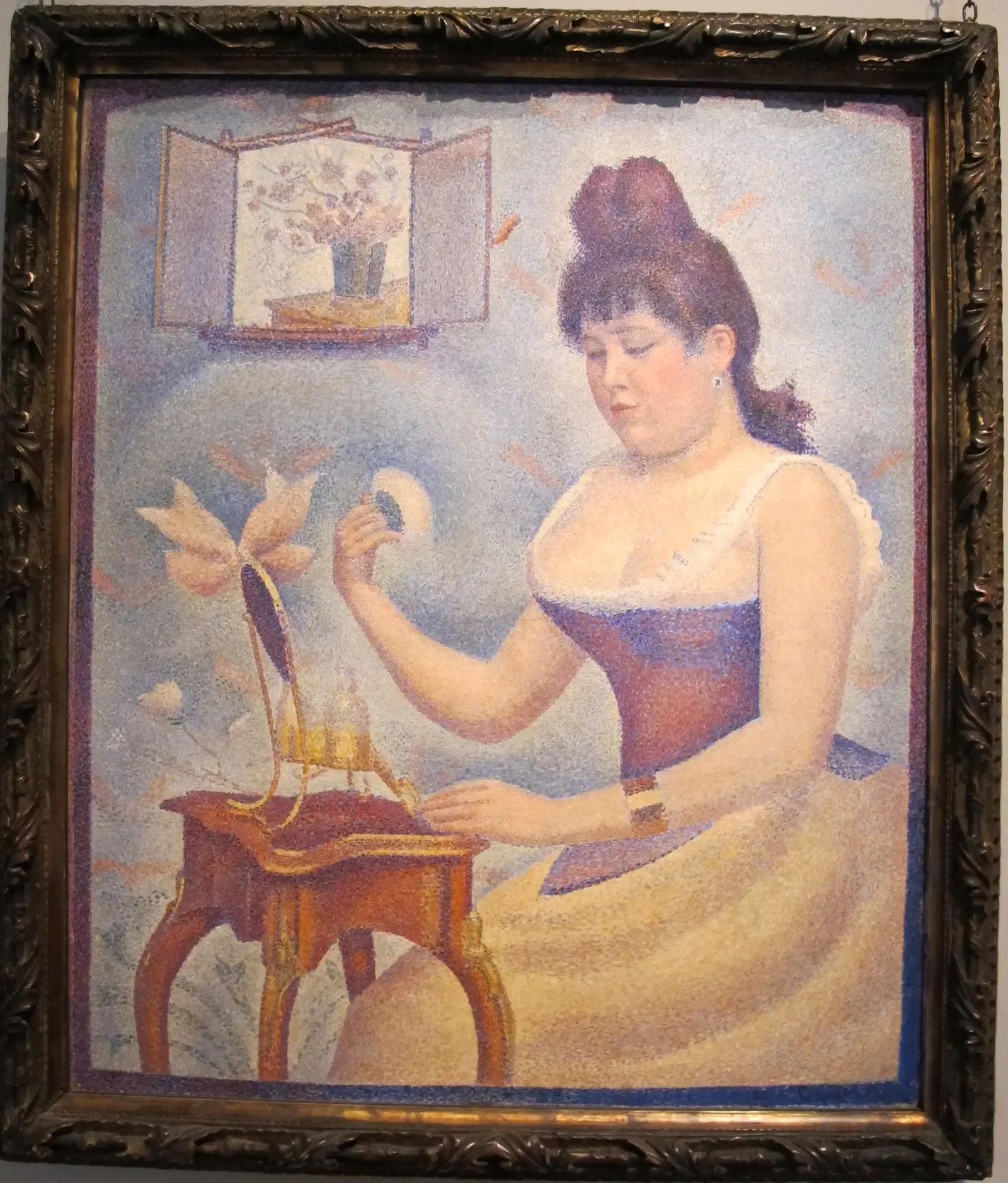
Georges Seurat is best known for pointillism, that painstaking technique of building images from thousands of tiny color dots. This particular painting depicts his companion, Madeleine Knobloch, in a private domestic moment. It seems simple and intimate. It is anything but.
A mirror with a man’s face was found by X-ray analysis in the same spot where there is now a window in Seurat’s painting, just behind its main subject, Madeleine Knobloch. She was Seurat’s preferred model and secret mistress, so it is very likely the painter himself whose face was originally in the painting, peeping in at her.
It has been speculated that Seurat hid himself to remain discreet and prepare the work to be exhibited publicly. When you consider that Seurat concealed his entire relationship with Knobloch from his social circle, the act of painting himself out of the canvas feels painfully symbolic. He erased himself from the image just as he concealed himself in life.
It is hard to say for sure what Seurat was thinking in that final decision to replace his own face with a window. But the discovery transforms what looks like a quiet scene of grooming into something far more emotionally charged. The hidden face is the most intimate thing in the entire painting, and it was never meant to survive.
8. Liberty Leading the People by Eugène Delacroix (1830) – Did the Painter Join His Own Revolution?
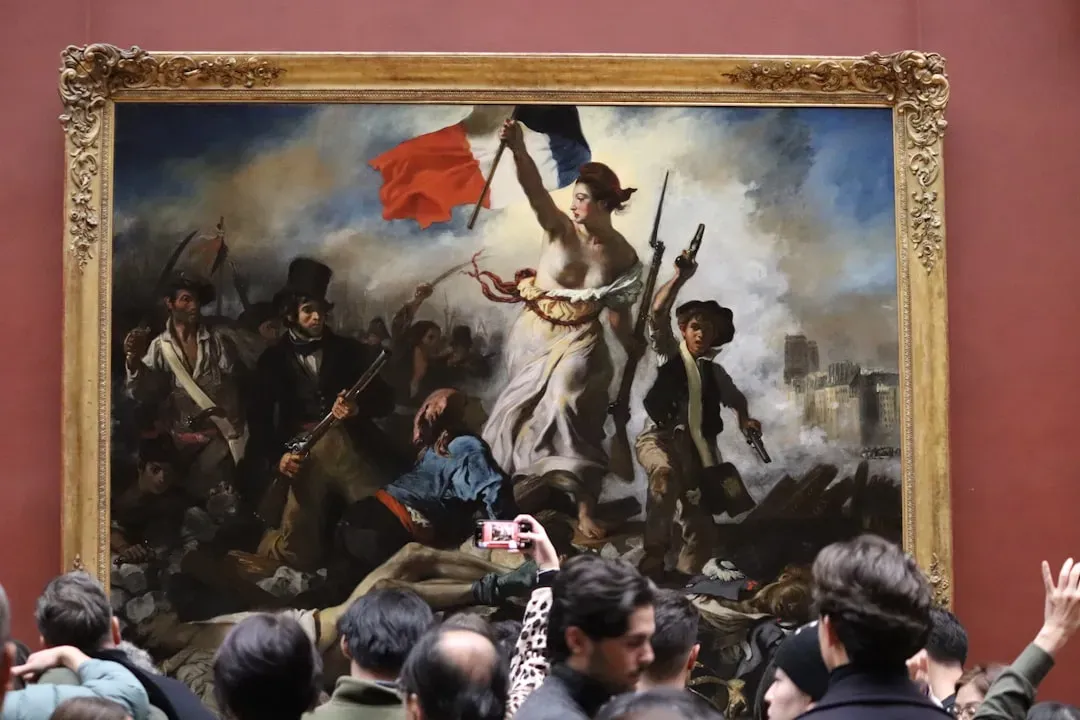
Delacroix’s enormous, theatrical canvas is one of the most recognizable paintings in French history. Liberty herself, bare-breasted and bearing the tricolor flag, strides forward over the fallen bodies of battle. It is a scene of chaos and heroism. The painting is dominated by the figure of Liberty, but if you look carefully at the crowded scene, you will spot a man in a top hat standing near the center. Some art historians believe this figure is a hidden self-portrait of Delacroix, quietly inserting himself into the chaos.
The idea that the painter joined his own revolution brings a personal dimension to the dramatic scene. The hidden face adds a layer of intrigue, making viewers wonder about the artist’s own beliefs and feelings during such a turbulent time. Delacroix was known to have complicated feelings about the political upheavals of his era, more observer than participant.
Liberty Leading the People has inspired generations of artists and political activists, its message of freedom and resistance as powerful today as it was nearly two centuries ago. The debate over the hidden face continues, keeping the painting alive in the public imagination. Whether or not the top-hatted figure is truly Delacroix, the ambiguity itself is part of what makes this painting endlessly compelling.
The possibility of a secret self-portrait only deepens its emotional impact. There is something profoundly human about the idea of an artist wanting to be present in the most important work of their life, even if only as a shadow in the crowd. It is an act of quiet, personal courage folded into an act of public spectacle.
Conclusion: What Hidden Faces Tell Us About Art and Human Nature
What all eight of these paintings share is an invitation. They reward the curious, the patient, and the slightly obsessive. Sometimes these ghostly images are apparent to the naked eye if you look closely enough. More often, they are revealed by restoration processes, X-rays, and careful investigation by art historians and preservation specialists.
Painted by artists such as Hans Memling, Lucas Cranach, Lorenzo Lotto, and Titian, Renaissance works range from portraits intended as portable propaganda to those designed to conceal a lover’s identity. The covers and reverses of these small, private portraits were adorned with puzzlelike emblems and allegories that celebrated the sitter’s character. The tradition of hiding something within an artwork runs deep into Western art history.
Instances of painterly corrections that expose previous versions of the design are referred to as pentimenti, from an Italian phrase meaning “to repent,” essentially because the artist has “repented” for a choice made. In other cases, the hidden faces were deliberate, intimate, even subversive acts. Think of Seurat erasing his own face, or Caravaggio squeezing a tiny self-portrait into the reflection of a wine jug.
Every one of these secret faces raises the same essential question: what else are we missing? The next time you stand in a gallery, staring at a painting you think you already understand, consider the possibility that it is staring back at you with a face you have never seen. What would you have guessed was hiding there?