Most stamps in an old shoebox are worth roughly what the post office charged for them, and often less. A small group of American issues has become famous because of printing errors, security experiments, or sheer scarcity. Their prices can change a collector’s life.
The eight stamps below are a mix of the headline makers and a few more attainable classics. Prices swing with condition, centering, and certification, so treat every figure here as a snapshot rather than a promise.
The 1918 24 Cent Inverted Jenny
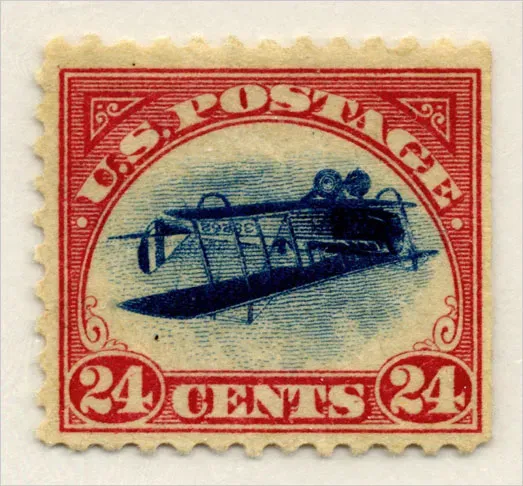
The stamp shows a Curtiss Jenny aircraft, printed upside down at the Bureau of Engraving and Printing because of an error. Only one sheet of one hundred was ever sold, to William T. Robey of Washington, D.C. That limited supply is a big part of why it sits at the center of American philately.
The best known copy, from position 49, reached $2,006,000 with Siegel’s 18 percent buyer’s premium in November 2023. The same stamp had sold for $1.6 million about five years earlier. Lesser copies cost less, but a single example selling for hundreds of thousands of dollars is not unusual.
The 1868 One Cent Franklin Z Grill

After the Civil War, the Post Office pressed a waffle like grill pattern into stamp paper to discourage reuse of cancelled stamps. The Z grill, which has horizontal ridges, was used only briefly in 1868. Exactly two one cent Z Grills are known.
One copy belongs to the New York Public Library. The other brought $4.366 million when Bill Gross’s collection was sold in June 2024, the most ever paid for a United States stamp. By comparison, an ungrilled 1861 one cent blue is often worth roughly 10 to 60 dollars used.
The 1851 Hawaiian Missionaries
Strictly speaking, these were issued by the Kingdom of Hawaii, not the United States. American collectors chase them anyway, since they are tied to U.S. postal history. The stamps went on sale October 1, 1851, in 2, 5 and 13 cent values.
The 2 cent is the rarest, with 15 copies recorded, only one of which is unused. Siegel sold that never used example in 2018 for $600,000. One price guide places the more available 5 cent and 13 cent values between $50,000 and $225,000, depending on condition.
The 1847 Alexandria Blue Boy
This is a postmaster’s provisional, made in Alexandria, Virginia, before the federal government issued its own stamps. It was the only one printed on blue paper out of seven known Alexandria provisionals. The color alone gave it its nickname and its mystique.
Valuations vary widely. One source puts the estimate around $1,000,000. Another lists about $2,244,100 as a current value. Since sales are so infrequent, any figure is more of an informed estimate than a market price.
The 1847 Five Cent Franklin
America’s first general issue stamps appeared in 1847, and the five cent Franklin was one of the pair. Fine used copies trade for roughly 500 to 2,000 dollars, while rare mint examples can reach $400,000 or more. That huge gap shows how much condition and status matter.
Another guide gives a broader range, from $10,000 to $150,000 for this stamp. The difference comes down to whether a copy has four clear margins, a clean cancel, and no repairs. Certification from a recognized expert group is usually what lets a buyer trust the number.
The 1847 Ten Cent Washington
The ten cent Washington was the companion stamp, meant for longer distance and higher rate mail. One reference lists its range as $500 to $8,000, which fits ordinary used copies. A different guide pushes the range much higher, from $15,000 up to $200,000, which reflects top quality examples.
The conflicting figures are a reminder that collectors rarely talk about one price for these classics. A faded, heavily cancelled copy and a sharp, well centered one can belong to different markets entirely. Checking recent auction results is the surest way to see where a specific stamp lands.
The 1869 24 Cent Declaration of Independence Invert
The 1869 pictorial series was the first to feature scenes rather than portraits. The 24 cent stamp, showing the signing of the Declaration of Independence, was printed in two colors. That process was error prone and produced invert errors in 1869 and 1901.
An inverted center example is a serious rarity. Invaluable lists the stamp at $625,000. Another guide gives a range of $500 to $750,000 for inverted examples, so the market is wide and condition driven.
The 1901 Pan-American Inverts
The Pan-American Exposition issue of 1901 included six stamps. They carry Scott numbers 294 to 299. Three of the values exist with the center printed upside down.
The one cent invert is considerably more common than the others, yet the catalogue value of a set of all three inverts is estimated at $100,000. Other guides show lower individual ranges, for example $5,000 to $50,000 for the issue. That makes it one of the more reachable invert errors for serious collectors.