There’s something unsettling about reading an old book and seeing today’s world staring back at you. Not just the general shape of things, but the details. The specific technologies we now carry in our pockets, the social anxieties we scroll through at midnight, the political systems that feel increasingly familiar.
Literature has always been more than entertainment. Sometimes it’s prophecy dressed up as fiction. The authors behind these works weren’t fortune tellers. They were observers, pattern recognizers, people who looked at the trajectory of their own time and extrapolated forward. What’s remarkable isn’t just that they got things right, it’s how eerily precise some of those predictions turned out to be.
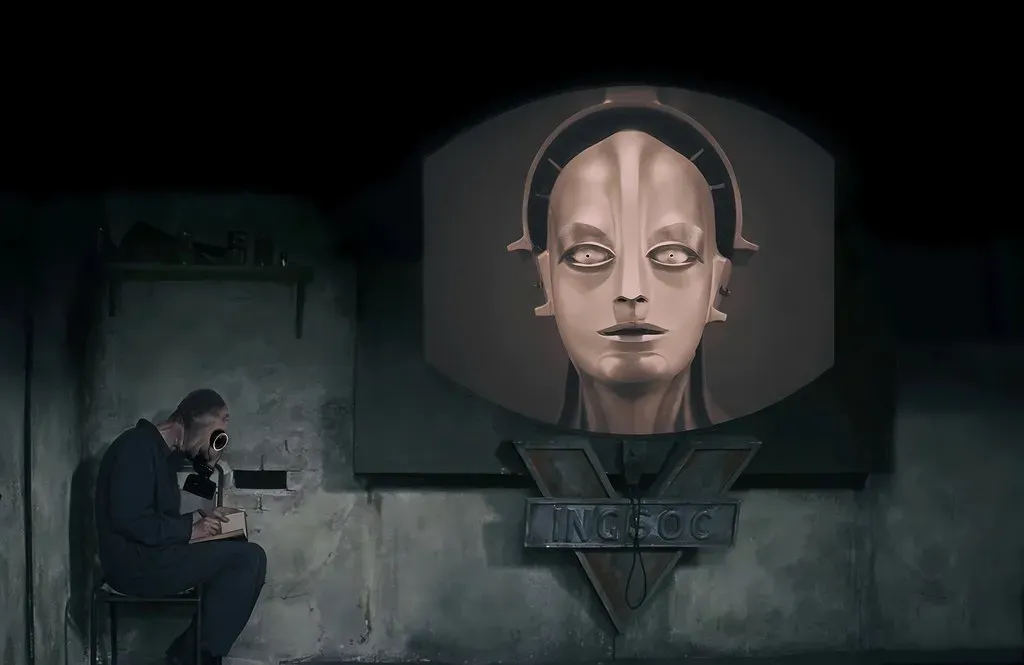
George Orwell’s 1984 and the Surveillance State

Taylor attributes Orwell’s popularity to his “uncanny ability … to predict so many of the things that trouble us here in the 2020s.” Written in 1949, Orwell’s dystopian masterpiece imagined a world where Big Brother watched every move, where telescreens monitored citizens constantly, and where truth itself became malleable. Emerging technologies, such as facial recognition and AI-powered surveillance, are enabling the rise of Orwellian-style control over individuals. The parallels to modern digital tracking, government surveillance programs, and corporate data collection are impossible to ignore.
Here’s the thing though. For 19 years, private companies practicing an unprecedented economic logic that I call surveillance capitalism have hijacked the Internet and its digital technologies. Orwell feared state power, yet today’s surveillance often comes from private corporations mining behavioral data. China’s social credit system shows just how close we’ve come to his dystopian vision.
The Smithsonian Institution noted how scholars continue mapping Orwell’s imaginings onto our world, particularly in scientific circles increasingly curious about surveillance technologies. It’s not that Orwell saw the future. He recognized patterns in authoritarian control that proved timeless, adaptable to whatever tools became available.
Aldous Huxley’s Brave New World and the Dopamine Economy

While Orwell worried about oppression through force, Huxley predicted something arguably more insidious: a society that loves its chains. Published in 1932, Brave New World imagined people conditioned from birth to consume endlessly, to seek pleasure above all else, to avoid discomfort through pharmaceutical intervention. Sound familiar?
We live in a culture of instant gratification, where the next source of entertainment or distraction is just a click away. Social media, online shopping, binge-watching TV series – these are our versions of soma, providing us an escape from reality and a shot of pleasure whenever we desire. Literary analysis from Medium and academic journals consistently draws connections between Huxley’s World State and modern digital culture. Huxley argues that, according to the logic of industrialism, people end up serving their economy, rather than the other way around.
The really unsettling part? Huxley wrote this during the Great Depression, as consumer culture was just beginning to take shape. He extrapolated what would happen if consumption became not just encouraged but engineered into the very structure of society.
Ray Bradbury’s Fahrenheit 451 and Wall-Sized Screens

Ray Bradbury published Fahrenheit 451 in 1953, when televisions were tiny black-and-white boxes in living rooms. Yet he imagined “parlor walls” – massive screens that took up entire walls, broadcasting immersive entertainment that kept people passive and disconnected. Enormous, wall-sized televisions play a central role in the story. Even though TVs existed in the 1950s when Bradbury wrote the novel, they were not massive flat screens like we have today. Bradbury also predicted many social changes in his novel, like the increasing disconnect between people because of technology and government use of surveillance technology.
Parlor walls are large, interactive TV screens that cover entire walls and broadcast immersive, mind-numbing entertainment. They function as tools of societal control, distracting citizens from critical thinking and keeping them complacent and disconnected from reality. MIT Technology Review and various Bradbury interviews have explored how his “seashells” and “thimble radios” essentially predicted earbuds and Bluetooth technology. Walk through any public space today and count how many people are plugged into their own private audio worlds.
Bradbury’s genius wasn’t predicting the technology itself but understanding what it would do to human connection. The screens weren’t the problem. The isolation they enabled was.
William Gibson’s Neuromancer and the Birth of Cyberspace

In 1984, William Gibson published Neuromancer and introduced the world to “cyberspace” decades before most people owned computers. Neuromancer expanded and popularised the setting and concepts of an earlier Gibson story, “Burning Chrome” (1981), which introduced cyberspace – a digital space traversable by humans – and “jacking in”, a bio-mechanical method of interfacing with computers. Gibson famously wrote the book on a typewriter, barely understanding computers himself.
Observers contend that Gibson’s influence on the development of the Web reached beyond prediction; he is widely credited with creating an iconography for the Information Age, long before the embrace of the Internet by the mainstream. Wired Magazine and the Smithsonian Institution have documented how the novel influenced early digital culture, virtual reality development, and even the visual language we use to talk about the internet. It inspired early computer programmers in the creation of the Internet and impacted early computer culture.
What’s fascinating is Gibson’s admission that his vision came from watching kids in video arcades, imagining the space behind the screens. Sometimes the best predictions come not from technical knowledge but from paying attention to human behavior around emerging technology.
Jules Verne’s From the Earth to the Moon and Space Travel Mechanics

This one still baffles scientists. In 1865, Jules Verne published From the Earth to the Moon, describing a journey to the lunar surface with mathematical precision. Verne used real engineering analysis to arrive at the design of his cannon and manned moon projectile. As a result, at the time of Apollo 8 and 11 missions it was noted that Verne had made an astonishing number of correct predictions about the actual missions.
Verne’s astronauts were launched from a Florida site, just miles from the NASA space center that launched Apollo 11 more than 100 years later. The storyline consisted of three astronauts, which married up with our heroes: Aldrin, Armstrong, and Collins. NASA historians acknowledge the eerie accuracy. During their return journey from the Moon, the crew of Apollo 11 made reference to Jules Verne’s book during a TV broadcast. Astronaut Neil Armstrong said, “A hundred years ago, Jules Verne wrote a book about a voyage to the Moon. His spaceship, Columbia [sic], took off from Florida and landed in the Pacific Ocean after completing a trip to the Moon.”
NASA even named the Apollo command module Columbia after Verne’s fictional spacecraft Columbiad. Verne attempted to do some rough calculations as to the requirements for the cannon and in that, considering the comparative lack of empirical data on the subject at the time, some of his figures are remarkably accurate.
E.M. Forster’s The Machine Stops and Remote Communication

E.M. Forster’s 1909 short story The Machine Stops imagined a world where people lived in isolated cells, communicating only through screens, completely dependent on a vast machine for survival. Physical contact became rare and disturbing. Direct experience of nature seemed barbaric. Sound like anyone’s pandemic lockdown experience?
The Atlantic and Literary Hub have extensively referenced this story in post-pandemic analysis, noting how Forster anticipated not just video calls but the psychological toll of technology-mediated isolation. He wrote this before radio broadcasting, before television, before any form of electronic communication existed between individuals. Forster simply looked at the increasing mechanization of society and asked: what if we became so dependent on machines that we forgot how to be human?
The story ends with the machine breaking down and society collapsing because no one remembers how to function without it. It’s a dark prediction, honestly, and one we might want to think about more seriously.
Margaret Atwood’s The Handmaid’s Tale and Reproductive Politics

Margaret Atwood published The Handmaid’s Tale in 1985, creating a theocratic dystopia where women’s bodies became state property, where reproductive rights evaporated overnight under the guise of protecting society. Margaret Atwood’s The Handmaid’s Tale anticipated debates around reproductive rights and authoritarian control, which scholars say remain highly relevant in modern political discourse. Harvard Gazette and Atwood’s own essays explore how the novel’s themes resurface constantly in contemporary politics.
Atwood has repeatedly stated she included nothing in the book that hadn’t already happened somewhere in human history. It wasn’t prophecy but pattern recognition. She understood how quickly rights could be stripped away, how easily authoritarian control could be justified through ideology, how vulnerable bodily autonomy remains when power shifts.
The uncomfortable truth is The Handmaid’s Tale keeps feeling more relevant, not less, as decades pass. Every time it starts trending again, we should probably ask ourselves why.
Neal Stephenson’s Snow Crash and the Metaverse
Neal Stephenson’s 1992 novel Snow Crash introduced the Metaverse – a virtual reality internet where people interacted through avatars, where digital real estate had value, where entire economies existed in virtual space. Snow Crash by Neal Stephenson predicted virtual worlds and avatars, concepts now mirrored in metaverse development and online identity systems. Wired and Meta research commentary have explored how the book essentially provided a blueprint for modern virtual world development.
Stephenson coined the term “avatar” for digital representations of users, described virtual architecture and economies, imagined a world where people spent more time in virtual space than physical reality. Tech companies building the metaverse today cite Snow Crash as direct inspiration, sometimes uncomfortably so given the novel’s dystopian elements.
The question is whether they learned the right lessons from the book. Stephenson wasn’t writing an instruction manual. He was writing a warning.
H.G. Wells’s The World Set Free and Atomic Energy

H.G. Wells published The World Set Free in 1914, describing atomic bombs and nuclear warfare decades before nuclear technology was developed. H.G. Wells’s The World Set Free foresaw atomic energy and nuclear warfare, written decades before nuclear technology was developed. Royal Society archives document how Wells based his prediction on newly discovered radioactive decay, extrapolating what weaponized atomic energy might look like.
Wells imagined cities destroyed by “atomic bombs” that continued burning for days, describing radioactive contamination and the devastating power of nuclear chain reactions. He got details wrong, obviously, but the core concept proved disturbingly accurate. Physicist Leo Szilard, who helped develop the first nuclear reactor, credited Wells’s novel with inspiring his work on nuclear chain reactions.
Sometimes predictions become self-fulfilling prophecies. Scientists read speculative fiction, imagine possibilities, then work to make those possibilities real. It’s a feedback loop between imagination and invention that makes distinguishing prediction from inspiration almost impossible.
The Pattern Behind Predictive Fiction

Modern literary research suggests predictive fiction succeeds not by prophecy but by identifying early social and technological patterns before they fully emerge. According to the Journal of Futures Studies analysis from 2024, successful predictive fiction works by recognizing existing trends and extrapolating logical consequences.
These authors weren’t mystics. They were observers who paid attention to the trajectory of their times, who asked uncomfortable questions about where current trends might lead, who took emerging technologies seriously before society at large did. They understood that social change follows patterns, that human nature remains remarkably consistent even as tools evolve, that power structures adapt but rarely fundamentally change.
The real question isn’t how they predicted the future. It’s why we keep making the same choices they warned us about. These books exist. People read them. We see the patterns. Yet somehow we keep building the worlds these authors cautioned against. What does it say about us that predictive fiction keeps coming true not despite our knowledge of it but seemingly because of our determination to ignore the warnings?