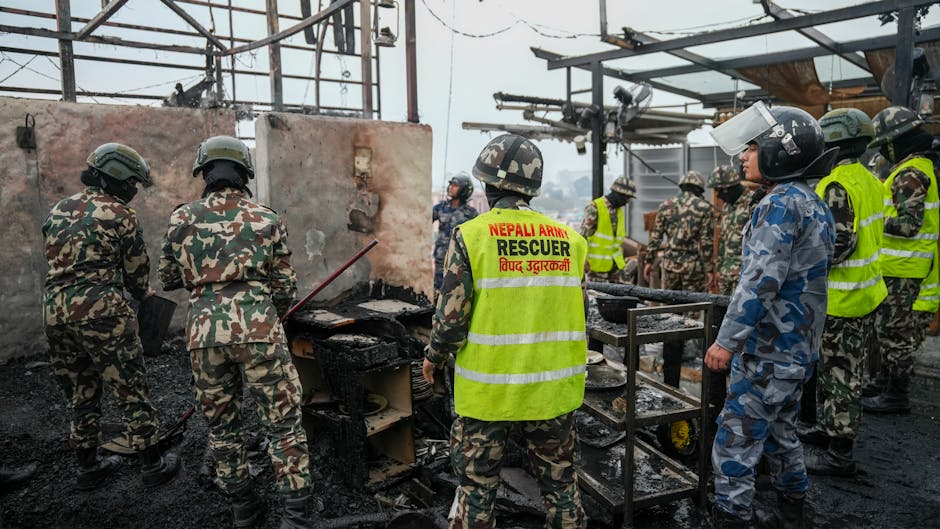
Catastrophe Unfolds in Minab (Image Credits: Pexels)
Minab, Iran – A devastating U.S. missile attack leveled an elementary school packed with children, as preliminary military probes pinned the tragedy on stale targeting data.[1][2]
Catastrophe Unfolds in Minab
Over 170 individuals perished when a Tomahawk cruise missile slammed into Shajareh Tayyebeh elementary school on February 28, 2026 – the opening day of U.S. and Israeli operations against Iran. Most victims were young girls attending the all-girls institution during school hours on a Saturday morning.[3]
The facility sat roughly 200 feet from an Islamic Revolutionary Guard Corps naval base. Satellite images captured civilian markers like murals and playgrounds, features absent from military sites. Debris recovered matched U.S.-made Tomahawks, the only such weapons deployed in the conflict.[1]
Video footage geolocated near the site showed the munition’s impact, with smoke rising from the school’s direction. Iranian state media tallied at least 168 child deaths alongside 14 teachers.[3]
Trump’s Evolving Position
President Donald Trump first pointed fingers at Iran, declaring to reporters aboard Air Force One, “In my opinion, based on what I’ve seen, that was done by Iran.”[1] He even suggested Tehran possessed Tomahawk missiles.
Later remarks showed uncertainty. Trump stated, “I don’t know about that,” when confronted with U.S. responsibility reports. By Monday, he pledged to abide by the Pentagon’s conclusions: “Whatever the report shows, I’m willing to live with that report.”[2]
Partner offer
White House press secretary Karoline Leavitt emphasized the ongoing probe while defending the president’s initial assessment as grounded in facts.
Breakdown in Targeting Process
Preliminary findings from a U.S. military investigation highlighted outdated Defense Intelligence Agency data as the culprit. The school once formed part of the IRGC compound about 15 years prior, but recent imagery from 2016 onward depicted clear separation via fencing and civilian activity.[3]
Experts noted the munition followed its programmed path without deviation. Questions arose over validation steps involving multiple agencies and possible Israeli input on targets. One report suggested the site appeared on a U.S. target list, potentially misidentified via AI tools.[4]
- Satellite photos from 2013 showed unified compound.
- By 2016, a dividing wall and school entrance emerged.
- December 2025 images confirmed courtyard gatherings.
- Missile fragments bore U.S. markings.
- No watchtowers or military structures visible pre-strike.
Senators Push for Transparency
More than 45 Democratic senators urged Defense Secretary Pete Hegseth for details on the strike’s vetting and Pentagon resource cuts affecting civilian safeguards at U.S. Central Command.[2]
Sen. Tim Kaine warned, “It’s either we’ve changed our traditional targeting rules or we made a mistake. If we’ve changed our traditional targeting rules and we no longer provide the same level of protection for civilians, that would be tragic.” Republican Sen. Kevin Cramer called for full accountability: “You also can’t undo it.”
Hegseth promised a thorough review, stressing efforts to minimize noncombatant harm. The Defense Intelligence Agency deferred to the Pentagon amid the active inquiry.
This incident underscores vulnerabilities in high-stakes targeting amid rapid operations. As the full report looms, pressure mounts for reforms to prevent future losses. What steps should follow? Share your views in the comments.
Key Takeaways
- Outdated DIA intel mislabeled a civilian school as a military target.
- Tomahawk strike killed 170+, mostly children, on Feb. 28 in Minab.
- Officials from both parties demand rigorous investigation and fixes.
Partner offer
Planning a trip to Vegas?
Compare hotel rates and show tickets on VEGAS.com.