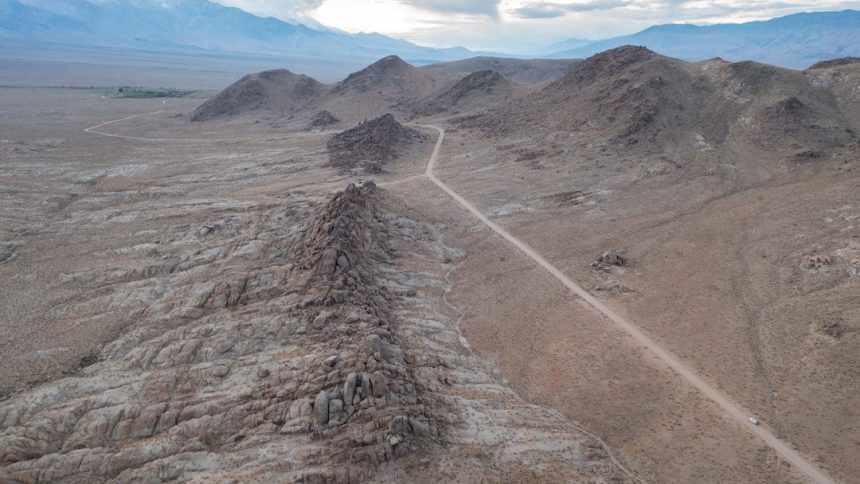
Nevada’s hidden earthquake risk revealed as Las Vegas, Reno shake – Image for illustrative purposes only (Image credits: Unsplash)
Nevada – A string of earthquakes struck the state in recent weeks, jarring residents near Reno and Las Vegas and prompting fresh discussions about long-simmering geological threats. The tremors included a magnitude 5.7 event that scattered goods in local stores and smaller but noticeable shakes closer to the urban centers. While no serious injuries or widespread destruction occurred, the activity highlighted Nevada’s position on active fault lines that extend beyond California’s borders.[1][2]
Series of Notable Tremors
On April 13, a magnitude 5.7 earthquake hit 45 miles east of Reno, delivering moderate-to-strong shaking to the community of Silver Springs. Items tumbled from shelves and cupboards in nearby Fallon, though officials reported no significant structural damage or injuries. Aftershocks persisted, with some as strong as magnitude 3.6, leaving locals with a sense of ongoing motion.[1][2]
The activity did not end there. A magnitude 5.2 quake struck about 40 miles east of Reno early Friday morning, followed two days prior by a magnitude 4.4 tremor roughly 60 miles north of Las Vegas. Residents in the Las Vegas area noted weak shaking from that event. Ongoing monitoring by the Nevada Seismological Laboratory revealed clusters of smaller quakes in regions like Fallon and Yerington, with magnitudes reaching 4.9 in some cases.[1][3]
Fault Lines Crossing State Borders
Nevada sits atop a complex network of faults, many of which straddle the line with California. Scientists point to the Lake Tahoe Basin as a particular concern, where large faults lie beneath the water. Christie Rowe, director of the Nevada Seismological Laboratory, noted major earthquakes have occurred there historically. She highlighted other systems, including the Death Valley fault 95 miles west of Las Vegas, known to produce magnitude 7 events.[1]
The Hurricane fault system, about 75 miles from Las Vegas in a remote stretch, has also generated powerful quakes in the past but remained quiet recently. Faults directly beneath Las Vegas exist as well, though urban growth has limited detailed study. These features underscore why seismic activity in Nevada demands attention, even if it pales next to California’s profile.[1]
Key Recent Quakes in Nevada
- Magnitude 5.7: April 13, 45 miles east of Reno (shook Silver Springs and Fallon).
- Magnitude 5.2: Early Friday (pre-May 4), 40 miles east of Reno.
- Magnitude 4.4: Two days before M5.2, 60 miles north of Las Vegas (weak shaking reported).
- Magnitude 4.9: Near Fallon (ongoing monitoring).
Past Events and Potential Toll
Nevada recorded 22 earthquakes of magnitude 6 or greater between the 1850s and 1950s. More recently, a magnitude 6 quake in Wells in 2008 collapsed buildings and caused $19 million in damage. A magnitude 6.5 event in 2020 cracked a half-mile stretch of U.S. Highway 95 in a remote area. Even distant quakes, like California’s 2019 Ridgecrest sequence, led to a fatality in Pahrump when a vehicle shifted.[1]
Experts warn of worse scenarios. A hypothetical magnitude 7 near Las Vegas could inflict $21 billion in losses on aging buildings and infrastructure. The Tahoe region faces risks from landslides and waves exceeding 30 feet on the lake from certain faults. Rowe emphasized the challenges in expanding early warning systems, noting Nevada lacks full coverage despite USGS efforts.[1]
Vulnerabilities in Daily Life
Certain structures amplify the danger. Tens of thousands of unreinforced brick buildings dot the state, prone to deadly collapses. Mobile homes in places like Silver Springs, built on soft lakebed soil, shake two to five times more intensely than standard homes. Residents there reported feeling even magnitude 3 aftershocks vividly, as Rowe described from recent calls.[1]
Nevada has no statewide earthquake early warning system, a gap that leaves it exposed compared to neighbors. Ironically, a Las Vegas quake might alert Californians first through shared networks. The recent tremors offer a timely cue for bolstering preparedness across the Silver State.[1]
These events, though mild in outcome, signal that Nevada’s earth remains restless. Officials urge securing homes and knowing evacuation plans to mitigate future threats.