
There is something deeply unsettling about picking up a novel written a century ago and recognizing your own world on its pages. Science fiction has long served as a mirror to the present, but some books went further – they became blueprints for the future. From mass surveillance and the internet to genetic engineering and wireless earbuds, certain authors described technologies so precisely that their works now read less like imagination and more like leaked documents from the future. The pattern is consistent enough to raise a serious question: were these writers simply lucky, or were they paying closer attention to the world than everyone else?
1984 by George Orwell – The Surveillance State Come True
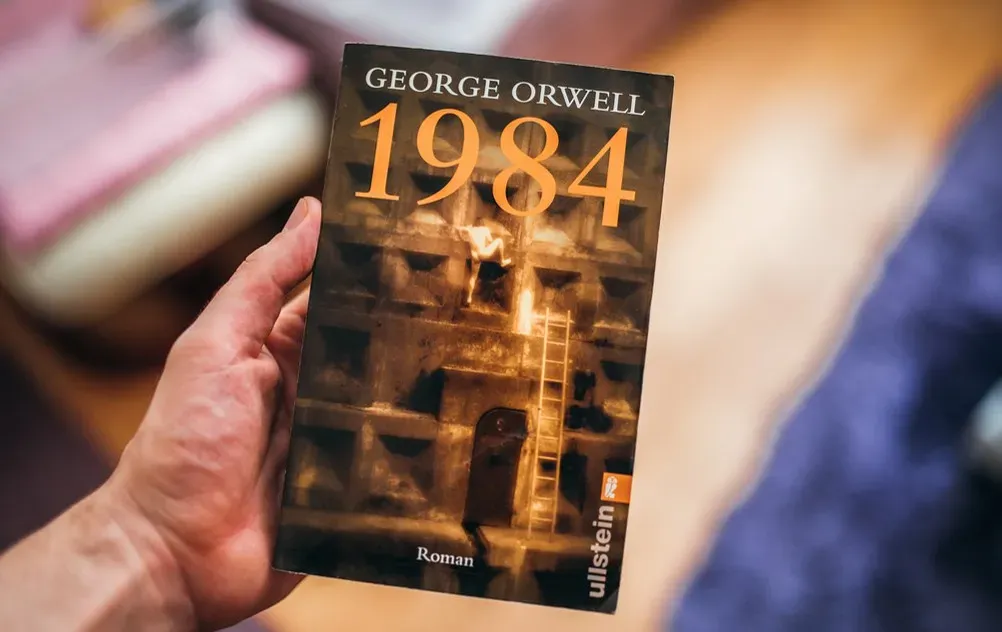
George Orwell’s dystopian novel 1984, published in 1949, predicted so many aspects of the future that referring to it has become shorthand for any situations in which technology threatens to control aspects of society. Among the technological advancements described in the book is the “telescreen,” essentially a large television used to monitor people’s private lives and identify a person based on their facial expressions and heart rate. Facial recognition technology, like the kind behind the telescreens Orwell imagines, has been central to contemporary debates about pervasive surveillance.
In George Orwell’s novel 1984, “telescreens” were both information hubs and surveillance tools. They filled public and private areas with cameras and microphones watched by the government. Today, smartphones and other internet devices have taken over this role. They connect us to the digital world but also raise big issues about privacy and surveillance. The novel’s all-seeing telescreens and constant monitoring have found echoes in today’s digital tracking and data collection. Recent research by Pew Research Center in 2024 showed that 79% of Americans worry about how companies use their data, a concern that 1984 anticipated decades ago.
Neuromancer by William Gibson – The Birth of Cyberspace

William Gibson’s 1984 novel Neuromancer revolutionized science fiction and prophesied the digital age with its concept of “cyberspace.” Gibson envisioned a virtual reality realm where users could “jack in” to a global computer network, navigating a three-dimensional digital space. This immersive digital world allowed direct neural interfaces, enabling users to experience data as tangible, visual constructs. In 1984, five years before Tim Berners-Lee introduced the Internet to the world, Gibson coined the term “cyberspace.”
Gibson’s Neuromancer introduced the concept of “cyberspace,” a digital matrix where people could directly connect their consciousness to computer networks. In his world, corporate power had superseded government authority, identity became fluid and customizable, and the line between digital and physical reality blurred beyond recognition. Information became the most valuable currency, and hackers were the new outlaws of the digital frontier. Neuromancer wasn’t just a literary success – it became a cultural touchstone, selling over 6.5 million copies worldwide.
Fahrenheit 451 by Ray Bradbury – Earbuds, Wall Screens, and Distraction Culture

In Ray Bradbury’s dystopian novel Fahrenheit 451, published in 1953, he imagined a society where people were constantly connected to audio devices, foreshadowing today’s ubiquitous earbuds. Bradbury described these as “little seashells” and “thimble radios” that fit snugly in the ear, providing a constant stream of entertainment and information. These devices isolated users from the world around them, creating personal bubbles of sound – a phenomenon eerily similar to modern earbud usage. Bradbury’s 1953 dystopia is famous for predicting not only government censorship but also the societal erosion caused by short attention spans and constant informational noise. It eerily foresaw flat-screen wall TVs, “ear shell” personal headphones, and the cultural abandonment of intellectual depth for superficial media.
Reading rates have declined significantly over recent decades, with many people preferring video content over written material. TikTok and similar platforms have conditioned audiences to expect information in bite-sized, rapidly changing segments. Earbuds and headphones create constant audio stimulation, making quiet contemplation increasingly rare. Bradbury’s real genius was recognizing that people wouldn’t need to be forced to stop reading – they’d simply choose not to when faced with easier, more immediate pleasures.
Paris in the Twentieth Century by Jules Verne – The Most Densely Prophetic Novel Ever Written

The book with the largest number of accurate predictions might be Jules Verne’s Paris in the Twentieth Century. Verne, the author of Journey to the Center of the Earth and Twenty Thousand Leagues Under the Sea, is one of the most influential sci-fi writers of all time. But Paris in the Twentieth Century proved to be particularly prophetic. In a single narrative, written during the 1860s, Verne mentions gasoline-powered vehicles, weapons of mass destruction, global warming, and changing gender norms. Written in 1860 but first published in 1994, the novel follows a young man who struggles unsuccessfully to live in a technologically advanced but culturally backward world.
The book describes in detail advances such as cars powered by internal combustion engines together with the necessary supporting infrastructure such as gas stations and paved asphalt roads; elevated and underground passenger train systems and high-speed trains powered by magnetism and compressed air; skyscrapers; electric lights that illuminate entire cities at night; fax machines; elevators; and primitive computers that can send messages to each other in a network somewhat resembling the internet. It also makes accurate predictions of 20th-century music, predicts the rise of electronic music, describes a musical instrument similar to a synthesizer, and outlines the replacement of classical music performances with recorded music.
Brave New World by Aldous Huxley – Genetic Engineering, Mood Drugs, and Consumer Control

In a future London, citizens are genetically engineered, conditioned from birth into rigid social castes, and kept content through synthetic entertainment and a steady supply of the mood-stabilizing drug Soma. The story follows Bernard Marx, an alienated individual, who attempts to integrate a “Savage” from a reservation into this utopian society, only to watch the manufactured perfection quickly unravel. This 1932 classic foretold a society where control is maintained by pleasure, not pain, predicting our modern preoccupation with rampant consumerism and instant gratification. It also anticipated the heavy reliance on pharmaceuticals for mood regulation and the pacifying effects of mass entertainment.
While current society is not a one-to-one copy of Huxley’s, there is a steady slide towards consumerism and hedonism. Likewise, genetic engineering and reproductive technology are already present, as well as the predominance of mood-altering drugs, constant sexualization, and the voluntary erosion of privacy for comfort. Aldous Huxley foresaw in Brave New World that the earth would be devastated by a nine-year global war that would include germ warfare. As a result, he predicted, a very controlled society would evolve in which man would be able to create test-tube babies.
Isaac Asimov’s Foundation Series – Predicting Big Data and Behavioral Science
First published in the early 1950s, Isaac Asimov’s Foundation series of sci-fi books predicted a science called “psychohistory” in which the future could be predicted by accurately measuring current developments and trends in human behavior and life. Today, data on past events is used in all manner of calculations, risk assessments, and AI and machine learning. Although statistics as a way of gauging the public existed back then, they were very rudimentary in comparison to today’s surveys and statistics, which are used every day to measure and predict everything from consumer behavior and voting preferences to the impact of COVID-19. “In other words, the psychohistory in Asimov’s science fiction has become a crucial way of life in our world.”
In Oryx and Crake (2003), Margaret Atwood predicted genetic engineering and bioengineering disasters. Today, advancements in genetic modification raise ethical concerns, proving her insights were ahead of their time. Asimov’s vision, however, remains the most striking parallel to modern data science. According to a 2024 survey by the American Psychological Association, over 60% of respondents reported feeling overwhelmed by the constant flow of online information – precisely the kind of information overload that Asimov’s fictional mathematicians sought to model and control across entire civilizations.