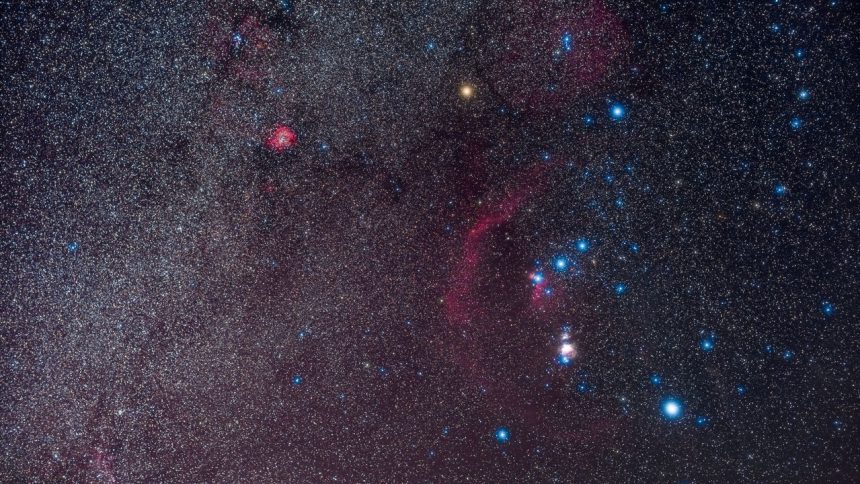

Orion Commands the Cold Night Sky (Image Credits: Cdn.mos.cms.futurecdn.net)
Clear winter nights reveal Orion’s distinctive belt, a striking lineup of three stars that draws stargazers worldwide to the southern sky.
Orion Commands the Cold Night Sky
Orion rises dramatically in the southeast after dark during winter months, reaching peak visibility high in the south around 8 p.m. local time before setting in the west near 2 a.m.[1][2]
Cold air enhances atmospheric clarity, allowing even faint stars to shine through. This constellation leads a parade of bright patterns across the late-evening heavens. Orion pursues Taurus the Bull overhead, creating a vivid celestial chase observable nightly.
The belt itself spans just 2.3 degrees, forming one of the sky’s most recognizable patterns thanks to its even spacing and uniform glow.
Spotlight on the Supergiant Trio
Alnitak, Alnilam, and Mintaka compose the belt, aligned from east to west, each shining at second magnitude for nearly identical brightness.
These blue supergiants belong to the Orion association, a loose group of young, hot stars. Their distances vary: Alnitak at about 740 light-years, Mintaka around 690 light-years, and Alnilam farthest at roughly 2,000 light-years.[2]
- Alnitak: Easternmost, marks the hunter’s sword tip nearby.
- Alnilam: Central star, the brightest of the three.
- Mintaka: Western anchor, near Orion’s right side.
Luminous Giants of the Milky Way
Each belt star outshines the sun by more than 200,000 times, dominating views of our galaxy’s spiral arms.[1]
Blue supergiants like these fuse elements rapidly, surviving only millions of years compared to the sun’s billions. They trace Gould’s Belt, a band of brilliant blue giants identified in the 19th century. Winter gazes pierce away from the galactic core, thinning the Milky Way but highlighting these beacons.
| Star | Distance (light-years) | Luminosity (vs. Sun) |
|---|---|---|
| Alnitak | ~740 | >200,000x |
| Alnilam | ~2,000 | >200,000x |
| Mintaka | ~690 | >200,000x |
Nearby standouts like Betelgeuse, at 500 light-years and up to 15,000 times the sun’s luminosity, complete the hunter figure despite not sharing the association.
Echoes in Ancient Skies
Orion’s belt captivated early observers as a standalone pattern. Greenland Inuit saw lost seal hunters; Chinese viewed a weighing scale; Australian Aboriginals imagined dancing youths near the Pleiades.
The Bible references it in Job 38:31, questioning if one could “loose the bands of Orion.” Arabic names persist, evoking the hunter’s girdle in Greek lore.
These stories underscore the belt’s timeless allure across cultures.
Key Takeaways
- Winter offers prime viewing from November to March, peaking mid-evening in December and January.
- Seek dark sites away from city lights for best clarity.
- Follow Sirius upward to Betelgeuse and Rigel; the belt lies midway.
Orion’s belt reminds us of the galaxy’s raw power, visible to the naked eye yet harboring immense scale. Step outside tonight and trace these cosmic titans – what catches your eye in the winter sky? Share in the comments.