


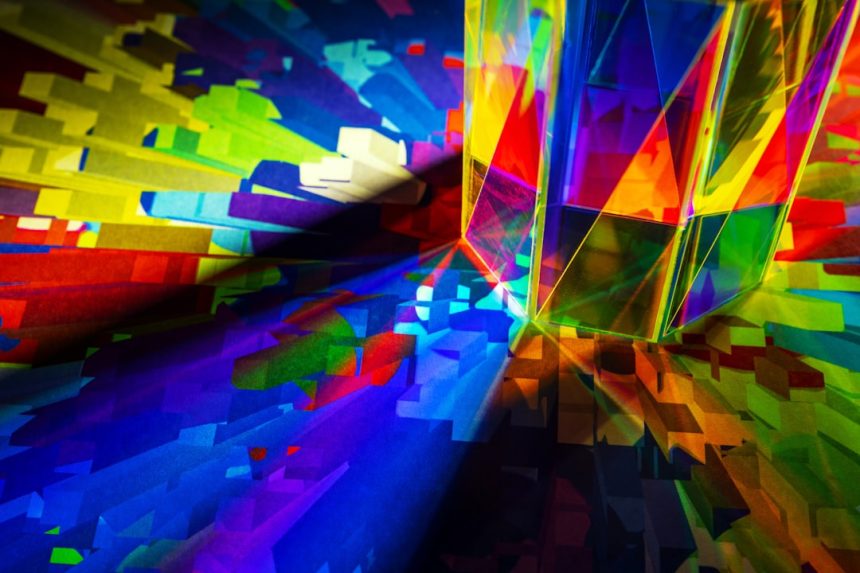


A Breakthrough in Light-Based Art (Image Credits: Unsplash)
Las Vegas – Visitors to the Sahara West Library step into a world where light bends to their will, revealing vibrant colors through simple interaction. The exhibit “Three Generations of Polarized Light Art” showcases a family's pioneering work in Polage, a medium invented decades ago that transforms ordinary materials into dynamic displays.[1][2] On view through May 2, 2026, this display highlights how art and science intertwine across generations in the Las Vegas area.
A Breakthrough in Light-Based Art
Austine Wood Comarow created Polage in 1967, coining the term from “polarized collage.”[1] She layered clear cellophane between cross-polarizing filters, harnessing polarized light to produce shifting colors without pigments or dyes.[2] This technique drew from natural light's prismatic spectrum, allowing hues to emerge and change as filters rotated or viewers shifted position.
Comarow refined her process after moving to the Las Vegas region in 1976 with her husband, David Comarow.[2] The couple established a studio in nearby Boulder City by 1985, where they developed commissions and displays that integrated the medium into public spaces.[3] Her works entered permanent collections, including the Museum of Science in Boston and the New Mexico Museum of Natural History and Science.
Family Tradition Takes Root
Eldest daughter Cara Wood Ginder joined Austine Studios in 1985 as an assistant and fabricator, eventually becoming studio manager and lead artist.[1] Younger daughter Erika Wood came aboard in 1998, introducing hybrid methods for producing multiples.[2] Cara's daughter, Charlotte Ginder, entered the fold in 2019, marking the third generation.
Austine Studios operated for decades until its closure in 2025, after Comarow's passing in 2020.[2] Cara and Erika now collaborate at Lightread Studios, continuing the legacy with new polarized light creations.[1] This exhibit at Sahara West Library traces their evolution from pioneer to contemporary practitioners.
Viewers as Co-Creators
What sets Polage apart lies in its interactivity. Each piece demands active engagement: visitors hold polarized filters to unlock hidden colors and patterns.[1] LED lighting enhances some works, while others rely on reflecting filters and birefringent materials for their effects.
The library gallery, open Monday through Thursday from 10 a.m. to 8 p.m. and weekends until 6 p.m., hosted a reception on February 12, 2026.[2] A 75-foot mural at the Spring Mountains Visitor Center further extends the family's reach, depicting local desert life.
- Hold a filter at different angles to watch colors bloom and fade.
- Observe how movement alters designs in real time.
- Discover subtle shifts between minimalist views and vivid revelations.
- Explore natural motifs like fish, portraits, and architecture.
- Note contrasts in styles across generations.
Diverse Visions in Polarized Form
Cara Wood Ginder captures historic lodgings and neon signs, evoking Las Vegas' midcentury charm in pieces like “Mirage.”[1] Erika Wood crafts bold portraits and patterns, often illuminated by LEDs, as seen in “Nine Portraits.”
Austine's contributions include “Breaking the Surface,” featuring colorful koi fish amid lilies, alongside unlit works that respond to ambient light.[1] Charlotte Ginder presents “Neighborhood,” framing suburban scenes through midcentury shapes in black and white that burst into color under filters.
| Generation | Key Artist | Signature Style |
|---|---|---|
| First | Austine Wood Comarow | Natural subjects, shifting light spectra |
| Second | Cara & Erika Wood Ginder/Wood | Historic motifs, LED innovations |
| Third | Charlotte Ginder | Suburban architecture, framed contrasts |
Enduring Appeal of Polage
This exhibit not only preserves a unique artistic lineage but also invites reflection on how technology and tradition merge.[4] Polage challenges passive viewing, turning every encounter into a personal discovery.
Key Takeaways:
- Polage uses polarized light for pigment-free, interactive color.
- Three generations span from 1967 invention to today's Lightread Studios.
- Visit before May 2 to experience the shifts firsthand.
As the Sahara West Library display draws to a close, it underscores Polage's timeless draw in a city known for spectacle. The medium endures, proving light's endless possibilities. What draws you to interactive art? Share your thoughts in the comments.


