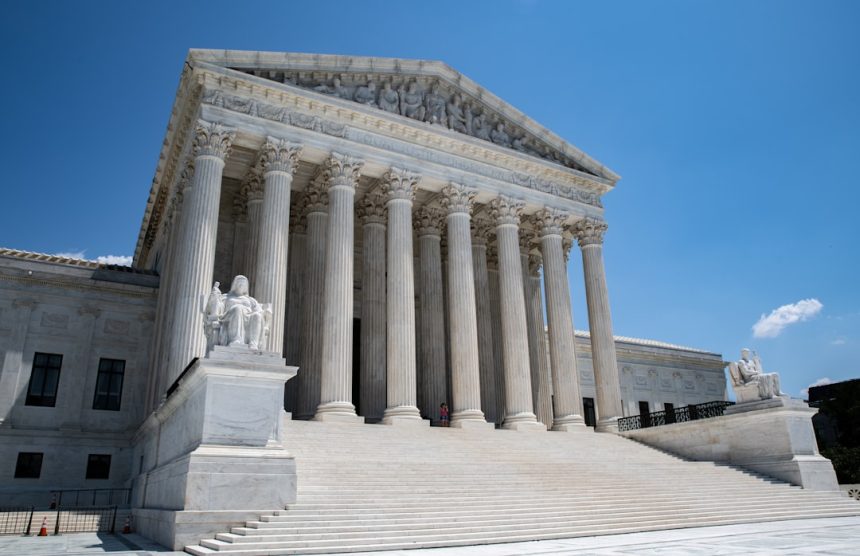

Trump’s Unprecedented Courtroom Appearance (Image Credits: Unsplash)
In a historic moment for the nation’s highest court, President Donald Trump attended oral arguments on his administration’s effort to restrict birthright citizenship, marking the first time a sitting president has done so.[1][2] The justices expressed widespread doubt about the legal foundation of the executive order, pressing lawyers on constitutional text, historical precedent, and practical implications. Trump remained in the courtroom for just over an hour before departing, as the two-hour session unfolded.[3]
Trump’s Unprecedented Courtroom Appearance
President Trump entered the Supreme Court chamber shortly before arguments began in Trump v. Barbara, taking a seat in the public gallery alongside White House counsel and Attorney General Pam Bondi. He listened intently for approximately 90 minutes, clasping his hands and wearing a signature red tie, before exiting amid murmurs from the audience.[4] This appearance came after Trump publicly affirmed his plans to attend, underscoring his personal stake in the outcome.[3]
Following his departure, Trump posted on Truth Social, decrying birthright citizenship and claiming the U.S. stands alone in granting it – a statement that overlooks similar policies in more than 30 other countries.[2] The executive order at issue, signed on January 20, 2025, titled “Protecting the Meaning and Value of American Citizenship,” directed federal agencies to deny citizenship documents to children born in the U.S. more than 30 days after its issuance if neither parent was a citizen or lawful permanent resident.[1] Lower courts had blocked its implementation, prompting the appeal.
Government Defends Narrow Reading of the 14th Amendment
Solicitor General D. John Sauer led the administration’s case, arguing that the 14th Amendment’s Citizenship Clause – “all persons born or naturalized in the United States, and subject to the jurisdiction thereof, are citizens” – requires full allegiance tied to parental “domicile” in the U.S.[2] He contended the clause, ratified in 1868 to grant citizenship to freed slaves and their children, excludes offspring of undocumented immigrants or temporary visitors, such as those on student visas.[1]
Sauer highlighted modern challenges like “birth tourism,” where individuals travel to the U.S. solely to secure citizenship for their children, noting hundreds of companies facilitating such trips from China alone. He distinguished the 1898 Supreme Court precedent United States v. Wong Kim Ark, where citizenship was affirmed for a child of Chinese immigrants, by emphasizing that case’s parents held lawful permanent residence and domicile.[2] Sauer maintained the order applies prospectively and aligns with 19th-century understandings of “jurisdiction” as political allegiance.
Challengers Invoke Century-Old Precedent
Cecillia Wang, legal director for the American Civil Liberties Union, represented parents affected by the order and urged the court to reaffirm the broad “jus soli” principle of citizenship by birthplace. She argued Wong Kim Ark established a “fixed bright-line” rule applicable to nearly all U.S.-born individuals, dismissing domicile as irrelevant to the holding.[1]
Wang warned that endorsing the government’s view would upend laws, strip citizenship from thousands of newborns, and cast doubt on millions of existing citizens. She noted Congress echoed the 14th Amendment’s language in the 1952 Immigration and Nationality Act without alteration, signaling acceptance of the broad interpretation.[2] The challengers also invoked statutory grounds, avoiding a direct constitutional showdown if possible.
Justices Across the Ideological Spectrum Raise Tough Questions
A majority of justices signaled discomfort with the administration’s position, including Trump appointees. Chief Justice John Roberts challenged Sauer’s expansion of narrow exceptions – like children of diplomats or invading forces – to cover undocumented immigrants, calling the examples “very quirky.” He rebuffed claims of a “new world” transformed by global travel: “It’s the same Constitution.”[3][2]
Justice Neil Gorsuch pressed Sauer on Native Americans’ status under the proposed test, receiving a hesitant response citing a 1920s statute. Justice Amy Coney Barrett questioned textual support for parental allegiance requirements, while Justice Brett Kavanaugh noted Congress’s post-Wong Kim Ark inaction as evidence against reinterpretation. Liberals like Elena Kagan dismissed Sauer’s historical sources as “obscure,” and Justice Ketanji Brown Jackson highlighted logistical chaos: “Is this happening in the delivery room?”[4]
- Roberts on exceptions: Limited to “tiny and idiosyncratic” cases, not mass application.
- Gorsuch on practicality: How to determine domicile for every birth?
- Barrett on text: Why no explicit parental limits in debates?
- Kagan on history: Text supports broad birthright, not esoteric meanings.
- Sotomayor on scope: Risks retroactive denaturalization.
Key Takeaways
- Justices repeatedly referenced Wong Kim Ark’s emphasis on birthplace over parental status.[1]
- Government struggled to reconcile modern policy goals with 1868 text.
- Decision could come by late June, potentially on statutory rather than constitutional grounds.
The oral arguments revealed deep fissures in the government’s bid to reshape a cornerstone of American identity, with the court poised to preserve the status quo that has defined citizenship for generations. This ruling will echo far beyond immigration policy, affirming whether the Constitution bends to contemporary pressures or endures unchanged. What implications do you see for the future of U.S. citizenship? Share your thoughts in the comments.