
Think back to your school days. Remember how confident your teachers sounded when they told you certain “facts” about history, science, or the world? Turns out, some of those lessons weren’t exactly accurate. I’m not saying your educators were trying to mislead you. Things change. New research emerges. Old textbooks get outdated.
We grew up believing these stories without question. They became part of our mental framework, the way we understood the world around us. Now it’s time to examine four of the most persistent myths that millions of us learned in classrooms across America, including right here in Vegas schools. The real stories? They’re actually more fascinating than the simplified versions we memorized for tests.
Columbus Discovered America in 1492
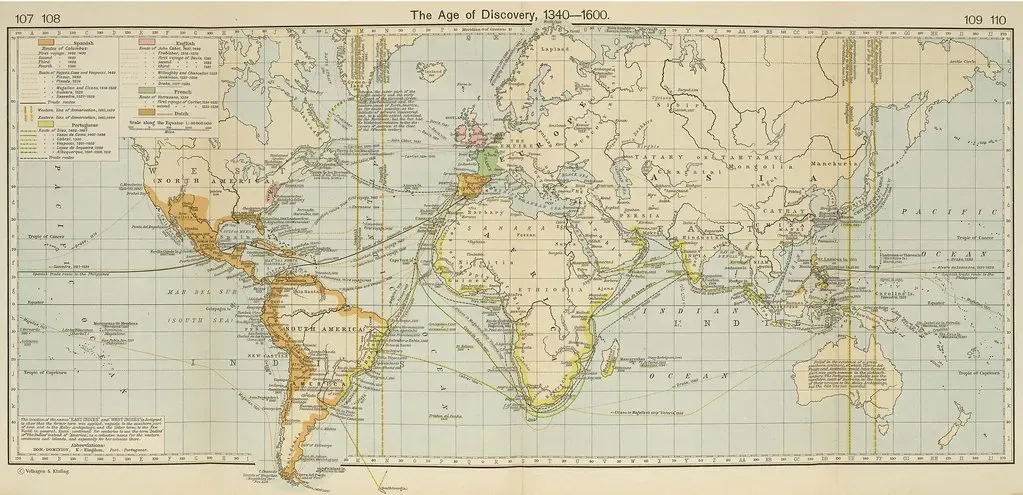
This one’s probably the biggest whopper in American history education. Christopher Columbus sailed the ocean blue in 1492, sure. He landed in the Caribbean. But discovered America? That’s a stretch so big it could reach from the Strip to Hoover Dam and back.
Indigenous peoples had been living across the Americas for tens of thousands of years before Columbus showed up. The Vikings established settlements in Newfoundland around 1000 AD. There’s even evidence suggesting other explorers might have reached American shores before either group. Columbus never actually set foot on mainland North America during his four voyages.
Here’s the thing that really gets me. Columbus wasn’t even trying to discover new lands. He was searching for a faster trade route to Asia and basically got lost. When he arrived in the Caribbean, he genuinely believed he’d reached the Indies. That’s why he called the native people “Indians” in the first place.
The myth persists because it fits a neat narrative about European exploration and American origins. It’s simpler to teach kids one name and one date than to explain the complex reality of multiple peoples discovering and inhabiting these continents over millennia. Schools are finally starting to shift their approach, but many of us learned the Columbus-discovered-America story as gospel truth.
You Only Use 10 Percent of Your Brain

This myth probably sounds familiar to anyone who sat through a motivational assembly or read a self-help book. The idea suggests we’re all walking around with 90 percent of our brainpower untapped, just waiting to be unlocked. Sounds inspiring, right? Problem is, it’s completely false.
Brain imaging technology has proven we use virtually all parts of our brain. Different regions activate for different tasks, but over the course of a day, every section sees action. Even while you sleep, your entire brain remains active in various ways. There’s no dormant 90 percent sitting idle.
Neuroscientists can actually trace this myth back to early misunderstandings about brain function. In the late 1800s and early 1900s, researchers discovered that damaging certain brain areas didn’t always produce obvious behavioral changes. They mistakenly concluded those areas must not be doing anything important. We now know those regions handle essential background processes.
The myth got a boost from self-improvement gurus and even appeared in advertisements. It’s hard to say for sure, but Hollywood certainly ran with it. Movies like “Lucy” built entire plots around the concept. Yet if you actually only used 10 percent of your brain, the other 90 percent would deteriorate from lack of use, just like an unused muscle. Brain scans of healthy people show no such dead zones.
The Great Wall of China Is Visible From Space

Teachers loved dropping this “fun fact” to illustrate how massive the Great Wall is. The structure stretches thousands of miles across northern China, so surely astronauts could spot it from orbit, right? Well, several astronauts have personally debunked this one, including Chinese astronaut Yang Liwei.
The Great Wall is wide enough for tourists to walk along, typically about 15 to 30 feet across. From low Earth orbit, where the International Space Station operates roughly 250 miles up, that’s nowhere near big enough to distinguish from the surrounding landscape. It’s made of materials that blend with the natural terrain. Without knowing exactly where to look, you’d never find it.
This myth likely started as an exaggeration that snowballed over time. Some versions claim it’s the only human-made structure visible from space, which makes the falsehood even more dramatic. In reality, astronauts can see plenty of human-made features from orbit, especially at night. City lights, for instance, create obvious patterns. Large-scale agriculture creates geometric patches of different colors. Highways sometimes show up as lines cutting through terrain.
I think what really sells this myth is the romantic notion behind it. We want to believe ancient humans created something so magnificent that it transcends ordinary human perception. The Great Wall is genuinely impressive as an engineering and historical achievement. It doesn’t need the space-visibility claim to be worth our admiration. Yet this myth appeared in textbooks and encyclopedias for decades, teaching generations of students something demonstrably untrue.
Different Parts of Your Tongue Taste Different Flavors

Remember that tongue map from biology class? The diagram showed specific zones for sweet, salty, sour, and bitter tastes. The tip supposedly detected sweet flavors. The sides handled salty and sour. Bitter lived in the back. Teachers even had us do experiments with sugar, salt, lemon juice, and coffee to “prove” it.
Total nonsense. Every taste bud on your tongue can detect all basic tastes. The receptors don’t specialize by location. This myth traces back to a mistranslation of a German paper from 1901. The original researcher, David Hänig, found slight sensitivity differences across tongue regions, but those variations were minimal. Later interpretations exaggerated his findings into the false map we all learned.
Modern research shows taste buds are distributed fairly evenly across your tongue, and each contains receptor cells for multiple taste types. Some areas might be marginally more sensitive to certain flavors, but you can taste sweet at the back of your tongue just as easily as at the tip. Try it yourself if you don’t believe me.
The persistence of this myth in education is actually kind of embarrassing for the scientific community. Scientists thoroughly debunked it decades ago, yet it kept appearing in textbooks well into the 2000s. Some schools probably still teach it today. It’s a reminder that educational materials don’t always keep pace with current knowledge, especially when a myth provides a neat, easy-to-remember visual.
Looking Back, Moving Forward

These myths reveal something interesting about how education works. Teachers often inherit simplified versions of complex topics, then pass them along without questioning their accuracy. Textbook publishers sometimes prioritize memorable content over precise truth. The system isn’t designed to constantly update every “fact” as new information emerges.
What strikes me most is how confidently these myths were presented. Nobody said “here’s a simplified version” or “this might not be entirely accurate.” They were taught as established facts, the kind of knowledge you’d better remember for the test. That’s partly why they stick with us into adulthood, even after we’ve encountered contradictory information.
The good news? We’re living in an era where information updates faster than ever before. When researchers make discoveries, the public learns about them relatively quickly. Schools are gradually improving their fact-checking and curriculum updates. Still, it takes time for old myths to die, especially when they’re embedded in decades of educational materials.
Next time someone confidently states one of these myths at a dinner party or bar here in Vegas, you’ll know better. Knowledge evolves. What we learned as kids doesn’t always hold up under adult scrutiny. The truth behind these myths is usually more nuanced and interesting than the simplified versions anyway. Did any of these surprise you, or were you already aware some of your school lessons weren’t quite right?