


Every Fourth of July, tens of millions of Americans flood the most famous fireworks hotspots, fighting for inches of lawn space and stewing in gridlock traffic for hours. In 2024, almost 300 million people celebrated Independence Day across the country, according to Capital One Shopping. That’s a lot of folding chairs. The thing is, some of the most jaw-dropping views of the night sky on July 4th aren’t found in the packed-to-the-gills grandstand zones. They’re found in the neighborhoods most people walk right past. Let’s dive in.
1. Gantry Plaza State Park, Long Island City, Queens – New York City’s Best-Kept Secret

Honestly, if you’ve never heard of Long Island City as a fireworks destination, you’re in good company. Most tourists race toward Manhattan or Brooklyn Bridge Park, which means the waterfront neighborhood of Long Island City in Queens stays comparatively calm on the Fourth. In 2024, Macy’s fireworks launched from five barges positioned between West 14th and West 34th Streets in Manhattan, the show beginning at 9:25 p.m. and lasting roughly 25 minutes, featuring over 60,000 shells in more than 30 colors and reaching heights of up to 1,000 feet. From Gantry Plaza State Park, you see all of it in sweeping panoramic glory without the elbow-to-elbow madness of the Manhattan side.
Queens’ Astoria Park, for example, is known for being home to the city’s largest and oldest public pool, and its location along the East River makes it an ideal spot for fireworks. Long Island City extends that same East River advantage, but without the organized event crowds that Astoria occasionally draws. The neighborhood feels like watching the show from someone’s private rooftop. Think of it as the “side door” entry to one of the most famous fireworks displays on Earth.
2. The Schuylkill Banks, Philadelphia – History Without the Chaos

For a more scenic and relaxed experience, the Schuylkill Banks and Kelly Drive offer riverside spots that are perfect for taking in the show away from the big crowds. While tens of thousands pack the Benjamin Franklin Parkway for Philadelphia’s main celebration, the riverbanks to the west of the Parkway offer an entirely different pace. It’s the difference between being in the mosh pit and watching the show from the balcony.
Part of West Fairmount Park in West Philly, Belmont Plateau rises 243 feet over the Schuylkill River two miles northwest of the Philadelphia Museum of Art, with picnic tables, cross-country running trails, athletic fields, and a clearing of green lawn which offers plenty of space to spread out on a blanket and enjoy the show from above the bustle. That elevation is the game-changer. As the birthplace of the nation, Philadelphia goes all out every year, hosting Wawa Welcome America for 16 days leading up to Independence Day, culminating in the massive free July 4th Concert and Fireworks on the Benjamin Franklin Parkway. You get all that ambiance without being sardined into it.
3. The MIT Riverfront in Kendall Square, Cambridge, Massachusetts – The Cerebral Side of the Charles

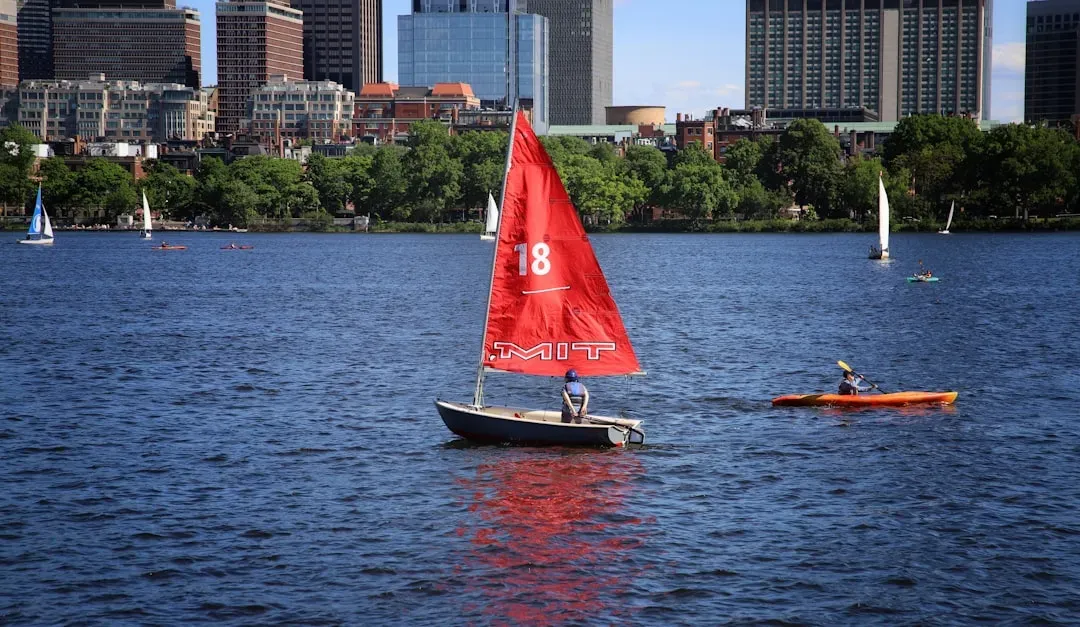
Boston’s Esplanade is famous. It’s also a commitment most people underestimate. Although most people tend to crowd onto the Esplanade to watch the fireworks, the Cambridge-side river banks actually offer a greater number of good viewing spots because of the way it curves. Fewer people know this. Walk across the bridge and you essentially double your options while cutting your crowd exposure in half.
The classic spot from which to watch the fireworks in Cambridge’s Kendall Square is the grassy quadrangle at MIT, where a giant screen live-streams the Boston Pops concert. The view from this side of the river, with the city skyline in the background and sweeping vantage points over the Charles River, might just beat being on the Esplanade itself. I think that’s a bold but defensible claim. For over 50 years, the Boston Pops Fireworks Spectacular has been the city’s biggest Fourth of July tradition, held annually at the Hatch Memorial Shell on the Charles River Esplanade with a free outdoor concert by the Boston Pops Orchestra, followed by a fireworks show over the river. Hearing it echo across the water from Cambridge, with the Boston skyline lit up behind the burst of colors, is something else entirely.
4. Hains Point and East Potomac Park, Washington, D.C. – The Monument Views the Tourists Miss


Washington, D.C. on the Fourth of July is iconic. The National Mall pulls enormous crowds, and the tight security perimeters mean you can spend more time in a queue than actually watching the sky. Here’s the thing: you don’t have to do it that way. East Potomac Park and Hains Point provide more open space and sweeping, less obstructed views across the water for those who want to avoid the heaviest crowds near the Mall.
The nation’s capital delivers a patriotic spectacle with its National Mall fireworks, a 17.5-minute display set against iconic monuments like the Lincoln and Jefferson Memorials. The event’s historical significance and free access make it a top choice for families and history buffs, with fireworks launching from both sides of the Lincoln Memorial Reflecting Pool, visible from the National Mall, U.S. Capitol West Lawn, and Potomac River viewpoints. Hains Point, a narrow peninsula jutting into the Potomac, offers all those same sightlines without the shoulder-to-shoulder press of the Mall. It’s like finding a back row seat to a sold-out concert where the acoustics are actually better.
5. Charlestown, Boston – Old Town Feel, Front Row Fireworks
Charlestown is arguably one of the most underrated neighborhoods in all of Boston, let alone on the Fourth of July. For something with more local flavor, head across the Charles over to Charlestown, the oldest neighborhood in Boston, where outdoor bars The Anchor and Pier 6 offer plenty of space to move around and a relatively clear line of sight to the fireworks. That “oldest neighborhood” label isn’t just tourism-brochure fluff. This is real American history on the streets around you, which adds something you can’t get at a generic festival ground.
It’s hard to say for sure exactly how packed Charlestown gets compared to the Esplanade, but anecdotally it offers considerably more breathing room. Castle Island, another South Boston alternative, is a less crowded option to view fireworks on Independence Day, and sources say that on a clear night, you can see fireworks from not only the Boston Pops Fireworks Spectacular, but also other displays from Quincy and beyond. Charlestown shares that multi-display advantage. Pair that with Pier 6’s open-air setup, the brick-lined streets of the neighborhood behind you, and the glow of bursting color over the Charles River, and you’ve got a July 4th experience that feels genuinely personal rather than processed.
Why the Crowd Numbers Actually Matter Here

A record 72.2 million people travel 50 or more miles from home for the Fourth of July, up 2.4% over 2024, setting a new record for the holiday. That’s a staggering number, and what it means in practice is that the most well-known viewing spots are getting busier every single year. The logic of finding a neighborhood alternative isn’t just about comfort. It’s increasingly about actually being able to see the show at all.
In 2023, roughly two in five people attended a fireworks celebration, a number that has climbed steadily since 2021. The mainstream spots simply cannot absorb that kind of growth gracefully. The neighborhoods described in this article aren’t secret in the conspiratorial sense. They’re just off the beaten tourist path, which in 2026 makes all the difference in the world.
The “Arrive Early” Rule Is Non-Negotiable


Many of the prime spots along the Charles River banks, especially on the Boston side and on the bridges, begin to fill up by late morning or early afternoon. Somewhere between 3:30 and 5:30 p.m., areas on the Esplanade near the Oval not blocked by trees get packed. Even the quieter neighborhoods referenced in this guide will see growing traffic as the evening approaches. The window of calm is real. It just doesn’t last forever.
Think of it like airport security. You know what you’re walking into. You control only when you arrive. A late arrival to even a relatively uncrowded neighborhood spot on the Fourth can quickly become a frustrating scramble for turf. A blanket, a good picnic basket, and an arrival that gets you settled well before sundown transforms the whole experience from stressful to sublime.
What Makes a Neighborhood Viewing Spot Actually Work


Not every neighborhood just outside a fireworks zone delivers a genuinely good view. Elevation matters enormously. A spot that’s even slightly elevated above a flat urban landscape can mean the difference between seeing the full burst overhead or watching only the upper half of the display peek over rooftops. That’s why spots like Belmont Plateau in Philadelphia stand out so distinctly from street-level alternatives.
Sightlines across water are the other major factor. Parks positioned along the East River afford incredible views, making them ideal spots for fireworks. The reflective surface of the water doubles the visual impact of a display, essentially giving you the show and its mirror image simultaneously. That’s something you rarely appreciate until you experience it. When you do, you wonder why you ever stood in a parking lot.
The Cost Factor Nobody Talks About

In 2024, Americans spent an estimated $15.5 billion preparing for Independence Day, with almost 300 million people celebrating. Despite those eye-watering national numbers, the beauty of a neighborhood viewing strategy is that it is almost completely free. No premium event tickets, no reserved lawn zones, no overpriced parking garages positioned to capitalize on holiday demand.
Transportation is often the largest expense for Independence Day events, running between $20 and $100 or more in major cities. In a neighborhood like Long Island City or Cambridge’s Kendall Square, public transit access is excellent. You walk out of the show and onto a train headed home, bypassing the gridlock that swallows the main event zones whole. That alone is worth the slight detour from the iconic viewpoints.
The 2026 Factor: Why This Year Changes Everything

Industry insiders believe 2026, America’s 250th anniversary, is going to see the largest celebrations ever, with demand for fireworks expected to be record-breaking. That means every already-crowded major venue will likely be at historic capacity levels this year. The National Mall, the Esplanade, the Benjamin Franklin Parkway – all of them will be operating at or beyond their comfortable limit on July 4, 2026.
This is not a year to assume your usual spot will work out. The neighborhood-based strategy described throughout this article isn’t just a clever lifestyle tip for a typical Fourth of July. In 2026, it may be the only realistic way for most people to actually enjoy the evening. The fireworks will be extraordinary. Whether your experience around those fireworks is extraordinary or miserable depends almost entirely on where you choose to stand.
A Final Note on Finding Your Own Perfect Spot

The five neighborhoods outlined here – Long Island City in Queens, the Schuylkill Banks in Philadelphia, Kendall Square in Cambridge, East Potomac Park and Hains Point in Washington D.C., and Charlestown in Boston – all share a common thread. They sit close enough to the action to deliver genuine spectacle, while sitting just far enough outside the main event perimeter to remain livable on one of the busiest nights of the American calendar.
Every great fireworks memory most people carry involves a feeling, not just a display. The feeling of space, of calm, of finding your own small patch of sky while the country celebrates around you. The neighborhoods above offer exactly that. The only question worth asking at this point is: which one will you choose? Drop your pick in the comments below and tell us what you’ve discovered.


