There are moments in a city’s life that feel bigger than a building coming down. In Las Vegas, implosions have always carried that weight – a strange, dusty kind of theater that says the old is gone, and something entirely different is coming. The Eastside Cannery implosion is one of those moments.
Honestly, it hit me differently than I expected. This wasn’t the Stardust or the Riviera. It wasn’t a Strip legend. It was a locals casino on Boulder Highway – the kind of place where regulars knew the cocktail waitress by name. Yet its fall tells a story about where Las Vegas is heading that I think deserves a closer look. Let’s dive in.
A Brief Life on Boulder Highway: From Nevada Palace to Eastside Cannery

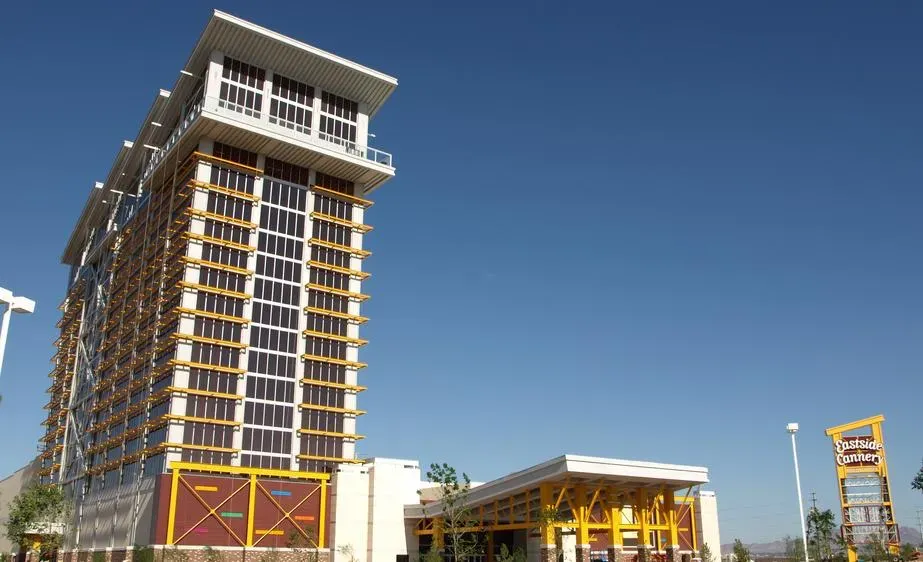
The hotel-casino opened in 2008 in the same spot where the Nevada Palace used to stand from 1979. That’s a layered history right there – one locals landmark built directly on top of another. It was the first hotel-casino to be built on Boulder Highway since the completion of Boulder Station in 1994.
The Eastside Cannery opened on August 28, 2008, amid the Great Recession. The property employed nearly 1,100 people. Opening a quarter-billion-dollar casino during a financial crisis takes either incredible nerve or incredibly bad timing. In hindsight, it was probably both.
The Eastside Cannery cost $250 million to develop, a low price compared with other recent locals casinos such as the Red Rock Resort and M Resort. Think of it like buying a solid, dependable family sedan while your neighbors are showing off sports cars. It was never meant to dazzle. It was meant to last.
What the Eastside Cannery Actually Was – A True Locals Haven


In addition to its hotel rooms, Eastside Cannery had a 64,000-square-foot casino, several bars and restaurants, a 16th-floor club, a 250-seat entertainment lounge and 20,000 square feet of meeting and ballroom space. For a locals property, that is genuinely impressive. Not Strip-flashy, but real, functional, and full of life.
It opened with 2,187 slot machines and 26 table games, as well as a 450-seat bingo hall and a sportsbook. The bingo hall alone tells you exactly who they were building this for. Not tourists hunting down a buffet. Regular people. Neighbors. Las Vegas residents with a Tuesday afternoon to kill.
In 2010, a portion of the casino floor was dedicated to coin-operated slot machines, boosting the property’s popularity among older gamblers. That detail always stuck with me. Coin machines in 2010. They genuinely cared about who was walking through that door.
March 2020: The Day the Lights Went Out and Never Came Back On


State casinos were ordered to close on March 17, 2020, due to the COVID-19 pandemic in Nevada. Every casino in the state went dark that day. It felt temporary. For most properties, it was. For Eastside Cannery, that door simply never reopened.
Nevada’s casinos were allowed to reopen in June 2020, but Eastside Cannery remained closed. Boyd Gaming opted to keep it dark in the years since and directed customers to nearby Sam’s Town in its place. That pivot said everything. The math had changed. Why restart a whole operation when Sam’s Town was already absorbing the crowd?
After the building’s 2020 COVID-19 shutdown, Boyd maintained it by investing more than a half-million dollars a month to run utilities inside and keep IT and security systems secure and operating. Let that number sink in. Half a million dollars a month – for a building generating zero revenue. That is not a company that abandoned this property carelessly.
Five Years Dark: The Slow Realization It Was Never Coming Back


In an April 2024 letter to Clark County officials, Boyd’s chief compliance officer Michelle Rasmusson stated that market conditions do not currently justify reopening. Reading between the lines on a statement like that is not difficult. “Market conditions” is corporate language for: the numbers don’t work and they probably never will again.
She also noted that Boyd would need to hire a few hundred employees to restart operations but is already facing hiring difficulties across its Southern Nevada properties, with more than 400 unfilled positions in the region. So it wasn’t just about demand. It was also about the impossibility of staffing up a full-scale locals resort in a tightened labor market.
Casinos on Boulder Highway and in the surrounding area were in decline before the pandemic. In 2019, Arizona Charlie’s Boulder removed all live table games. The pandemic accelerated something that was already happening. The Eastside Cannery closure was not a fluke. It was the loudest chapter in a quieter, longer story.
The Property Didn’t Sit Completely Idle: Community in an Empty Shell

Three Square Food Bank used the property for a weekly food distribution site during the pandemic, and police and firefighters used it for training drills. The Metropolitan Police Department conducted training exercises at Eastside Cannery, including room clearing, active-shooter scenarios and cadet seminars.
Crime-scene investigators also used hotel rooms as part of their academy testing. Plus, the Clark County Fire Department used the property to train on stairwells and to practice room searches and elevator rescues. There is something quietly poignant about that. A casino dark to gamblers but alive to the community in other ways. Las Vegas is full of those strange second lives.
The Decision: Demolish It, Sell the Land, Move On


Boyd Gaming Corp. will demolish its long-closed Eastside Cannery Casino Hotel in Las Vegas and sell the land for residential development. Boyd purchased the land under the shuttered hotel-casino last February for $45 million, property records show. It had been leasing the roughly 29.5-acre footprint. Buying the land right before announcing demolition tells you the plan was already locked in.
The Clark County Building Department on Oct. 20 issued a commercial demolition permit, valued at $7.5 million, for the Boyd-owned Eastside Cannery on Boulder Highway, records show. Seven and a half million dollars just to tear it down. That figure doesn’t include land purchase, ongoing maintenance costs, or site remediation. The full price of this closure is staggering.
The county Building Department on Feb. 24 issued a commercial demolition implosion permit, valued at $487,210, for the 16-story tower, records show. The permit lists Controlled Demolition Inc. as the contractor. In Las Vegas, it was the explosives subcontractor for the Tropicana hotel-casino implosion in 2024. These are the professionals who have been quietly erasing old Vegas for decades.
March 5, 2026: The Implosion That Nobody Was Invited To


Las Vegas’ long history of explosive demolitions will continue next month when Boyd Gaming Corp. implodes the shuttered Eastside Cannery’s hotel tower. Boyd spokesman David Strow said Monday that the tower will be imploded at 2 a.m. on March 5.
Casino implosions in Las Vegas are often early-morning parties, with fireworks and masses of people gathering to watch and cheer the destruction. The Eastside Cannery implosion, however, is not a public event, and there will be no designated public viewing areas. That absence says something, I think. No fanfare. No fireworks. Just a tower coming down in the dark before the city wakes up.
Work crews have been tearing down portions of the property lately, but the hotel tower, which has been gutted and stripped of windows, still stands. A building stripped of its windows looks like it already knows what’s coming. It’s almost too obvious a metaphor, but Vegas has always loved a dramatic visual.
Las Vegas Has Been Erasing Its Past for Decades – This Is Different


Between 1993 to 2016, 13 major properties were imploded, and others were just torn down. Las Vegas built its identity on reinvention, and implosions became the city’s favorite exclamation point. The Dunes gave way to the Bellagio. The Stardust made room for Resorts World. Every demolition meant something bigger and shinier was rising.
The Riviera, which opened in 1955, was another classic Las Vegas hotel that couldn’t stand the test of time. Known for its glamorous history, including appearances in films like Casino and Ocean’s 11, the Riviera was ultimately imploded in two stages in 2016. Homes for housing developments were not part of that old formula. The Eastside Cannery breaks the pattern entirely.
For Las Vegas, the move signals that the off-Strip corridor may increasingly shift from gaming to residential or mixed-use development, reflecting structural market change. That is the real story. Not just one casino closing, but an entire corridor shifting its identity away from gambling altogether.
The Boulder Highway Corridor: A Market That Changed Beneath Everyone’s Feet


The Boulder Strip gaming market is a division used by the Nevada Gaming Commission for a segment of the casino industry in Las Vegas, Nevada. The region is named for the Boulder Highway which is the dominant highway in the region. For decades this corridor served the working-class east side of Las Vegas. It was never glamorous. It was always dependable.
The Boulder Highway area is one of the poorest in Las Vegas. The Las Vegas economy has seen better days. Tourism is down, and in many months in 2025, gaming numbers have also dropped. Here’s the thing – when a locals market weakens, there is no flood of tourists to pick up the slack. Boulder Highway casinos get little in the way of tourism. Most Las Vegas visitors stay on the Strip, downtown, or at other off-Strip properties.
Eastside Cannery joins a growing list of casinos that have shuttered in less than two years: the Tropicana Las Vegas closed permanently on April 2, 2024; the Mirage shut ahead of major redevelopment on July 17, 2024; Buffalo Bill’s Resort & Casino in Primm closed after declining business on July 7, 2025; and the Poker Palace Casino in North Las Vegas, a more than 50-year-old local casino, closed October 1, 2025. That is a remarkable concentration of closures in a very short window.
What Comes Next: Apartments Where Slot Machines Used to Spin


Boyd Gaming plans demolition of the Eastside Cannery in Las Vegas, to make way for a potential multifamily housing project in its place. Ultimately, Boyd intends to sell the site for residential use. There is something almost disorienting about imagining apartment balconies where a bingo hall used to be.
The planned Eastside Cannery demolition marks the final Las Vegas Valley casino property disposal since the massive COVID-19 shutdowns. Red Rock Resorts sold and eventually demolished three of its properties: North Las Vegas’ Texas Station and Fiesta Rancho and Henderson’s Fiesta Henderson. One by one, the casualties of the pandemic shutdown are being permanently retired.
Redevelopment projects like Eastside Cannery housing play a vital role in urban revitalization strategies. Boyd Gaming’s initiative is part of a growing trend in Las Vegas to diversify the economy beyond tourism by developing mixed-use spaces. It’s a genuine pivot. Las Vegas building homes instead of casinos is not a headline anyone predicted fifteen years ago.
Conclusion: The Dust Settles, and Old Vegas Goes With It


The Eastside Cannery was never a legendary property. It didn’t have the mythology of the Stardust or the cultural weight of the Riviera. But that’s exactly what makes its loss feel so pointed. It was the kind of place that existed for real people, not for movie montages or celebrity poker tournaments. When a casino like that goes away quietly, in the dark, with no public viewing area, no fireworks, and no fanfare, it means something different.
It means the business case for serving everyday locals in aging corridors is getting harder to make. It means a city that once replaced old glamour with new glamour is now replacing old casinos with apartment complexes. Las Vegas has always been a city of reinvention – but this particular reinvention feels less like a spectacle and more like an admission.
The Eastside Cannery’s 16-story tower stood gutted and stripped of its windows in early 2026, waiting for a 2 a.m. implosion that the public wasn’t invited to watch. I think there’s a reason for that. Some endings aren’t meant to be celebrated. They’re just meant to be over. What do you think – does Old Vegas still have a future, or is this the moment the city finally stops looking back?