Art has always had a secret language. Long before playlists and streaming services, painters were quietly embedding musical codes, instruments, and melodies into their works – sometimes as symbols, sometimes as personal jokes, and sometimes as messages only the sharpest eyes could ever hope to find. The connection between paint and sound runs far deeper than most people ever realize when standing in front of a canvas.
Some of history’s most iconic paintings are hiding musical surprises that have shocked scholars, gone viral online, and changed the way entire artworks are understood. From a literal melody buried in a Renaissance fresco to a full jazz tribute painted in colored squares, the list ahead will almost certainly surprise you. Let’s dive in.
1. The Last Supper – Leonardo da Vinci (c. 1495–1498)
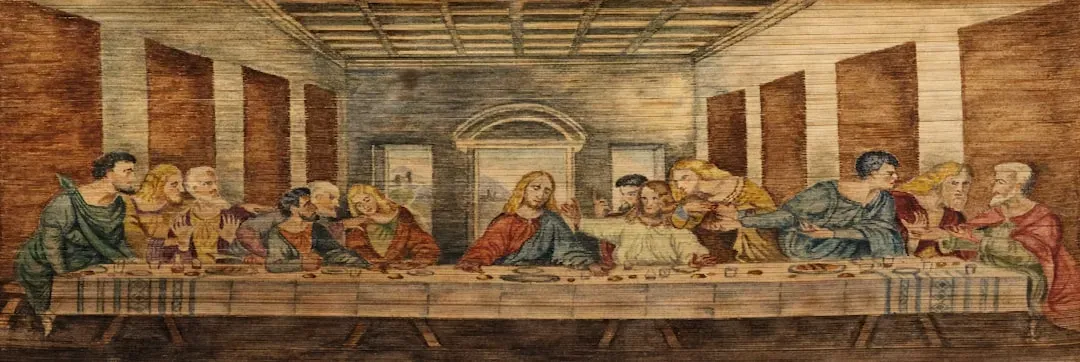
Let’s be real: this is probably the most jaw-dropping music discovery in the entire history of art. Italian musician Giovanni Maria Pala discovered what could very well be a musical melody written into the painting. If you draw the five lines of a musical staff across the painting, the apostles’ hands and the loaves of bread on the table fall into positions that correspond with musical notes. The sheer precision of this arrangement feels almost impossible to dismiss as coincidence.
When the notes are read from right to left, the way da Vinci wrote, the combination transforms into a 40-second composition that sounds like a requiem. There is always a chance this is pure coincidence, but the composition sounds very harmonious when played. Researchers also confirm that besides being a painter, da Vinci was an excellent musician, which makes intentional placement far more plausible. Honestly, the man who designed flying machines in the 1400s probably had the creative bandwidth for this too.
2. The Garden of Earthly Delights – Hieronymus Bosch (c. 1490–1510)
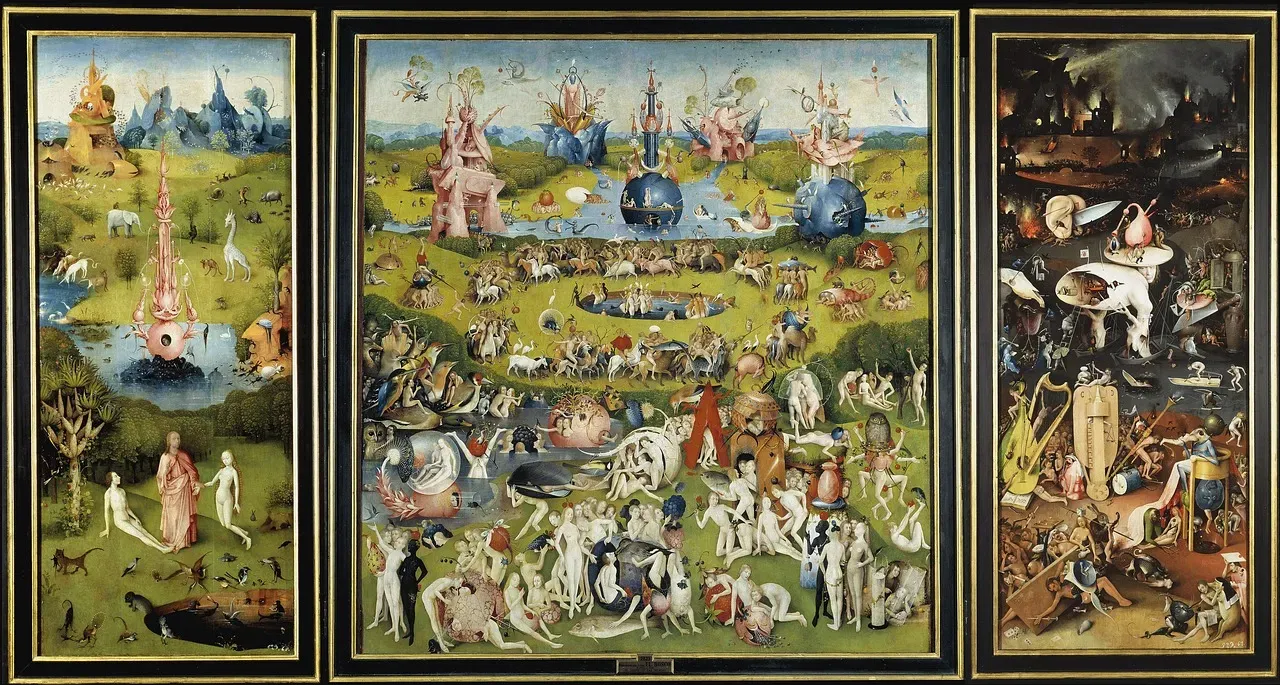
This triptych oil painting shows the Garden of Eden, Paradise, and Hell. The detailed artwork is full of little elements that are often overlooked at first glance, and a musical score was carefully discovered on the buttocks of an agonized man. The sheet music can be found in the bottom left of the third panel, which depicts sinners in Hell. The focus of this scene is a man lying flat on the ground as he is crushed by a giant lute.
The musical score was transcribed and recorded by Oklahoma Christian University student Amelia Hamrick, who played it on a lute, a harp, and a hurdy-gurdy. Hamrick decided to transcribe it into modern notation, assuming the second line of the staff is C, as is common for chants of this era. Her recording, titled “The 500-Year-Old Butt Song from Hell,” went viral and scored immediately 200,000 views after she posted it on her blog. Few artworks can claim to have spawned a viral internet moment more than five centuries after they were painted.
3. The Ambassadors – Hans Holbein the Younger (1533)
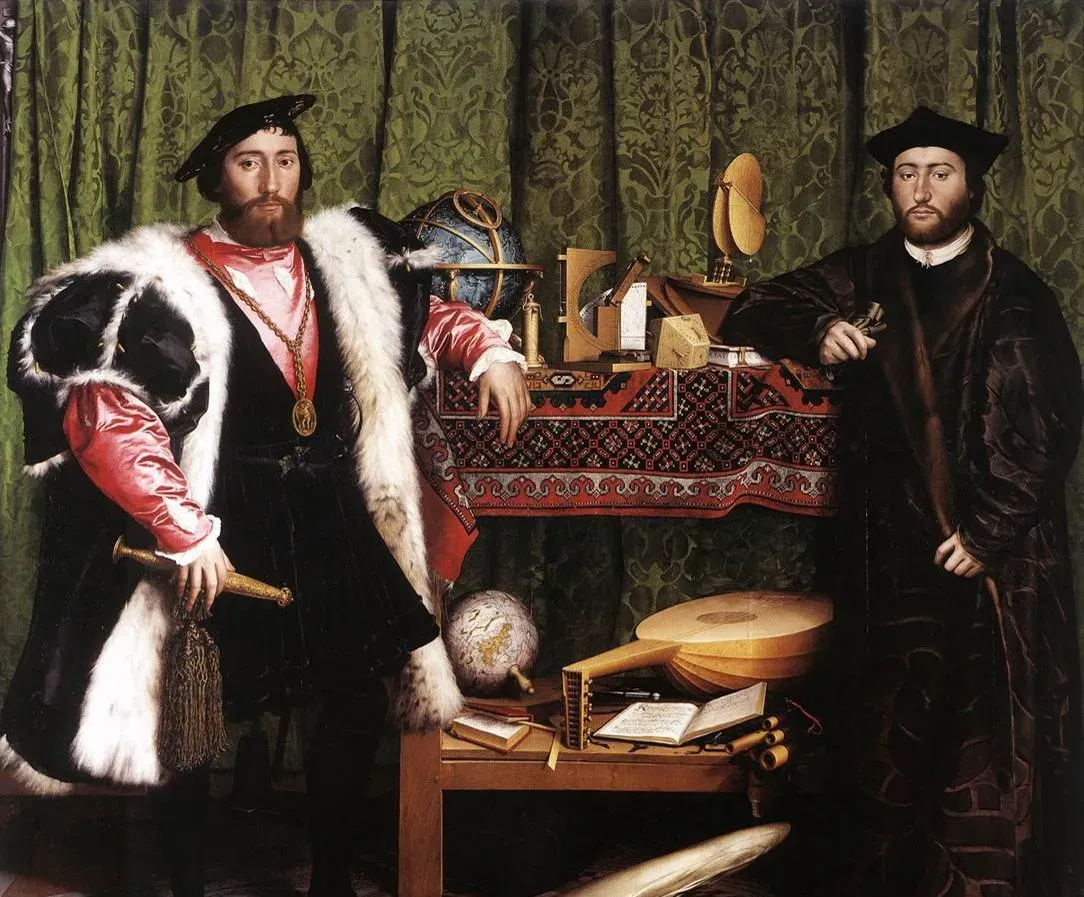
Hans Holbein’s “The Ambassadors” is a masterpiece layered with symbols, but one detail rarely escapes the eyes of art lovers: a lute with a broken string. In the 16th century, music wasn’t just entertainment – it was a code, a language of culture and intellect. The broken string is far more than an accident; it’s a metaphor for discord and tension in Renaissance Europe, especially between science, religion, and the arts.
Next to the lute, a book of musical notation sits open, quietly asserting music’s intellectual status. The painting’s objects, including globes and scientific instruments, show the era’s thirst for knowledge, but it’s the that quietly tug at the deeper currents of human experience. This detail is so famous that modern scholars frequently cite it as a prime example of hidden storytelling in art. Think of the broken string like a cracked mirror – its meaning goes well beyond the physical object itself.
4. The Music Lesson (Lady at the Virginals with a Gentleman) – Johannes Vermeer (c. 1662–1664)
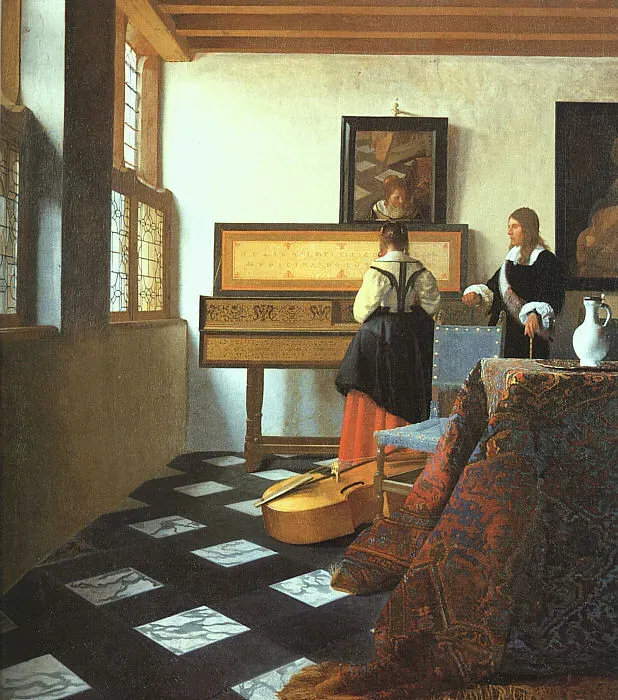
As a testament to music’s central role in Vermeer’s world, 14 Vermeer paintings include a musical instrument, more than a third of his paintings. The inventory includes a recorder, a trumpet, a guitar, two citterns, three lutes, three virginals, a harpsichord, and four violas de gambas. The Music Lesson is perhaps the most loaded of them all, layering romantic tension right on top of the musical setting.
In The Music Lesson, Vermeer alludes metaphorically to the harmony of two souls in love, suggested by the unattended bass viol on the floor before the couple. The juxtaposition of the two instruments, the virginal and the bass viol, refers to an emblem by Jacob Cats that describes how the sound of one instrument resonates on the other, just as two hearts can exist harmoniously even if separated. The tilted mirror on the wall provides the most interesting detail: the woman’s reflection is flawed. We can plainly see by the back of her head that she is concentrating on the keyboard, but in the reflected image, her head is turned to the right, toward the gentleman.
5. A Young Woman Seated at a Virginal – Johannes Vermeer (c. 1670–1675)
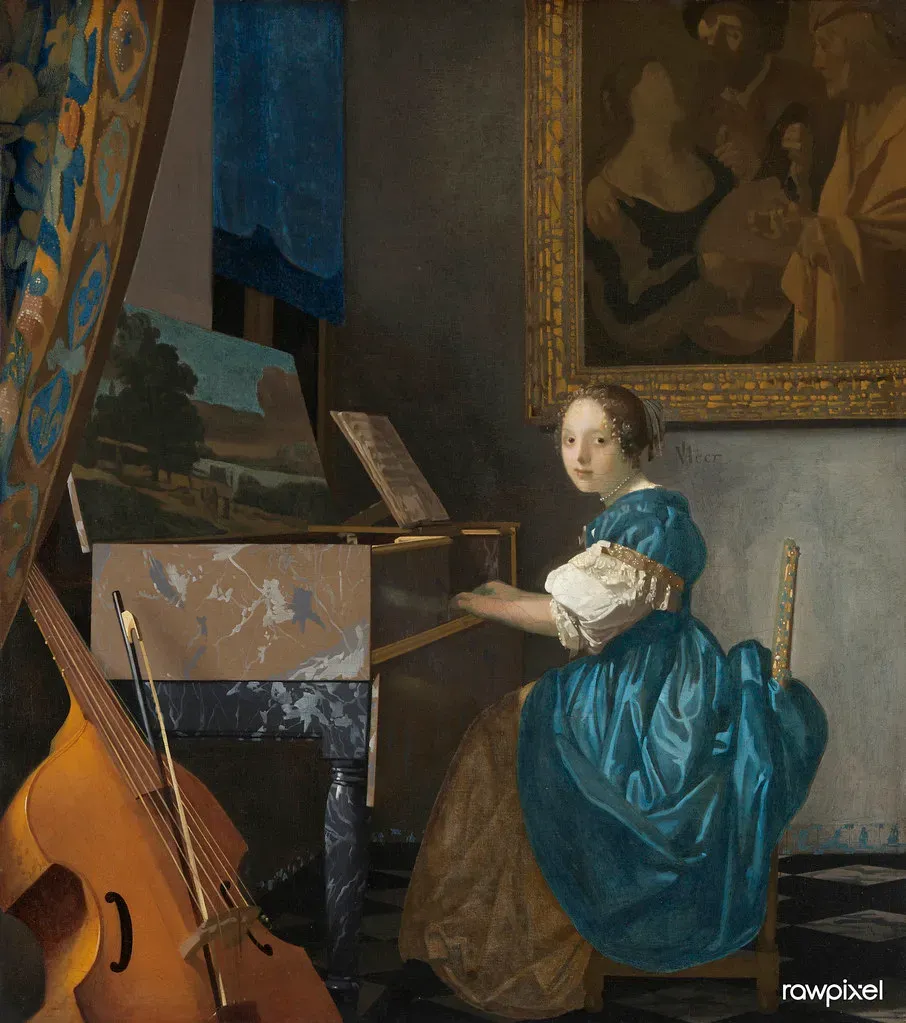
On the wall behind the figure, the picture shown depicts a prostitute flirting with a client. Musical scenes like this could be understood in different ways – some were depicted as bawdy occasions, while others were entirely decorous. Vermeer tended to hedge them with uncertainties, but here the background picture gives an unusually strong hint, which encourages us to wonder if the keyboard player has more than music on her mind.
Van Baburen’s Procuress has led some critics to interpret the seated musician’s gaze as an invitation to profane love, but it is more likely that her virginal, often employed as a symbol of harmony, had associations with a more elevated form of love. The presence of the Van Baburen thus establishes a thematic contrast between the uncontrolled libido of the bordello scene and the virginal music associated with harmony and moderation. The painting works like a riddle where music is both the question and the answer.
6. The Musicians – Caravaggio (1595)
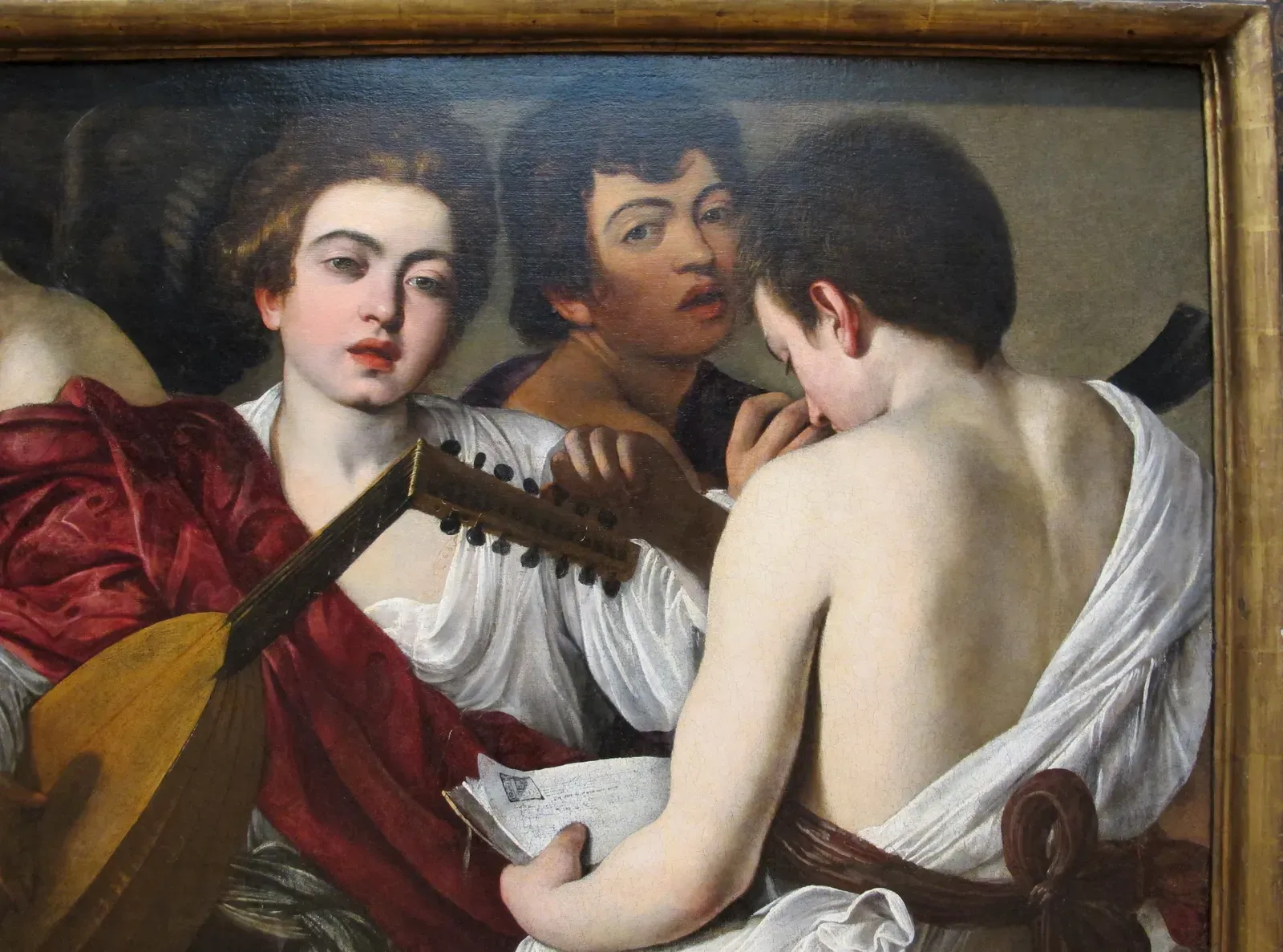
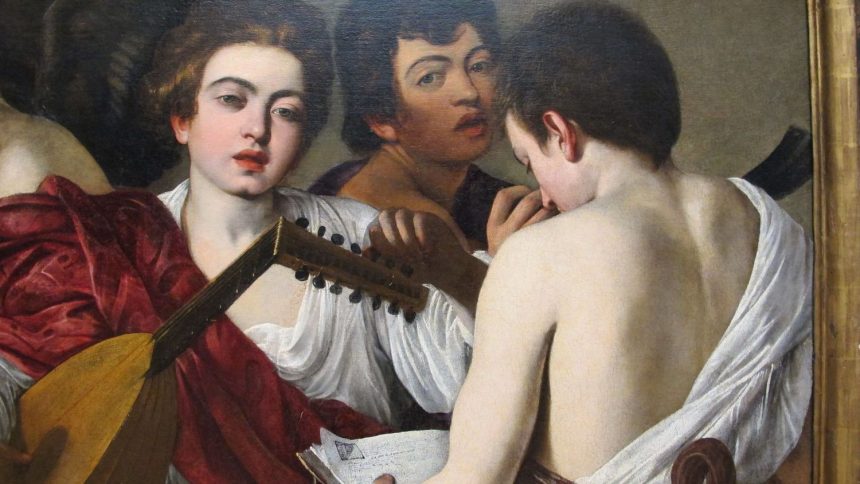
In The Musicians by Caravaggio, we find a rich emotional life. A few young men prepare to play, their countenances a mixture of focus and melancholy. This painting was commissioned by Cardinal Francesco Maria Del Monte, one of the most musically inclined patrons of the Roman Baroque world, which makes the careful placement of every instrument deeply intentional.
The eroticism is brought to life by the bodies of idealized young people with refined faces, in which only the character playing the cornet could be ascribed to the genre of the self-portrait, so much so that it could depict the young Caravaggio himself. At the time, young musicians dressed in the classical style, as Eros or Bacchus, just as might have been the case during the performances beloved by the painter’s greatest patron, Cardinal del Monte. Every single instrument here tells a story of ambition, longing, and the intoxicating power of music in aristocratic Rome.
7. Broadway Boogie Woogie – Piet Mondrian (1942–1943)
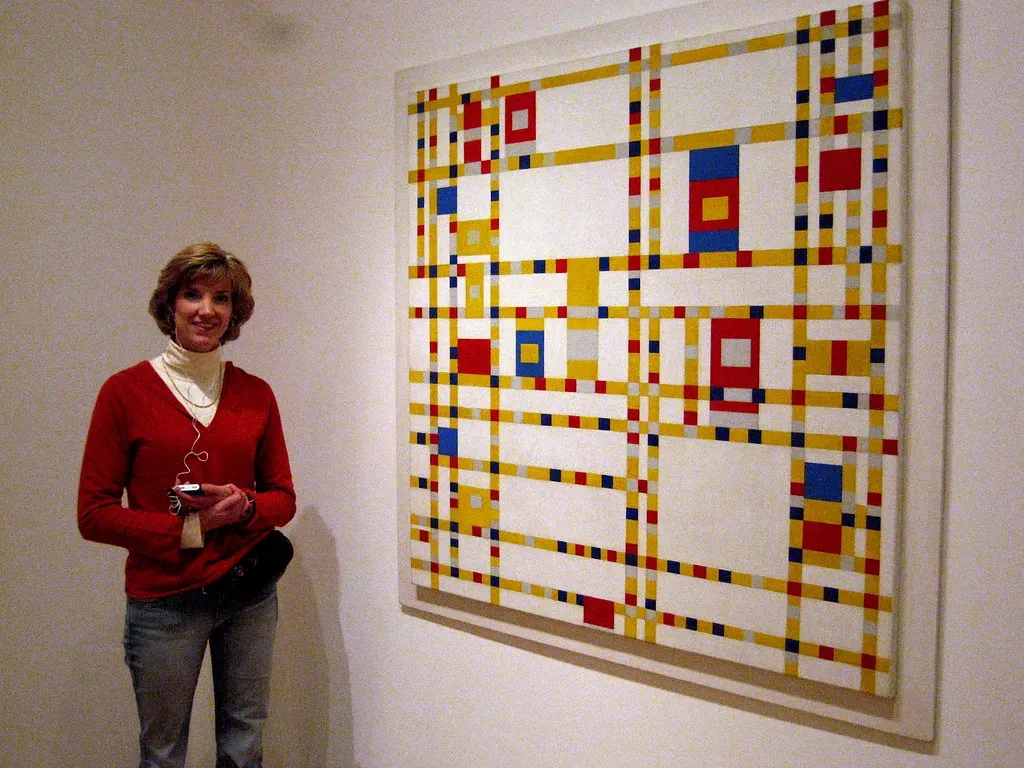
Mondrian was introduced to boogie-woogie on his first evening in New York and began frequenting the famous jazz club Minton’s Playhouse, where he grew closer and closer to African-American blues music. The frenetic and syncopated rhythm of Boogie-Woogie dominates the painting. It seems almost miraculous that a man better known for quiet grids of black lines ended up producing one of the most energetic tributes to jazz music in the history of painting.
Whereas Mondrian’s early paintings were built up out of long continuous lines and large planes, which could be compared to whole or half notes in music, there now appear much smaller forms comparable to eighth and sixteenth notes, contrasting only here and there with larger areas. This innovation, which evidently took place while Mondrian was working on the painting, gives the canvas a new and sparkling vivacity. Boogie-woogie music, with its unexpected syncopation of rhythm, is elaborated visually in this painting. Broadway Boogie Woogie resides in the permanent collection of the Museum of Modern Art in New York City and is one of the most innovative paintings in the 20th century.
8. Composition VIII – Wassily Kandinsky (1923)
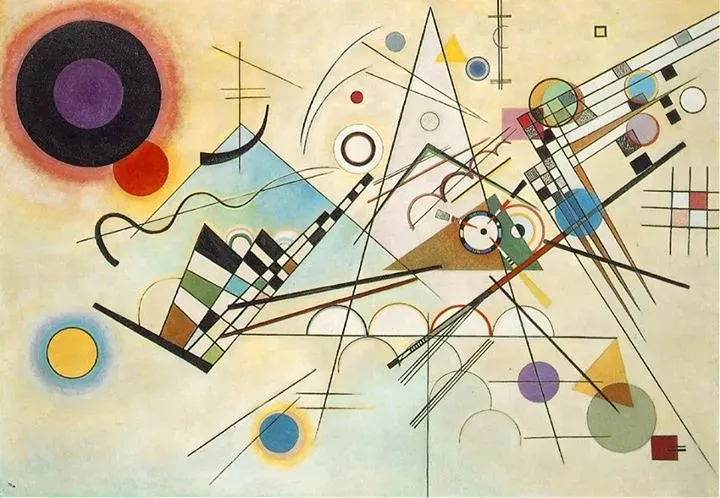
Wassily Kandinsky, a synesthete, believed a shape and a hue could be identical to a note. In Composition VII (1913), he created a vision symphony, a riotous union of form and colour reminiscent of the range and power of music. Here, no musicians are required; the music is in the chaos of sight. Kandinsky is, in many ways, the most musically minded painter who ever lived.
Partner offer
In line with his pursuit of an abstract language that resonates emotionally, Kandinsky aimed to evoke in his audience the same powerful emotions elicited by music. Critics have aptly interpreted Kandinsky’s Composition series as a visual homage to music, viewing the artworks as symphonies where different elements converge to create a cohesive and emotionally resonant piece, mirroring the collaborative harmony of musical instruments. Every brushstroke in his Composition series is, in effect, a musical note that the eye rather than the ear decodes.
9. The Musician’s Table – Pablo Picasso (Cubist Period)
In “The Musician’s Table,” Picasso breaks down the familiar elements of music into a Cubist puzzle of forms and fragments. Sheet music, a guitar, and other instruments are scattered across the tabletop, but none are portrayed in a conventional way. This painting reflects the dramatic changes occurring in both music and visual art at the start of the 20th century, as traditional harmony gave way to experimentation and dissonance.
Picasso’s bold lines and overlapping shapes challenge the viewer to reconstruct the scene, much like a musician would interpret a complex modern score. Art historians see this work as a statement about the creative process, emphasizing the interplay between order and chaos. The painting is often referenced as a touchstone in discussions about the close relationship between Cubism and the avant-garde music of its time. It’s a painting that feels like it was made while someone played dissonant jazz in the next room.
10. The Concert – Johannes Vermeer (c. 1663–1666)
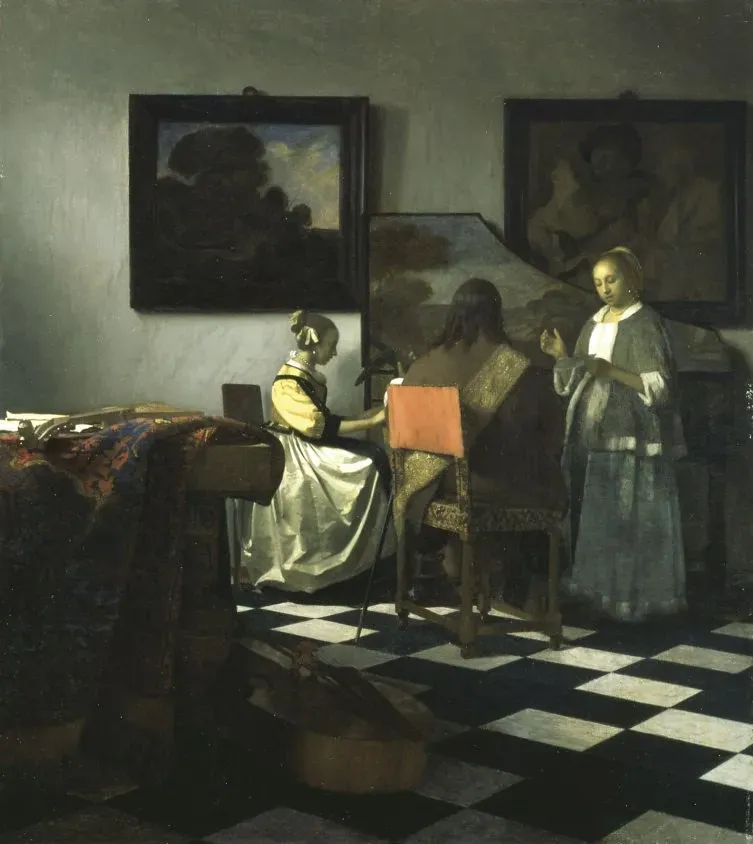
A copy of the painting by Dirck van Baburen was owned by Vermeer’s mother-in-law, in whose house he lived and worked, and he included it in another painting, The Concert. The Concert shows two young women singing and playing a harpsichord while a man accompanies them on a lute. This makes The Concert one of the most layered music-within-a-painting works in all of art history.
In The Music Lesson and The Concert, both from the 1660s, Vermeer depicted men and women who had gathered in an elegant room to play music, sing, and otherwise to enjoy their social interactions. The Concert is also infamous for a tragic reason: it was stolen from the Isabella Stewart Gardner Museum in Boston in 1990 and has never been recovered, making it one of the most valuable missing artworks in the world. The music in this painting has been silenced in more ways than one.
11. Polyphony – Paul Klee (1932)

Paul Klee, another artist who began as a musician, routinely structured his painting as if it were written music. Small, colored shapes repeat and vary in Polyphony (1932) like melodic lines in a fugue. The painting doesn’t represent music – it operates like it. Klee studied violin seriously before committing to painting, and that early training never truly left him.
Here’s the thing about Polyphony: the title itself is a direct musical term referring to multiple independent voices or melodies sounding simultaneously. Klee wasn’t hiding the music reference at all, he was wearing it openly, but the depth of how compositional structure from music directly shaped his visual rhythm is what makes this work so remarkable to scholars. The painting is less a picture to look at and more a score to feel.
12. A Lady Seated at a Virginal – Johannes Vermeer (c. 1670–1675)
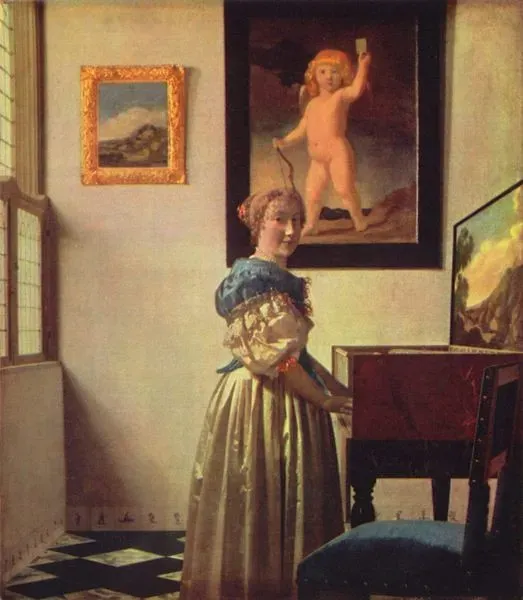
This painting is one of several works by Vermeer featuring keyboard instruments, including The Music Lesson, The Concert, and Lady Standing at a Virginal. Scholars believe these may all be based on the same instrument, built by Johannes Ruckers. The musical thread running through Vermeer’s entire body of work is extraordinary. It is almost as if music was his true subject, and the people were simply there to hold the instruments.
Van Baburen’s Procuress has led some critics to interpret the seated musician’s gaze as an invitation to profane love, but it is more likely that her virginal, often employed as a symbol of harmony, had associations with a more elevated form of love. The Music Lesson has been part of the Royal Collection of Great Britain since 1762, when King George III bought Smith’s collection of paintings. The survival of these interconnected music-laden works across centuries feels like its own kind of melody, continuous and unbroken.
13. Whistler’s Nocturne in Black and Gold: The Falling Rocket – James McNeill Whistler (c. 1875)
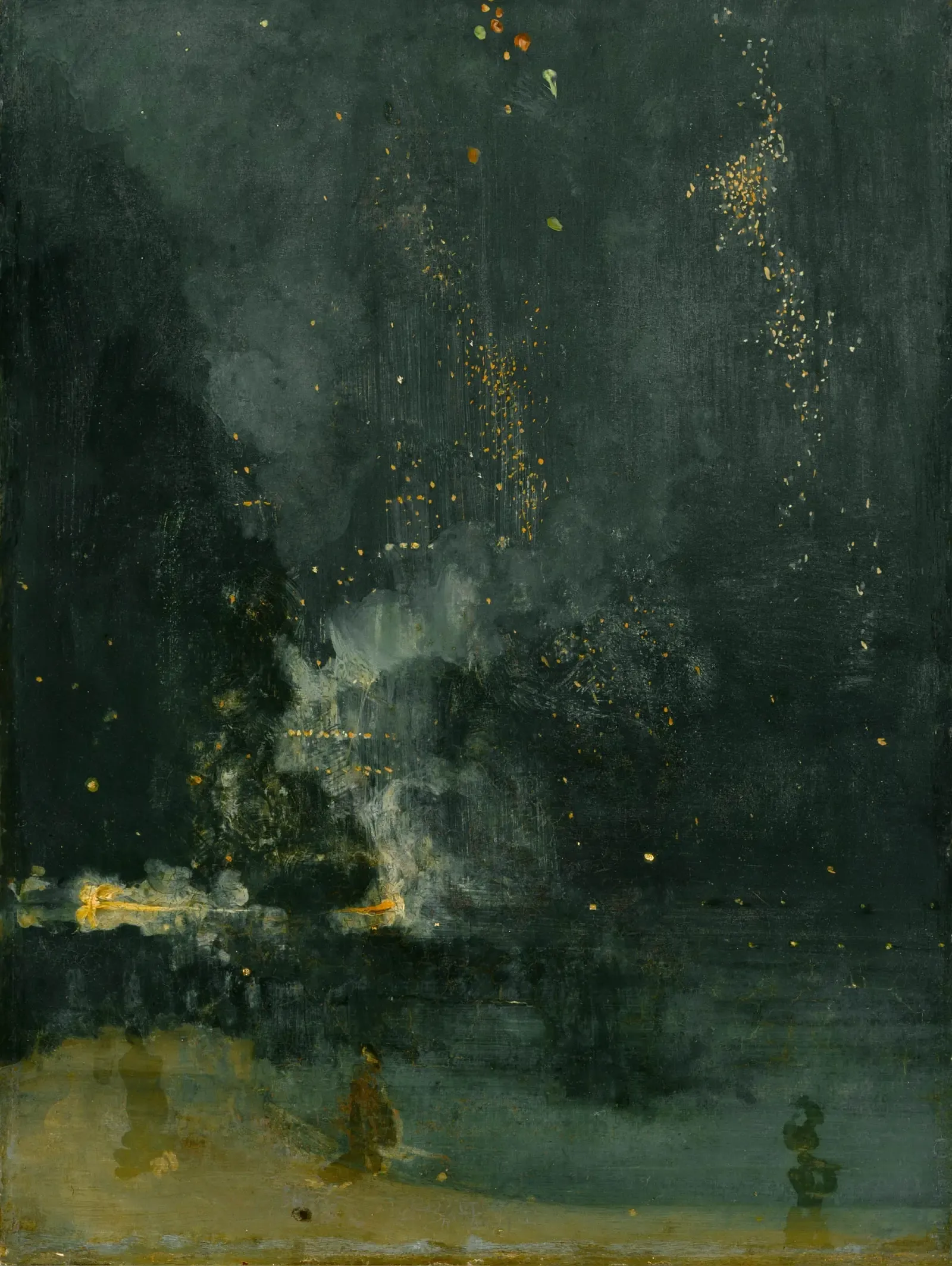
James McNeill Whistler, a visionary artist of the late 19th century, found profound inspiration in the realm of music, drawing a parallel between the auditory and visual arts. The series of paintings known as “Nocturnes” emerged as a testament to Whistler’s belief in the interconnectedness of painting and music. The term “Nocturne,” coined by Whistler himself, not only reflected scenes suggestive of the night but also embodied a dreamy mood akin to the evocative compositions of Chopin’s Nocturnes.
Whistler quite deliberately borrowed his titles from musical vocabulary, calling his paintings “arrangements,” “harmonies,” and “nocturnes” rather than using traditional descriptive titles. This was a bold artistic statement for the 1870s, essentially arguing that painting and music should obey the same abstract, emotional logic. Critics of the time found this deeply confusing, which is perhaps the best endorsement any bold artistic theory could receive.
14. The Birth of Venus – Sandro Botticelli (c. 1484–1486)
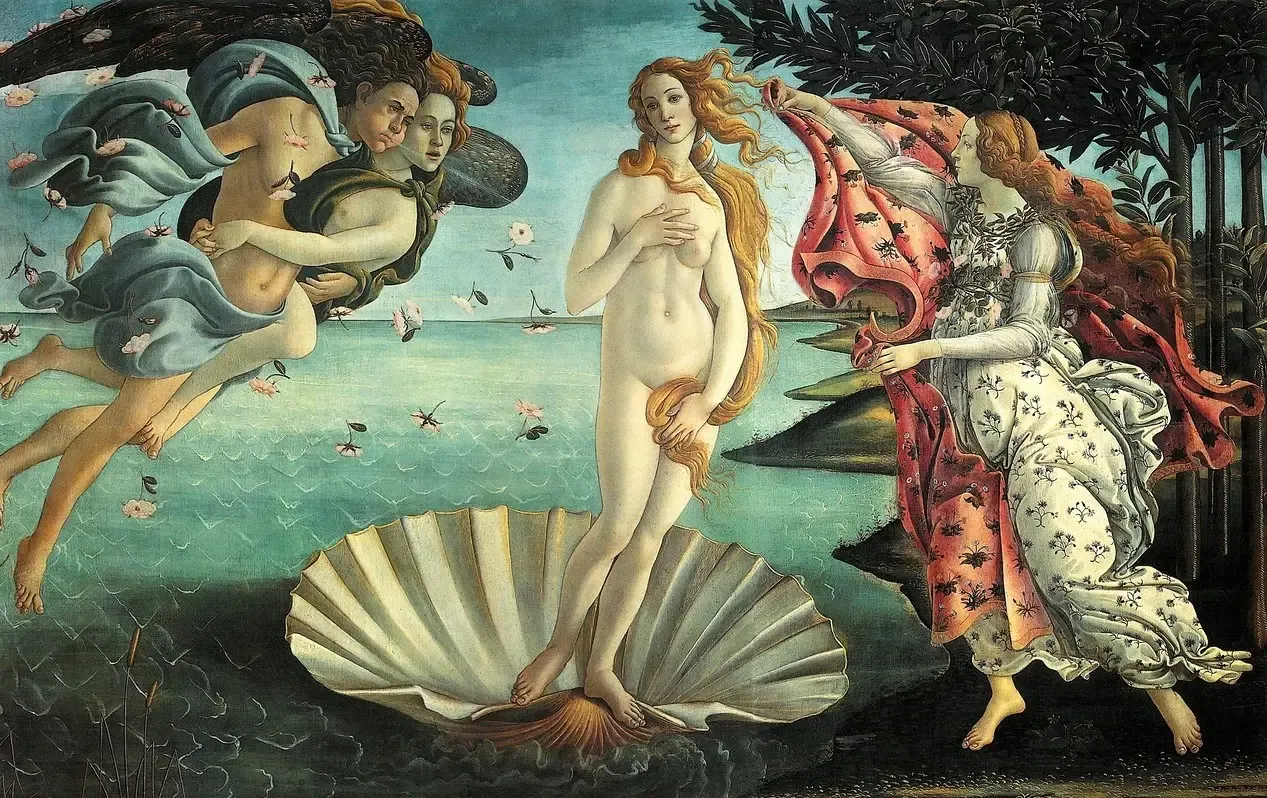
This symphony was inspired by three paintings by Sandro Botticelli: Spring, The Birth of Venus, and The Adoration of the Magi. One of Botticelli’s most famous paintings, Primavera, is an early Renaissance work featuring mythological figures like Venus, Cupid, and Mercury. It is also considered one of the most popular and most controversial paintings in the world. The Birth of Venus itself contains musical undercurrents that are often overlooked.
The figure of Zephyrus, the wind god blowing Venus toward shore, was deeply associated in Renaissance iconography with the breath that animates music. Air, breath, and musical tone were philosophically linked concepts in Neoplatonic thought, which heavily influenced Botticelli’s patrons, the Medici family. The painting is, in a sense, a visual poem about the divine breath that gives birth not just to beauty but to all musical and creative expression. It’s hard to say for sure exactly how deliberate this was, but it is difficult to believe it was entirely accidental either.
15. The Starry Night – Vincent van Gogh (1889)
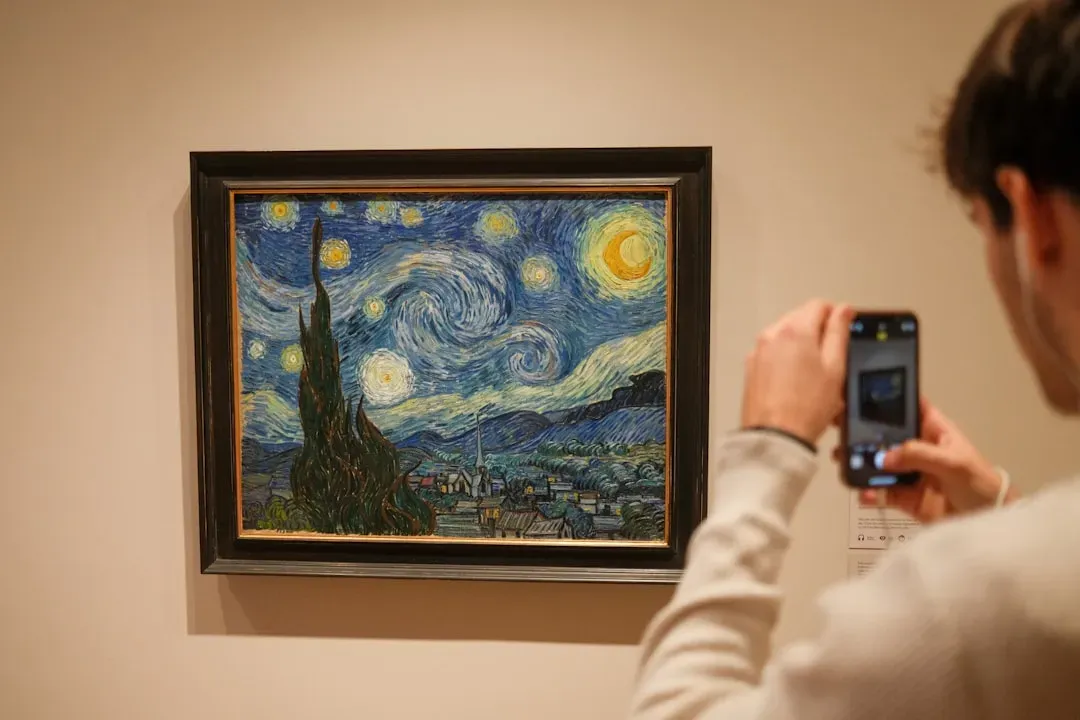
Van Gogh also inspired classical musicians. Henri Dutilleux’s orchestral work “Timbre, Space, Movement” references The Starry Night, and Finnish composer Einojuhani Rautavaara wrote both an opera and a symphony about Van Gogh’s life. The swirling, rhythmic motion of the brushwork in The Starry Night has a deeply musical quality that composers and musicologists have noted for generations.
The undulating lines of the night sky move across the canvas with the cadence of a symphony in full swing, each curve echoing the way sound waves travel through air. Van Gogh himself described his work in musical terms in letters to his brother Theo, mentioning a need that felt akin to religion whenever he painted the stars. There is an undeniable symbiosis between painting and music. The influence of one medium on the other is profoundly apparent in the works of many artists such as Wassily Kandinsky and Paul Klee.
Final Thought
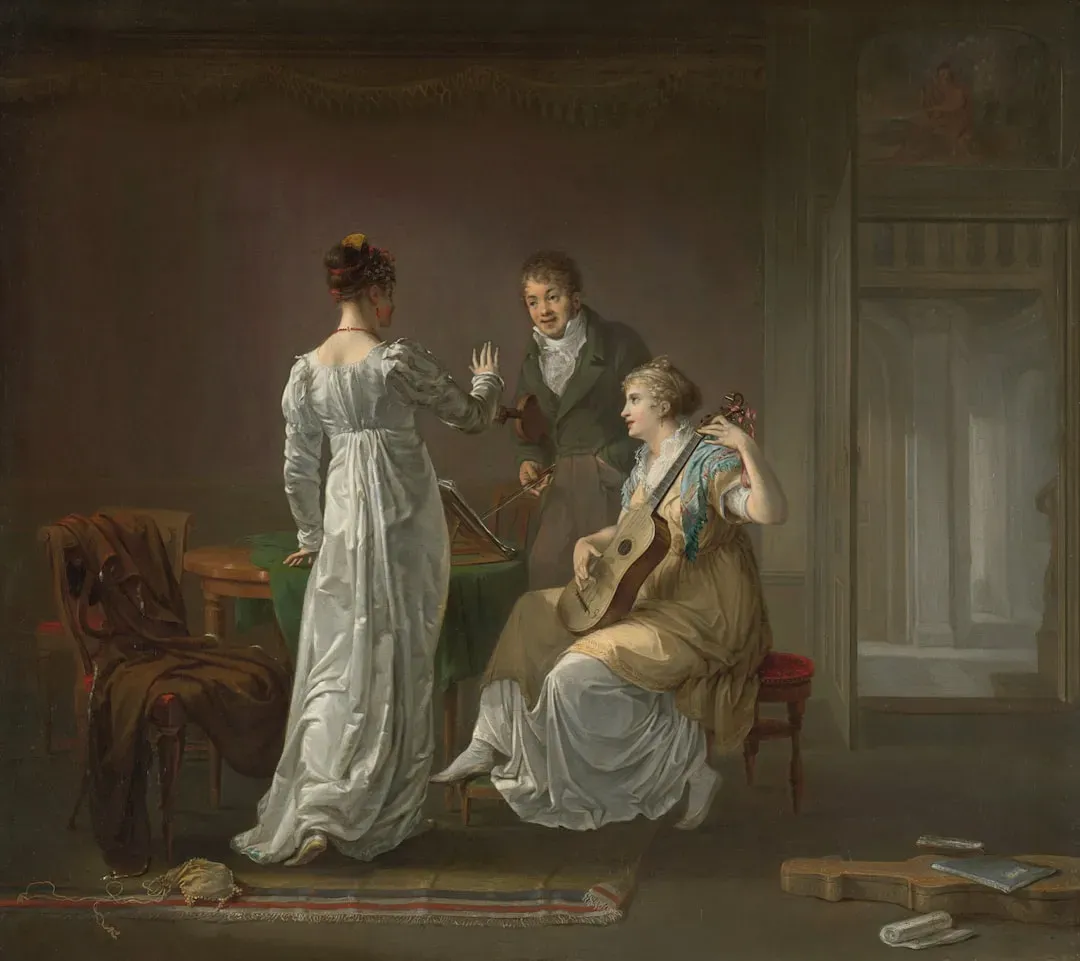
What this gallery of musical secrets tells us is something genuinely profound: the greatest artists in history were rarely working in just one dimension. They were composers of visual experiences, hiding rhythms, melodies, and harmonic codes inside paint and canvas for whoever cared to look closely enough. The bond between art and music has never really been a metaphor. It has always been quite literal.
Next time you stand in front of a famous painting, it might be worth asking yourself: what are you hearing? What do you think is hiding in plain sight in your favorite artwork? Let us know in the comments.
Partner offer
Planning a trip to Vegas?
Compare hotel rates and show tickets on VEGAS.com.