You spend two hours fine-tuning every bullet point. You proofread twice. You feel good about it. Then you hit “submit” and hear absolutely nothing back. No rejection email, no callback, just silence. Here’s the thing: your resume may never have reached a human pair of eyes at all.
The hiring world has changed fast, and most job seekers don’t realize how dramatically the rules have shifted. What triggers a rejection, who (or what) is doing the rejecting, and how you can avoid the traps that are quietly killing your chances – it’s all worth knowing before you send another application. Let’s dive in.
The Scale of AI Screening Is Bigger Than You Think

Let’s start with the numbers, because they’re genuinely staggering. Currently, roughly half of all hiring managers use AI to screen resumes, and by the end of 2025, that number is expected to jump to around eighty-three percent. That’s nearly the entire industry, moving at a pace that most job seekers simply haven’t kept up with.
As of 2025, nearly all Fortune 500 companies use an Applicant Tracking System to filter resumes before human review, and close to half of all organizations globally now use AI specifically for HR tasks. Even small and mid-sized companies are catching up fast.
Currently, roughly one in five companies automatically reject candidates at all hiring stages without any human review, and another half use AI exclusively for rejections during initial resume screening – meaning half of all candidates never have a human being look at their application before being eliminated. That’s not a typo. Half.
The average corporate job posting now receives somewhere between 242 and 257 applications, more than double the 2022 average, and some remote tech roles hit over a thousand applicants within days. With those volumes, employers have handed the first gate entirely over to machines.
Red Flag #1: Unreadable Formatting That Breaks the Parser

Honestly, this one surprises people the most. You might think a beautifully designed resume with columns, icons, and fancy fonts makes you look polished. To an AI parser, it’s complete chaos.
A large share of resumes are filtered out by ATS platforms due to formatting errors or missing keywords, not lack of qualifications. Qualified candidates get silently rejected for avoidable reasons like tables, text boxes, or mismatched phrasing. Think of it like handing your resume to someone who can only read plain text – they won’t see any of those slick design elements.
Using a clean, single-column layout with standard fonts is essential. Avoiding headers and footers for critical contact information, as well as tables, text boxes, images, and special characters, keeps your document readable. Standard section labels that ATS parsers expect help the system work logically, since complex visual designs break the top-to-bottom, left-to-right parsing logic and cause the system to scramble or skip sections entirely.
According to hiring data, nearly three quarters of hiring managers reject candidates due to poor formatting of resumes – and that’s before the AI layer even gets involved. So a confusing layout hurts you twice: once with the machine, once with the human who eventually gets to see what survived.
Red Flag #2: Missing or Mismatched Keywords
Here is where a lot of smart, qualified people get tripped up. AI screening systems don’t intuitively “understand” your experience the way a thoughtful person would. They look for specific language that maps to the job description.
Keyword matching remains foundational in how modern AI systems operate. AI scans resumes for specific skills, experiences, and qualifications from job descriptions. Resume parsing then converts unstructured resume content into structured data, with the AI reading your resume and organizing it into fields like years of experience, education level, specific skills, previous employers, and job titles.
If your resume lacks the exact skills, job titles, or keywords the system is tuned to, your match score will suffer. A mismatch in wording or synonym usage can mean losing points entirely. A real-world example that circulates widely: a tech lead discovered their own company’s ATS was filtering for “AngularJS” when they actually needed “Angular” – two completely different frameworks that a human would naturally connect but an AI treated as unrelated.
ATS systems auto-reject about nine in ten candidates who are even one year below the required experience threshold, with only a small fraction of systems allowing fuzzy matching. Precision in the language you use is not optional anymore.
Red Flag #3: Vague, Generic Language with No Measurable Results


This one stings a little because so many people write this way without realizing it. Phrases like “results-driven professional” or “dynamic team player” are everywhere. They’re also meaningless to both humans and AI systems.
AI tends to produce text that is grammatically correct but overly formal and vague. Phrases like “I am a results-driven professional with a proven track record of success” are common in AI-generated content but lack specificity. When your resume sounds like a template, it scores like one too.
Vague phrasing like “responsible for managing projects” scores lower than specific, outcome-linked language like “led a twelve-person team delivering a two-million-dollar project three weeks ahead of schedule.” That’s not a stylistic preference – it directly affects your algorithmic score.
Research by Enhancv found that more than half of recruiters prioritize numbers that prove impact. Quantified achievements aren’t just nice to have. They’re the difference between landing in the shortlist and disappearing into the void. Think of your resume like a product pitch: if you don’t show the ROI, nobody buys it.
Red Flag #4: Unexplained Employment Gaps

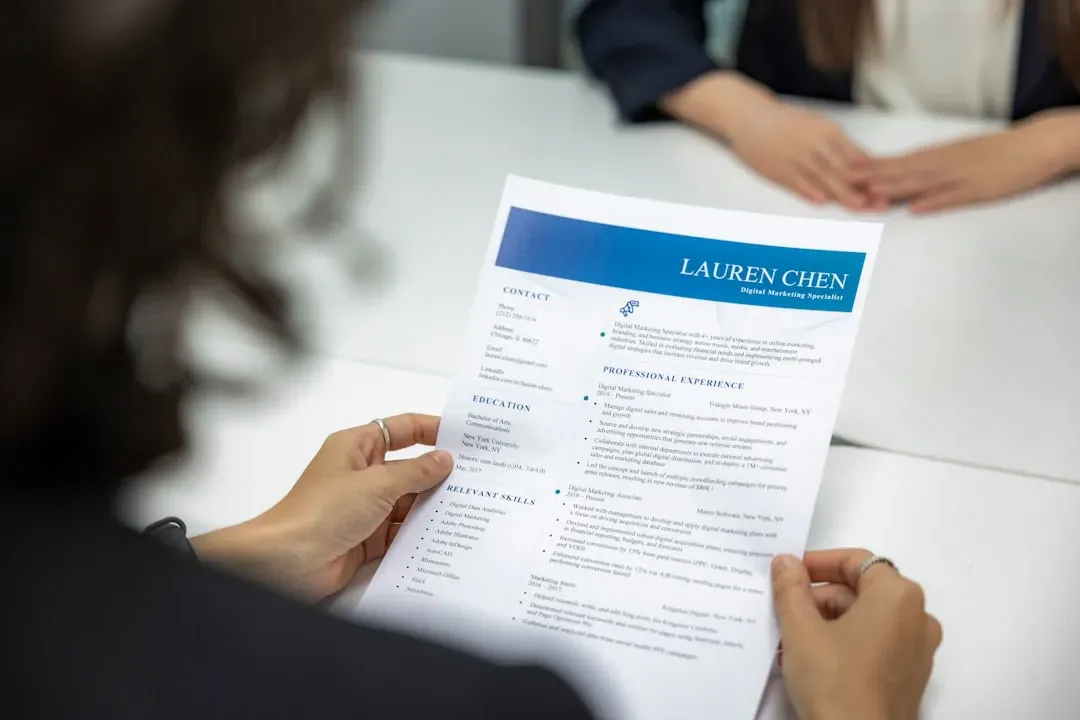
I know it sounds unfair. Life happens. People take time off to care for family members, deal with health issues, travel, retrain, or recover from layoffs. But here’s the cold, uncomfortable truth: AI systems often flag gaps without context.
You may have a good explanation for a gap in your resume, and maybe you even communicate it effectively in your cover letter – but it doesn’t matter if AI rejects you right away. You can work around this by making sure each month is accounted for by providing a brief explanation of what you were doing and learning during that period.
AI tools can miss important context on a resume, such as career gaps or transferable skills. Without a human touch in the hiring process, some candidates with non-traditional backgrounds might get overlooked. The solution isn’t to hide gaps. It’s to frame them clearly so the parser can still calculate your timeline without flagging an anomaly.
Red Flag #5: Obvious AI-Generated Content Without Personalization


Here’s the great irony of 2025 hiring. Companies use AI to screen resumes. Candidates use AI to write resumes. Then the AI screening tool penalizes the candidate for using AI. It sounds absurd, but the data backs it up completely.
About sixty-two percent of employers say AI-generated resumes without customization are more likely to be rejected. Despite the widespread use of AI tools by job seekers, many applicants are submitting generic, impersonal content. The survey this data comes from involved 925 American HR workers, conducted in March 2025.
Stanford University research identified four particularly suspicious words that may indicate AI assistance: realm, intricate, showcasing, and pivotal. The word “delve” has become another red flag after appearing in countless AI-generated cover letters. These aren’t just stylistic tells anymore – some systems are specifically trained to detect them.
Hiring managers can detect AI-generated patterns within twenty seconds, according to TopResume survey data from May 2025. Over a third of hiring managers reported they could spot AI-generated resumes that quickly. Using AI to assist your writing is fine – using it to replace your writing entirely is a fast track to the reject pile.
Red Flag #6: Keyword Stuffing and Invisible Text Tricks

Some job seekers have started getting creative in ways that backfire spectacularly. One popular TikTok trend involved hiding blocks of job description text in white font at the bottom of a resume, invisible to readers but visible to ATS systems. It doesn’t work the way people hope.
While it’s important to include keywords, some candidates overstuff their resumes with keywords in an attempt to trick the system. Some ATS software can actually spot keyword stuffing and may even flag those resumes as spam. So the very trick designed to get you noticed gets you discarded instead.
ManpowerGroup, the largest staffing firm in the US, told The New York Times it detects hidden text in approximately a hundred thousand resumes annually, about ten percent of all resumes it scans with AI. Greenhouse, which processes around three hundred million resumes per year, found that about one percent contained white text messages in the first half of 2025.
The idea that keyword stuffing guarantees success is a myth. Modern ATS uses context-based parsing, not raw keyword counts. Weaving relevant terms naturally into real descriptions of real work beats any hidden text scheme, every single time.
Red Flag #7: Unprofessional or Mismatched Digital Presence
Your resume doesn’t exist in a vacuum. About forty-two percent of companies scan social media or personal websites as part of the hiring process. That means what’s happening outside your resume document matters, sometimes a great deal.
According to ResumeGo, candidates who include a link to an active LinkedIn profile get seventy-one percent more interviews than those who don’t, yet less than half of job seekers include one. That’s an enormous missed opportunity sitting right there on the table.
According to data from Motley Fool, roughly three in ten resumes are disregarded by recruiters for having an unprofessional email address. It sounds almost comically minor, but it signals carelessness before the reader has absorbed a single line of your experience. A first impression is still a first impression, even for a machine scanning text at a fraction of a second.
There is also an increasing number of digital platforms leveraging AI to scan a candidate’s social media footprint, helping employers instantly gain a broader picture of the candidate as a whole person. Cleaning up inconsistencies between your resume and your LinkedIn profile, and making sure your public social presence tells a coherent professional story, is no longer optional.
The Bias Problem Nobody Talks About Enough

Here’s something that deserves a serious mention. AI screening isn’t just eliminating poorly formatted resumes or vague language. Research shows it is absorbing the biases baked into historical hiring data and amplifying them at scale.
A 2024 study found that large language model screeners favored white-associated names in the vast majority of cases and male-associated names in nearly nine out of ten cases. Resumes with Black male-associated names were disadvantaged in up to every single test case. These aren’t fringe findings.
About fifty-six percent of companies are worried that AI could screen out qualified candidates, and forty-six percent fear that AI may introduce bias based on factors such as age, gender, or race. Companies know the problem exists and are still using these systems, largely because the volume of applications leaves them little practical choice.
In July 2024, a US federal judge allowed a major class action lawsuit against Workday to proceed, with the court ruling that Workday could be held liable as an agent of its employer clients, opening the door for software companies to face legal consequences for discriminatory algorithms. The legal landscape is finally catching up, but slowly.
What 88% of Employers Quietly Admit About Their Own Systems

This is the statistic that should make every job seeker feel both frustrated and, strangely, a little relieved. The systems working against you are also frustrating the people running them.
Perhaps most frustrating for job seekers, roughly eighty-eight percent of employers believe ATS systems screen out highly qualified candidates due to formatting issues or missing keywords. This means companies know their systems are rejecting good candidates yet continue using them due to volume pressures. It’s a trap everyone is aware of, and no one has quite figured out how to escape.
The overwhelming culprit behind “ghosted” applications is sheer volume, with high-demand roles attracting four hundred to over two thousand applicants in just days. That context matters. This isn’t a targeted conspiracy against your resume specifically. It’s a flood management problem, and your document is just one of many trying to get through a very narrow opening.
Research indicates that applying within the first forty-eight to seventy-two hours significantly boosts visibility, as many hiring teams pause postings or fill shortlists early. Timing, it turns out, is one of the most underrated variables in the entire equation.
Conclusion: The Rules Changed. Your Resume Needs to Catch Up.

The hiring game in 2026 rewards people who understand how algorithmic screening actually works – not people who worked the hardest on their resume or have the most impressive credentials on paper. It rewards clarity, specificity, proper formatting, and genuine personalization.
Avoid complex layouts, vague language, unexplained gaps, and AI-flavored phrasing that sounds like it came from a content generator. Mirror the specific keywords in each job description. Show numbers. Apply early. Make sure your digital presence is consistent and professional. These aren’t hacks – they’re just the new baseline.
The uncomfortable truth is that a beautifully crafted human story can still get buried if it’s wrapped in the wrong formatting or missing three keywords. The system isn’t perfect. But knowing how it works puts you ahead of most of the competition. What would you do differently on your next application after reading this?