Science fiction gets labeled as prediction more often than it deserves. Most authors weren’t trying to forecast anything, they were using invented gadgets to talk about the people around them. Still, a handful of books landed remarkably close to inventions that arrived decades later.
What follows is a gallery of nine novels, each paired with a technology it described before engineers built it. Some matches are strikingly direct. Others are looser, and I’ve tried to say so where that’s the case.
From the Earth to the Moon by Jules Verne

Published in 1865, this novel follows a group of Americans who launch a crewed projectile toward the Moon. Verne set the launch in Florida, not far from where NASA’s Apollo missions would later lift off. He also gave the crew a three-person capsule, which echoes the size of the Apollo crew.
The method, a giant cannon, wouldn’t work in reality, since the acceleration would be fatal. Yet the broader idea of a organized, publicly funded lunar expedition proved prescient. Treat it as a spirit match rather than an engineering blueprint.
Looking Backward by Edward Bellamy

Bellamy’s 1888 novel sends a man to the year 2000, where he finds a society that uses something resembling credit cards. Citizens receive a card that represents their yearly share of the national output, and they spend against it at public warehouses. It isn’t quite the same as a bank card, but the concept of paying with a card instead of cash is clear.
The book also describes music piped into homes from central sources, which sounds a lot like modern streaming or radio. Bellamy’s politics drew most of the attention at the time. The small consumer details are what read as uncanny today.
Ralph 124C 41+ by Hugo Gernsback

Gernsback serialized this story in 1911 in his magazine Modern Electrics, and it’s packed with devices. It features a type of radar, with radio pulses reflected off objects, along with video calls and solar power. The prose is clunky, and critics have long said so.
As a catalog of ideas, though, it’s hard to beat. Gernsback later became so influential that the Hugo Awards are named for him. His fiction worked as a kind of imagination lab for the technologies he loved.
Brave New World by Aldous Huxley

Huxley’s 1932 novel imagines babies grown outside the body in bottles and a society shaped by reproductive technology. In vitro fertilization became a real medical practice in 1978, when Louise Brown was born in England. The real thing is very different in purpose, since it helps families conceive rather than manufacturing a social order.
The book also describes sleep learning and mood-regulating drugs, ideas that echo modern debates about psychiatric medication. Huxley wasn’t predicting a lab procedure so much as warning about where biotechnology could be steered. The overlap with IVF is real, but it’s a partial one.
Nineteen Eighty-Four by George Orwell
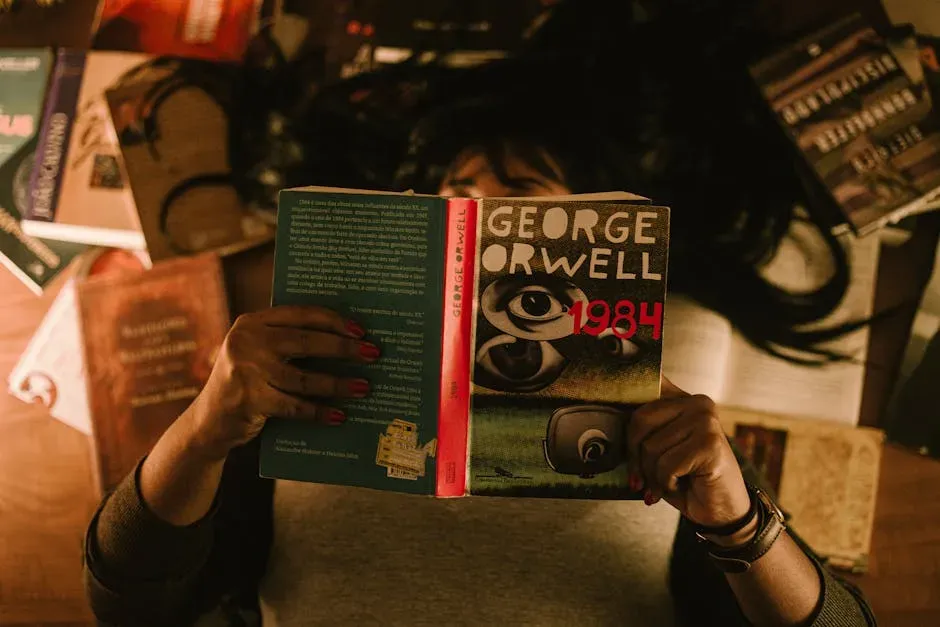
Orwell’s 1949 novel introduced the telescreen, a device in homes that broadcasts to viewers while also watching them. Modern smart TVs, voice assistants and networked cameras have revived that comparison again and again. The parallel is imperfect, because today’s devices are mostly bought voluntarily and run by companies, not a single state.
Even so, the book’s central worry about pervasive surveillance has stayed relevant. Governments and firms now have tools for tracking that Orwell could only gesture at. His imagined hardware was simple, but the underlying concern was well aimed.
Fahrenheit 451 by Ray Bradbury

Bradbury’s 1953 novel features tiny radio earpieces called Seashells, which people wear to block out the world. Anyone who has watched commuters in wireless earbuds will recognize the scene. The book also has giant wall-sized television screens that pull viewers into scripted programs.
Bradbury himself said the book was about censorship and the decline of reading, not television. Still, his picture of constant, immersive media has aged unusually well. Home theaters and large flat screens now sit in countless living rooms.
2001: A Space Odyssey by Arthur C. Clarke

Clarke’s 1968 novel, developed alongside Stanley Kubrick’s film, includes a talking computer called HAL 9000 and a pair of astronauts who use flat, tablet-like screens, which the book calls Newspads. Clarke had also written earlier, in 1945, about communications satellites in geostationary orbit. That idea became real, and the orbit is sometimes called the Clarke Belt in his honor.
Conversational AI has moved quickly in recent years, and voice assistants and chatbots now handle natural language in ways HAL’s creators would have admired. HAL’s murderous turn remains fiction. The tablet comparison is the cleanest hit, as modern slate devices closely resemble what the book describes.
Neuromancer by William Gibson

Gibson’s 1984 debut gave the world the word cyberspace, which he used for a shared digital realm that users could enter. He wrote it on a manual typewriter, with only a loose sense of how computers worked. The book appeared before the public internet existed in any familiar form.
The term stuck, and it shaped how people talked about networks for decades. Today’s virtual reality headsets and persistent online worlds owe something to the mood he created. Gibson’s matrix isn’t the web, but the cultural vocabulary he supplied has been durable.
Snow Crash by Neal Stephenson

Stephenson’s 1992 novel describes the Metaverse, a shared virtual world where people appear as avatars. Both words, metaverse and avatar in its digital sense, spread widely thanks to the book. The term gained fresh attention in 2021, when Facebook renamed itself Meta and committed to building such spaces.
Whether the real thing will resemble Stephenson’s version remains an open question, since adoption of consumer virtual worlds has been uneven. The book also features a mapping program much like Google Earth, which arrived in the 2000s. Together, the two ideas make it one of the more influential vocabulary donors in tech.