


She was born Norma Jeane Mortenson in a charity ward in Los Angeles. She spent most of her childhood moving between foster homes, an orphanage, and uncertain guardianship. Nobody looking at that young girl in 1926 would have predicted the most recognizable face of the 20th century. Yet within three decades, the name Marilyn Monroe would be synonymous with glamour, desire, and mystery on a scale the world had never quite seen before.
The truth is, none of it was accidental. Every curl, every whisper, every carefully chosen film role was part of a construction so thorough it eventually swallowed the real woman entirely. The story of how that image was built, layer by layer, is fascinating, complex, and in some moments, genuinely shocking. Let’s dive in.
The Birth of a Name: From Norma Jeane to Marilyn Monroe

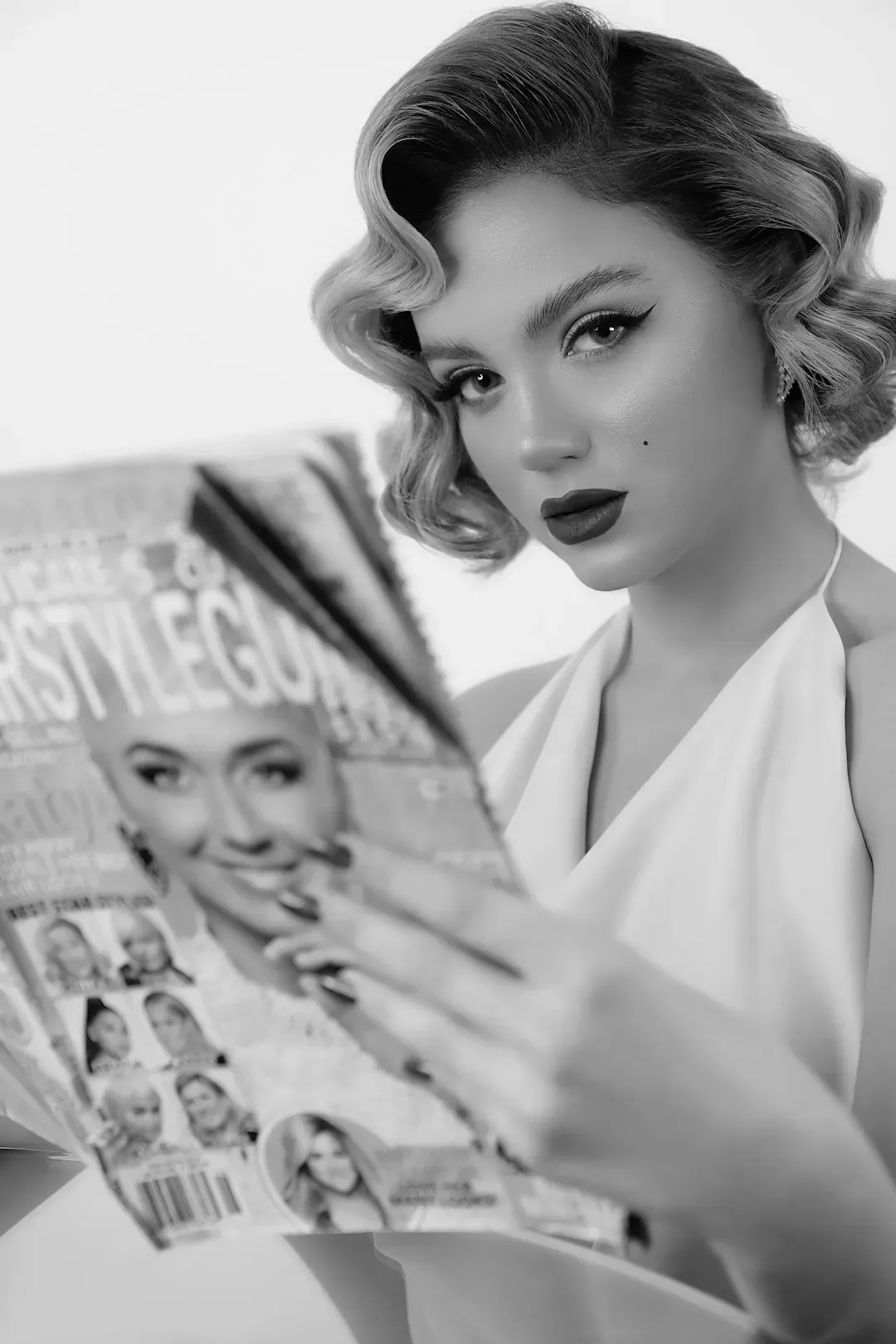
The very first act of image crafting was something as simple as a name. The name “Marilyn Monroe” emerged thanks to Hollywood executives wanting something more marketable than the humble, girl-next-door “Norma Jeane.” “Marilyn,” reminiscent of Broadway star Marilyn Miller, and “Monroe,” a family name, collectively offered an easy-to-pronounce moniker that exuded classic star quality. The name itself was a product before the person had even set foot on a movie set.
With the name change suggested by studio executives, Marilyn Monroe dyed her hair platinum blonde, reinvented her voice, studied acting tirelessly, and her image. Think about that for a moment. She didn’t just change her hair color. She changed her entire identity from the ground up, like a building being demolished and rebuilt according to someone else’s blueprint.
She signed away part of herself in exchange for stardom. Yet as her persona took shape, so too did the mythic power behind the Marilyn Monroe brand – a woman who seemed approachable yet irresistibly tantalizing.
The Physical Transformation: Hair, Makeup, and the Face She Built

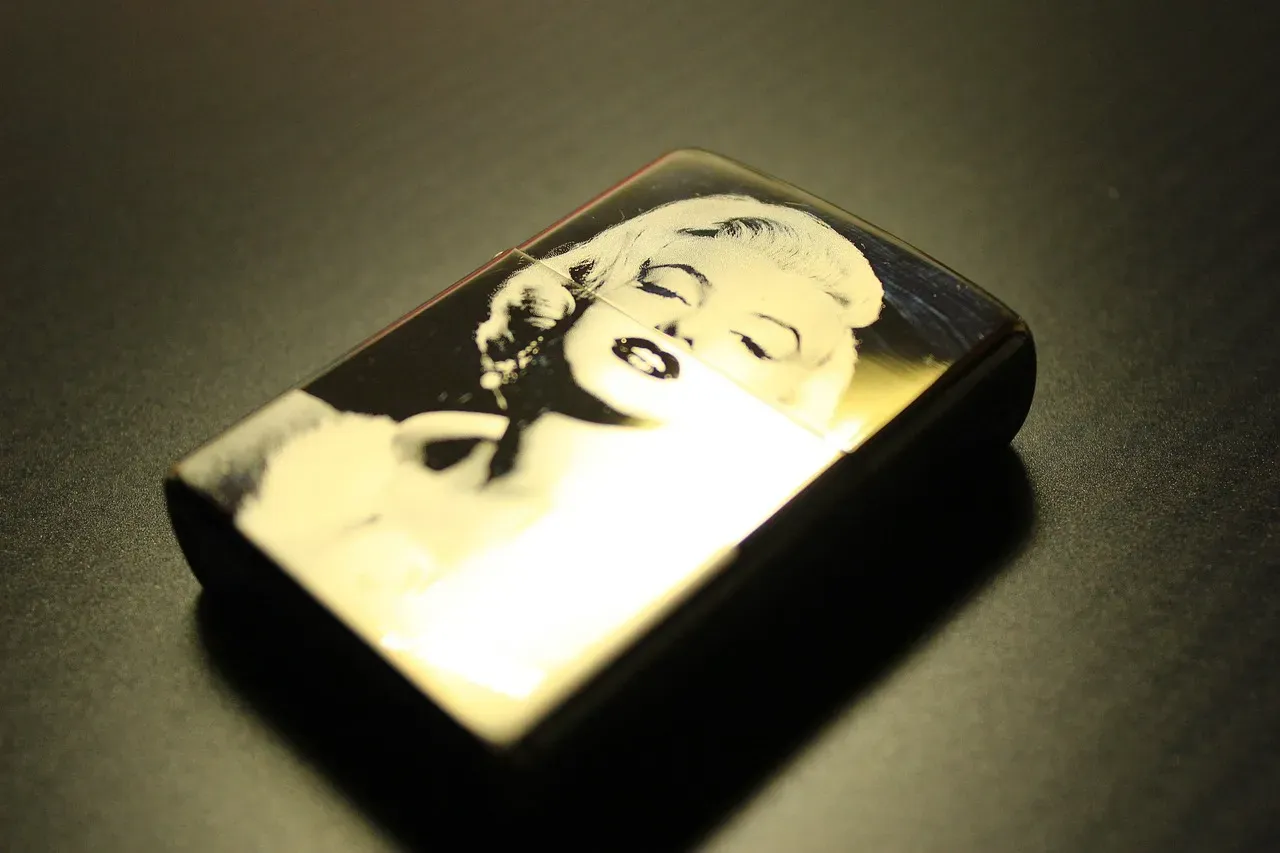
Honestly, it’s easy to assume Monroe simply won the genetic lottery. The reality is far more deliberate. Marilyn collaborated with various photographers, stylists, and makeup artists to curate her image. She her signature look, characterized by platinum blonde hair, red lips, and a figure-hugging wardrobe that accentuated her curves.
Her iconic “bedroom eyes,” an effect achieved with makeup techniques such as black liquid liner on the upper and lower lash lines, highlighted her captivating gaze. Beyond cosmetics, the physical transformation reportedly went even further. Evidence from auctioned medical records, X-rays, and notes from renowned plastic surgeons suggests that Monroe had cosmetic surgery on her chin and nose, revealing a carefully curated image that was crafted, at least in part, through surgical enhancements.
Marilyn Monroe was also notorious for undergoing electrolysis, removing her widow’s peak to change her face shape. According to Monroe’s medical records, when she returned to a surgeon’s office in 1958, nearly a decade after her alleged chin graft, she used then-husband Arthur Miller’s surname to cover her tracks. Every detail, right down to her hairline, was adjusted and engineered with precision.
The Voice That Was Trained, Not Born
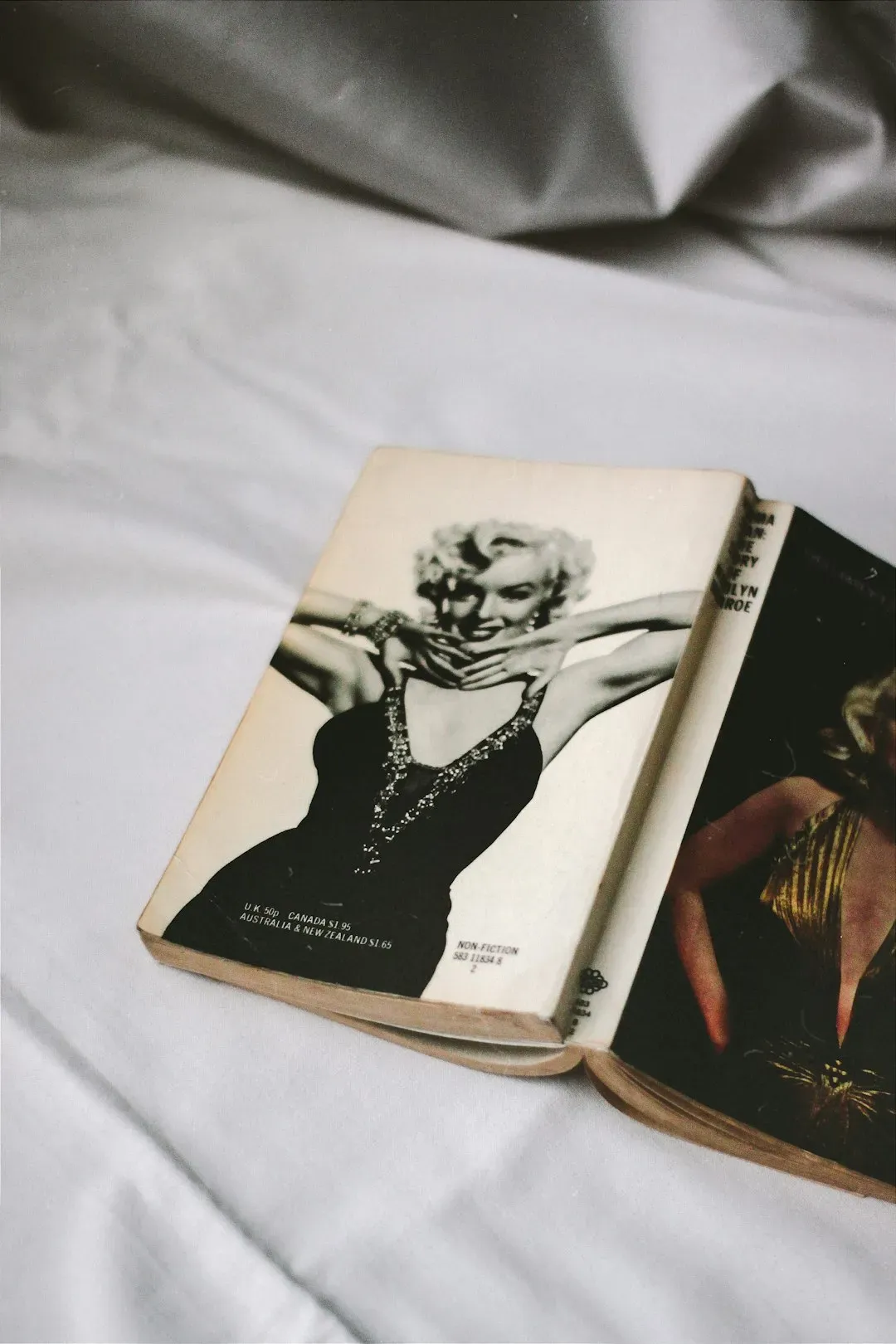
That breathless, whispering voice is one of the most imitated sounds in pop culture history. Here’s the thing most people don’t realize: it wasn’t how she naturally spoke. Due to circumstances that shaped her as a child, Monroe had a stutter, according to The Stuttering Foundation. Vogue reported she worked with a speech therapist to improve her stutter, and together they developed the breathy style of speaking that she continued to use into adulthood.
Marilyn’s voice was created in part by her drama coach, Natasha Lytess. The emphasis on certain letters in words gave her a clipped tone, and she also slowed her natural voice down deliberately. What most people hear as sultry and effortless was actually a coping mechanism that became a brand signature.
Her stutter returned occasionally when Monroe was an adult. When she was filming “Something’s Got to Give,” she was so stressed by studio infighting and personal issues that her stutter came back. This led to Monroe botching many of her lines and requiring multiple takes of her scenes, according to Vogue. The performance, even in her final moments on set, was one she had to fight to maintain.
The Dumb Blonde Was Always Just a Role
Although Monroe’s screen persona as a dim-witted but sexually attractive blonde was a act, audiences and film critics believed it to be her real personality. This became a hindrance when she wanted to pursue other kinds of roles, or to be respected as a businesswoman. Let’s be real: few pieces of image-making in Hollywood history have been this effective, or this damaging to the person behind the mask.
Monroe may have been perceived as a ditzy blonde but she was well read, owning over 400 books. The academic Sarah Churchwell, who studied narratives about Monroe, argued that “the biggest myth is that she was dumb. The second is that she was fragile. The third is that she couldn’t act. She was far from dumb, although she was not formally educated, and she was very sensitive about that. But she was very smart indeed – and very tough. She had to be both to beat the Hollywood studio system in the 1950s.”
Biographer Lois Banner writes that Monroe often subtly parodied her sex symbol status in her films and public appearances, and that “the ‘Marilyn Monroe’ character she created was a brilliant archetype, who stands between Mae West and Madonna in the tradition of twentieth-century gender tricksters.” She was playing a character. A brilliant, calculated, and exhausting one.
The Studio System That Packaged Her

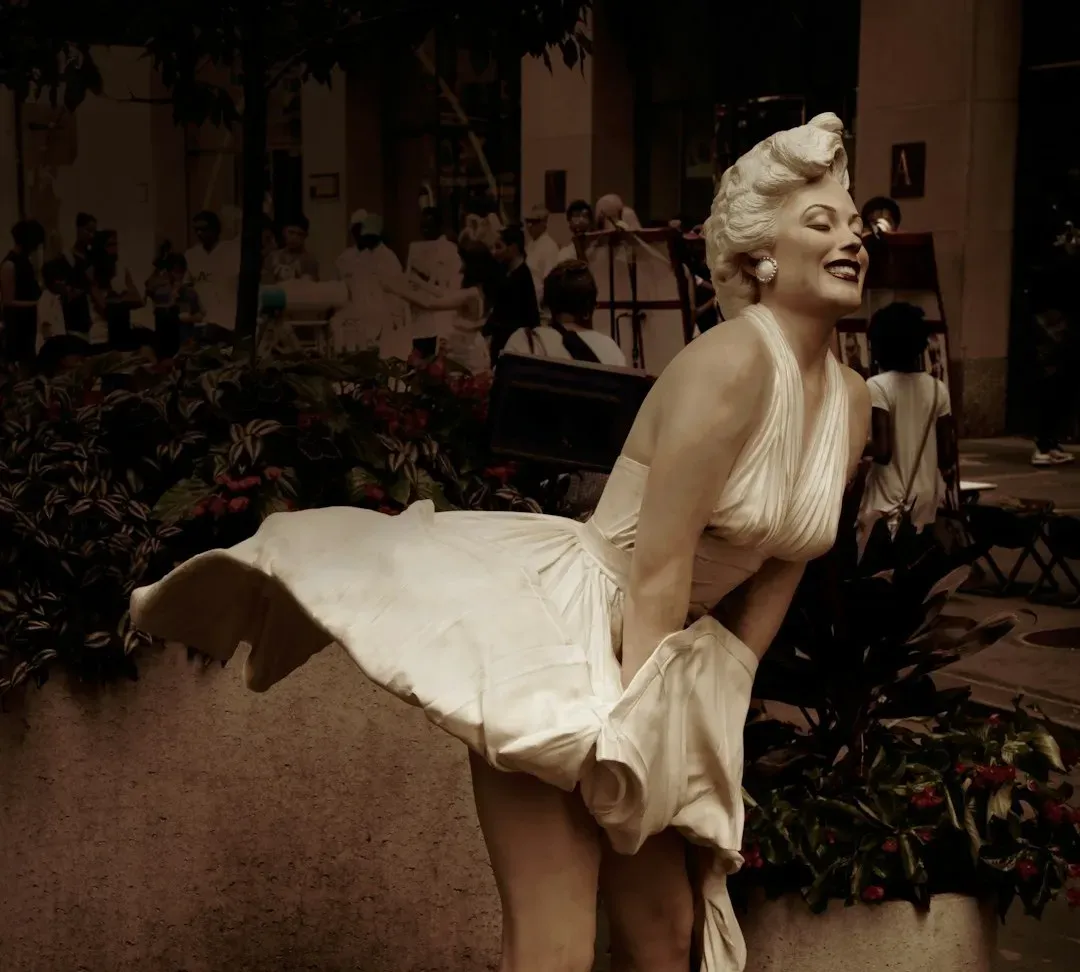
Monroe’s image was meticulously crafted through both film and publicity, often relying on suggestive still photography to enhance her persona. In the 1950s, the Hollywood studio system was a machine, and stars were its products. In Hollywood, producers worked with studio executives including in-office publicists to put out personal information about potential stars through magazines, newspapers, radio, and television.
Monroe arrived on the scene at a time when the studios wielded total power over their performers. Once signed, a performer’s say in matters was relegated to the bottom of the pile. It would be the studio that decided your fate, and ultimately, it would be their decision that could make you a star.
By the mid-1950s, Monroe stood for a brand of classless glamour, available to anyone using American cosmetics, nylons, and peroxide. Twentieth Century-Fox further profited from her popularity by cultivating several lookalike actresses, such as Jayne Mansfield and Sheree North. She had become a template, copied and replicated like a consumer product.
Photography and the Deliberate Crafting of an Icon

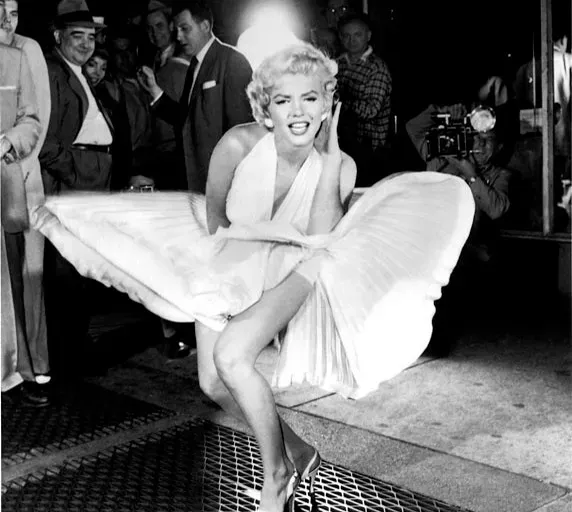
Countless renowned photographers sought to capture the “real” Monroe, and she knew the power that the camera held. Today, we’re more aware that our favorite celebrities maintain a public image, but Monroe’s enigma still fascinates us. Photography was the engine behind her myth. It wasn’t passive. She actively worked with the lens.
Fashion historian Caroline Young notes that Monroe put forth a on-screen persona that was sexy, glamorous, and glitzy. This is the side of Monroe that was most heavily documented and that’s what we most associate with her style, even though it did not necessarily reflect Monroe’s actual wardrobe.
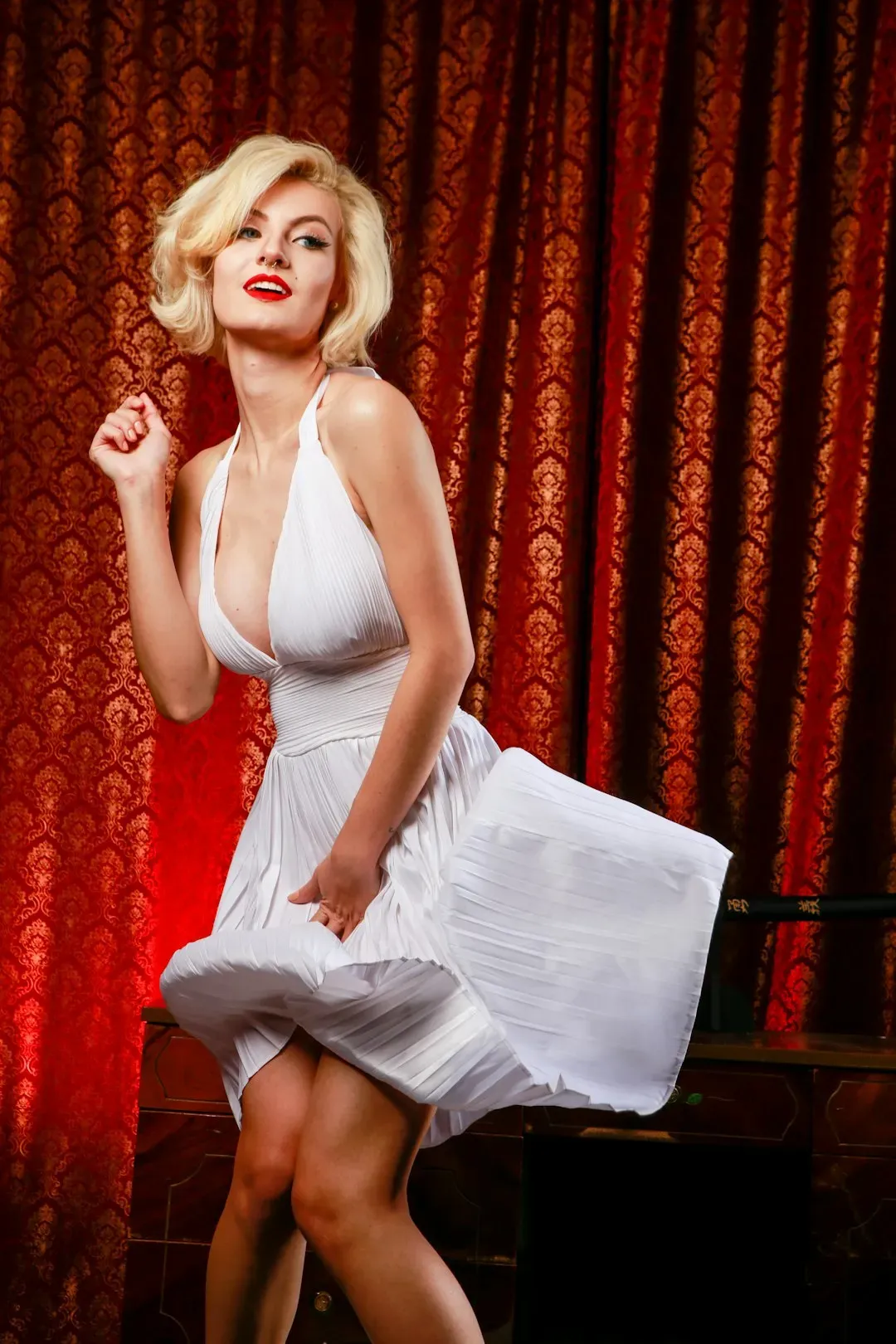
While in her downtime, Monroe preferred slacks and turtlenecks or simple sheath dresses, it’s the images of her in striking outfits on red carpets or in classic on-screen moments – like when her white dress billowed out as she stood over a subway grate for the filming of The Seven Year Itch – that are much more widespread. The camera froze her forever in the version of herself she had constructed for the world.
The Seven Year Itch and the Ultimate Image Moment

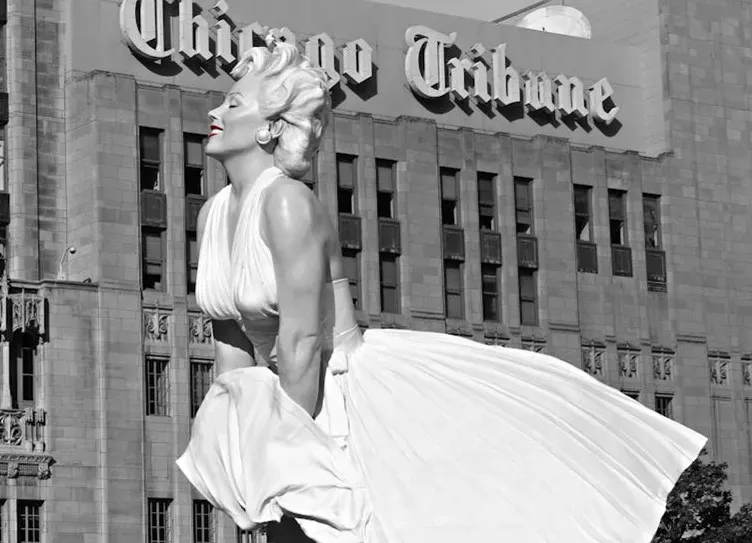
I think it’s fair to say that no single moment cemented an image quite like that street corner scene. The release of “The Seven Year Itch” in 1955 marked a pinnacle in her career, highlighted by the famous skirt-blowing scene that captivated audiences and became emblematic of her allure.
When it comes to Billy Wilder, the myth of Monroe gets its ultimate image thanks to “The Seven Year Itch.” You know the one: the superstar in the white dress standing on the vent. In that moment alone, history was made, and Monroe was written into it, providing one of the most iconic images in pop culture that also captures exactly what the myth was and who Monroe is: seductive yet utterly knowing and aware of how to use that for her own power.
The swirl of press coverage around the “dress scene” in “The Seven Year Itch” showed how the public used her for their own indulgence. That evening, her carefully orchestrated coquette persona was on full display. The scene wasn’t accidental. It was, in every sense, a performance within a performance.
Her Own Role in Building the Brand

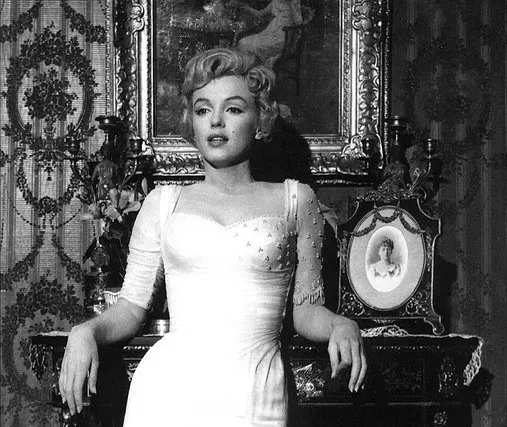
Here is where things get genuinely nuanced. Monroe wasn’t purely a passive object shaped by others. From the beginning, Monroe played a significant part in the creation of her public image, and towards the end of her career exerted almost full control over it. She was, in many ways, her own best publicist.
Some, such as Gloria Steinem, have viewed Monroe as a victim of the studio system. Others, such as Molly Haskell, Jacqueline Rose, and Sarah Churchwell, have instead stressed Monroe’s proactive role in her career and in the creation of her public persona. The truth almost certainly lies in the middle, which makes her story even more compelling.
If men wanted the fantasy, and if the fantasy made money, she decided to set about becoming it, using their predictable desire to earn herself financial freedom, a powerful career, and power. That’s not victimhood. That’s strategy. Uncomfortable, costly strategy, but strategy nonetheless.
Breaking Free: Marilyn Monroe Productions and the Fight for Control
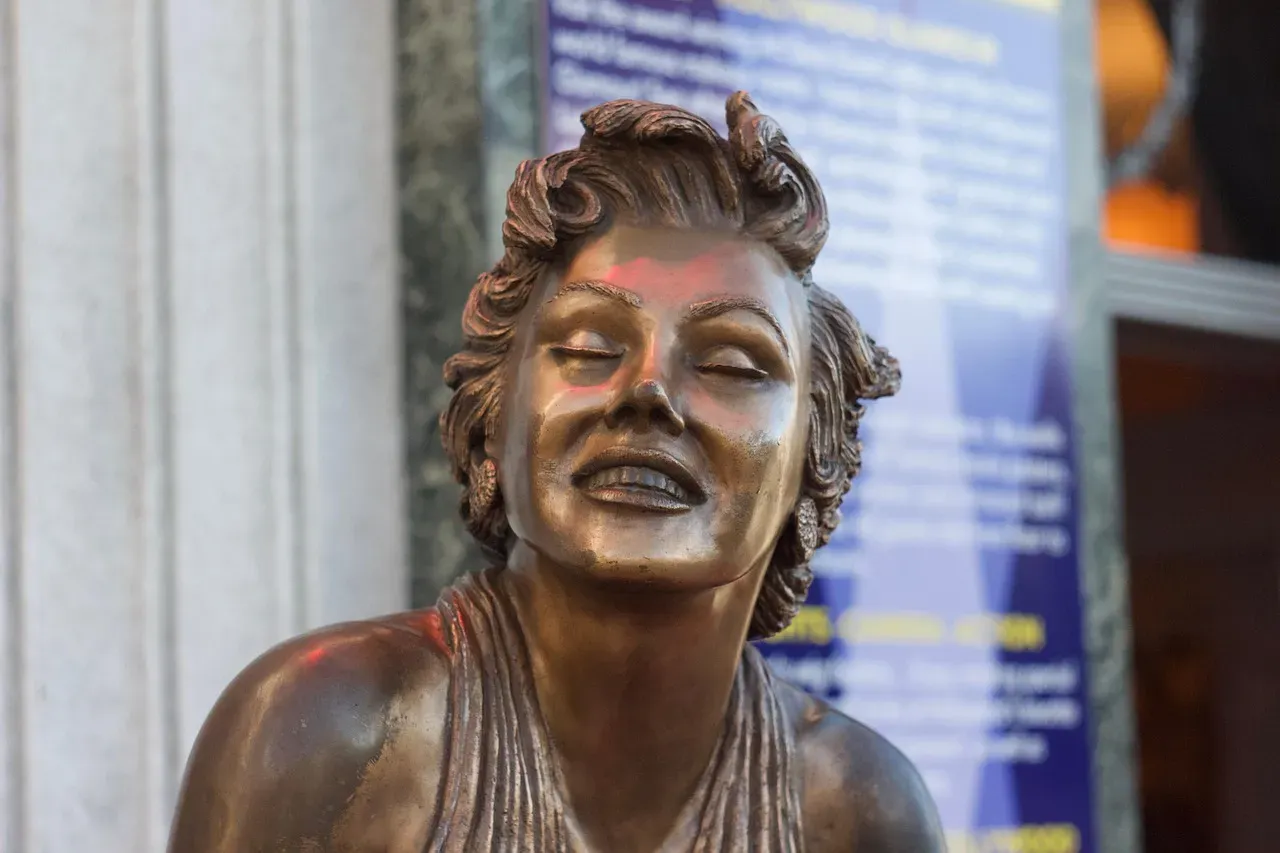
Perhaps the least told chapter of Monroe’s image story is the one where she tried to reclaim it entirely. In a bold move for independence, Monroe founded her own production company, Marilyn Monroe Productions, in 1955, becoming one of the first women in Hollywood to do so.
The Hollywood studio system that had an ironclad hold over its stars since the 1930s was already in a period of decline. Monroe’s founding of her own production company was considered a major blow to the studio system as it once was. It gave her a nearly unmatched power, allowing a star of her stature to control her own career rather than being at the mercy of a capricious studio.
An agreement was ultimately reached: Monroe would be given more say over what scripts she agreed to, as well as who the director and cinematographer would be. Additionally, her pay was increased to $100,000 per film, and she only had to commit to making four pictures for the studio over the next seven years. For the first time, the woman behind the image held genuine power over it.
The Legacy of a Manufactured Icon: Then and Now

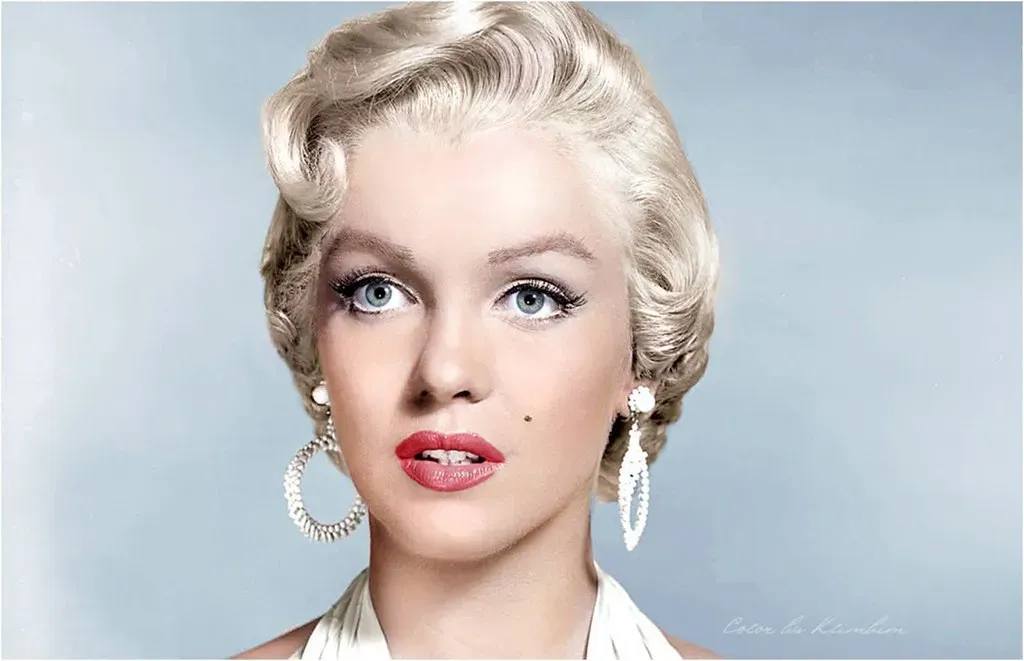
Marilyn Monroe remains an enduring icon decades after her passing, captivating the collective imagination with her radiant smile, sultry charm, and an almost otherworldly allure. She didn’t just rise to fame – she constructed a persona so powerful that the Marilyn Monroe brand still thrives in films, fashion, and beauty lines today.
Monroe’s image and name have been licensed for hundreds of products, and she has been featured in advertising for brands such as Max Factor, Chanel, Mercedes-Benz, and Absolut Vodka. The brand outlived the woman by more than six decades and shows no signs of fading. She was a top-billed actress for a decade, and her films grossed $200 million, equivalent to $2 billion in 2025, by her death in 1962.
As one commentator observed, the culture we live in reduces women to caricatures. With Marilyn, that’s easy to do because of her damage and the roles she played, allowing people to make money off a bimbo image. It’s so much easier to just go along with that cliché than it is to do the work of understanding who she really was. Marilyn was always trying so hard to be seen for who she really was, someone who loved to read and who loved to create and who had incredible ideas.
The image won. It almost always does. The question that lingers, quietly, long after you think you’ve moved on from it, is this: did Marilyn Monroe build the myth, or did the myth eventually consume the woman entirely? What do you think? Share your thoughts in the comments.


