
Most people, if given the choice between a guaranteed $50 and a coin flip for $100, will take the sure thing. That much is not surprising. What’s stranger is how deeply the fear of losing shapes choices even when the math clearly favors the gamble. We’re not just cautious about money. We’re wired, in a measurable and fairly predictable way, to feel the pain of a loss far more intensely than the pleasure of an equivalent gain.
This isn’t a personality quirk or a sign of weakness. It’s one of the most well-documented patterns in behavioral science, with decades of evidence pointing to the same basic conclusion: losing something hurts more than gaining the same thing feels good. Understanding why this happens, and how it quietly shapes everything from investment decisions to the wording of an advertisement, is genuinely useful.
The Founding Research That Changed Economics

One of the most influential studies on loss aversion was written by psychologists Daniel Kahneman and Amos Tversky in 1979, titled “Prospect Theory: An Analysis of Decision Under Risk.” It introduced the concept of loss aversion and presented evidence supporting the idea that people experience a greater emotional impact from losses than from gains of equivalent value.
Prospect theory was developed by Kahneman and Tversky in 1979, and the theory was cited in the decision to award Kahneman the 2002 Nobel Memorial Prize in Economics. Based on results from controlled studies, it describes how individuals assess their loss and gain perspectives in an asymmetric manner. For some individuals, the pain from losing $1,000 could only be compensated by the pleasure of earning $2,000.
The Loss Aversion Coefficient: What the Numbers Actually Say

Empirically, losses tend to be treated as if they were twice as large as an equivalent gain. That figure has become one of the most cited numbers in behavioral economics, though it’s worth knowing where it comes from. A large-scale, interdisciplinary meta-analysis systematically accumulated knowledge from numerous empirical estimates of the loss aversion coefficient from 1992 to 2017, examining 607 empirical estimates from 150 articles across economics, psychology, neuroscience, and other disciplines. The mean loss aversion coefficient found was approximately 1.955.
Experimental studies typically measure the loss-aversion coefficient between 1.5 and 2.5, meaning a loss feels roughly 1.5 to 2.5 times more intense than an equivalent gain. This range matters because it tells us the effect is real and consistent, while also reminding us that individual variation exists. Not everyone is equally loss averse.
The Neuroscience Behind the Sting of Losing

When we stand to lose something that we already have, it can trigger feelings of fear, anxiety, and sadness, leading us to make decisions driven more by emotion than by rational thought. Neuroscientific research has added texture to this picture, showing that the brain processes losses and gains through different mechanisms. When defined in terms of the pseudo-utility function as in cumulative prospect theory, the loss side of the function increases much more steeply than gains, making it more “painful” than the satisfaction from a comparable gain.
From an evolutionary perspective, loss aversion may have evolved as an adaptive self-protective mechanism, because the costs of events such as injury or resource depletion would have outweighed the benefits of comparable gains. Humans are theorized to be hardwired for loss aversion due to asymmetric evolutionary pressure: for an organism operating close to the edge of survival, the loss of a day’s food could cause death, whereas the gain of an extra day’s food would not cause an extra day of life. What kept our ancestors alive is, in a modern context, making us hold onto losing stocks too long.
Loss Aversion Is Not the Same as Risk Aversion
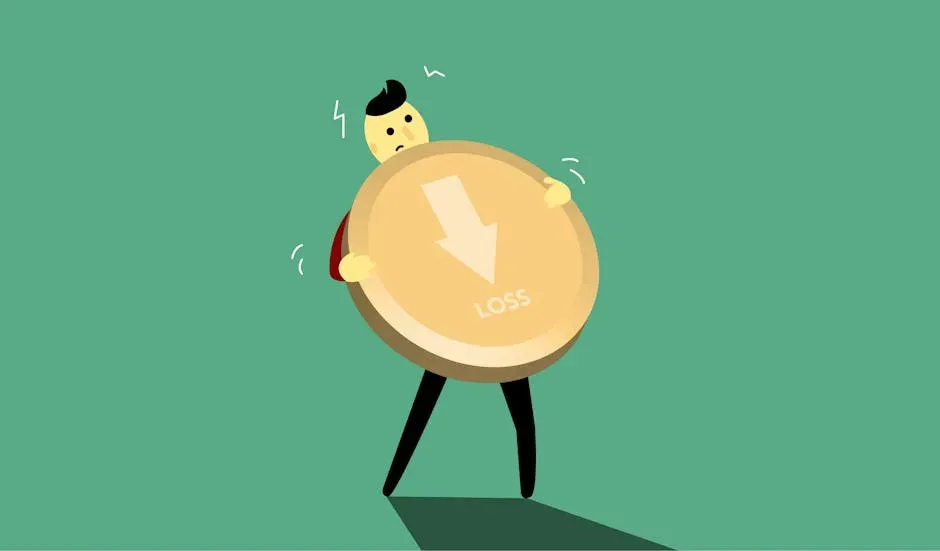
In cognitive science and behavioral economics, loss aversion is a cognitive bias in which the same situation is perceived as worse if it is framed as a loss rather than a gain. It should not be confused with risk aversion, which describes the rational behavior of valuing an uncertain outcome at less than its expected value. The distinction is subtle but important.
When dealing with gains, people are risk averse and will choose a sure gain over a riskier prospect, even if the expected values are equal. Losses are treated in the opposite manner: when aiming to avoid a loss, people become risk-seeking and take the gamble over a sure loss in the hope of paying nothing. This flip in behavior depending on framing is one of the most striking and reliable findings in all of decision science.
How Framing Changes Everything

A “95% survival rate” and a “5% mortality rate” are the same fact. The first activates gain framing, the second activates loss framing, and they produce different decisions. Kahneman and Tversky demonstrated this vividly in their famous “Asian Disease Problem” experiment. About 72% of participants voted for a program that saved a guaranteed 200 lives because they were risk-averse. But when the identical scenario was reframed in terms of deaths rather than survivors, a majority of 78% of respondents voted for the riskier option, since 400 people dying felt scarier.
Whether a transaction is framed as a loss or as a gain is important. The same change in price framed differently, for example as a $5 discount or as a $5 surcharge avoided, has a significant effect on consumer behavior. Framing is not spin. It is, as the evidence shows, a genuine shift in how our brains evaluate outcomes.
Partner offer
Loss Aversion in Investing: The Disposition Effect

The disposition effect is one of the most prominent and widely studied behavioral biases observed among investors. It describes the tendency to close out winning investments prematurely while holding on to losing ones for too long, and is generally associated with reduced investment returns.
Loss aversion bias is one of the top three most influential biases affecting investment decision making. The retail investor’s tendency toward loss aversion leads to the “disposition effect,” involving investors holding underperforming assets with a goal of breaking even while quickly exiting performing assets. Research findings show that loss aversion exerts a distinct influence on investment behavior by retail investors, causing increased inefficiency in capital allocation. In practical terms, it means many investors end up with portfolios full of bad bets they can’t bring themselves to close.
The Endowment Effect: Owning Something Makes You Value It More

Loss aversion was first proposed as an explanation for the endowment effect, the fact that people place a higher value on a good that they own than on an identical good that they do not own, by Kahneman, Knetsch, and Thaler in 1990. The classic coffee mug experiment illustrates this. In one experiment, sellers who received a coffee mug would not part with it for less than $7.12, while buyers evaluated the same mugs at a maximum of $2.87. Between those two figures lies the gain/loss perspective.
Tversky and Kahneman discussed loss aversion in riskless choices, for instance, not wanting to trade or even sell something that is already in our possession. The endowment effect is loss aversion in its most everyday form. It’s why selling a used car feels harder than buying one, even at the same price.
How Marketers Exploit This Bias

Research consistently shows that framing discounts as avoiding losses generates higher conversion rates than equivalent gain-framed messages. Promotional strategies like “30% off,” “last one available,” and “buy one get one free” are designed to exploit this cognitive bias by framing the offer in terms of avoiding a loss.
Software companies and subscription services harness loss aversion through strategically designed free trials. By providing full access to premium features, then messaging trial expiration as a “loss” of those features, they create a powerful conversion incentive. Netflix uses loss aversion, specifically the fear of losing personalized content, and sunk costs to sustain what researchers call “zombie subscriptions.” The product hasn’t changed. Only the framing has.
When Loss Aversion Is Not as Strong as We Think

The picture is not entirely settled. Recent research has raised legitimate questions about how universal and robust the effect really is. A 2025 re-meta-analysis sought to re-examine the most comprehensive meta-analytic dataset of loss aversion studies, which had reported strong evidence for loss aversion across 607 empirical estimates from 150 articles. The results showed that for studies with symmetric gains and losses and no ordering of items, the loss aversion parameter was approximately 1.07 and not significantly above 1.0.
Early studies of utility functions showed that while very large losses are overweighted, smaller losses are often not. Loss aversion appears more pronounced in specific contexts, such as high-stakes decisions, personal ownership, and situations with emotional attachments. It may be less reliable in situations involving very small payoffs or highly abstract concepts. Acknowledging these boundaries does not undermine the concept. It sharpens it.
How to Make Better Decisions Knowing You Are Loss Averse

Awareness is not a cure, but it’s a genuine starting point. The basic principle of loss aversion can explain why penalty frames are sometimes more effective than reward frames in motivating people, and has been applied in behavior change strategies. Recognizing that motivation helps you become both a more critical consumer of persuasion and a more intentional decision-maker.
Loss aversion has been shown to be a key driver of people’s investment decisions, and encouraged by regulators, financial institutions are seeking ways to integrate this behavioral factor into client risk classifications. On a personal level, building rules in advance for things like when to sell a stock or how long to hold a position can reduce the emotional drag that loss aversion creates in real time. Decision frameworks that guide choices can ensure decisions are based on rational assessments rather than emotional impulses. Educating individuals about cognitive biases increases self-awareness, enabling them to recognize when their decisions are being influenced by emotional factors.
Conclusion

Loss aversion is one of the most replicated and practically consequential findings in behavioral science. Since the publication of the seminal Kahneman and Tversky study, loss aversion has been widely studied and found to play a role in a variety of decision-making contexts, including financial decision-making, risk-taking, and consumer behavior. From the investor who can’t close a losing trade to the shopper who buys something they didn’t need because a countdown timer said the deal was ending, the bias runs through daily life in ways most people never consciously notice.
The science doesn’t say you should stop caring about losses. Caution has its place. What it does suggest is that when the fear of losing is louder than the logic of the situation, it’s worth pausing to ask which one is actually driving the decision. That $100 you’re afraid to lose may cost you far more if the fear of it shapes every choice you make.
Partner offer
Planning a trip to Vegas?
Compare hotel rates and show tickets on VEGAS.com.