There is something almost unfair about the piano. No other instrument on earth can move from a whisper to a thunderstorm in a single breath, carry the weight of a broken heart one moment, then dissolve into pure light the next. Throughout history, certain composers have stumbled upon something truly rare – a sequence of notes so emotionally precise that listeners feel seen, understood, maybe even undone. These are not just pieces of music. They are experiences.
Some pieces on this list are hundreds of years old. Others are more recent. All of them share a strange, irreplaceable quality that is almost impossible to define but instantly recognizable the moment you hear it. Let’s dive in.
1. Frédéric Chopin – Nocturne in C-sharp Minor, Op. Posth.
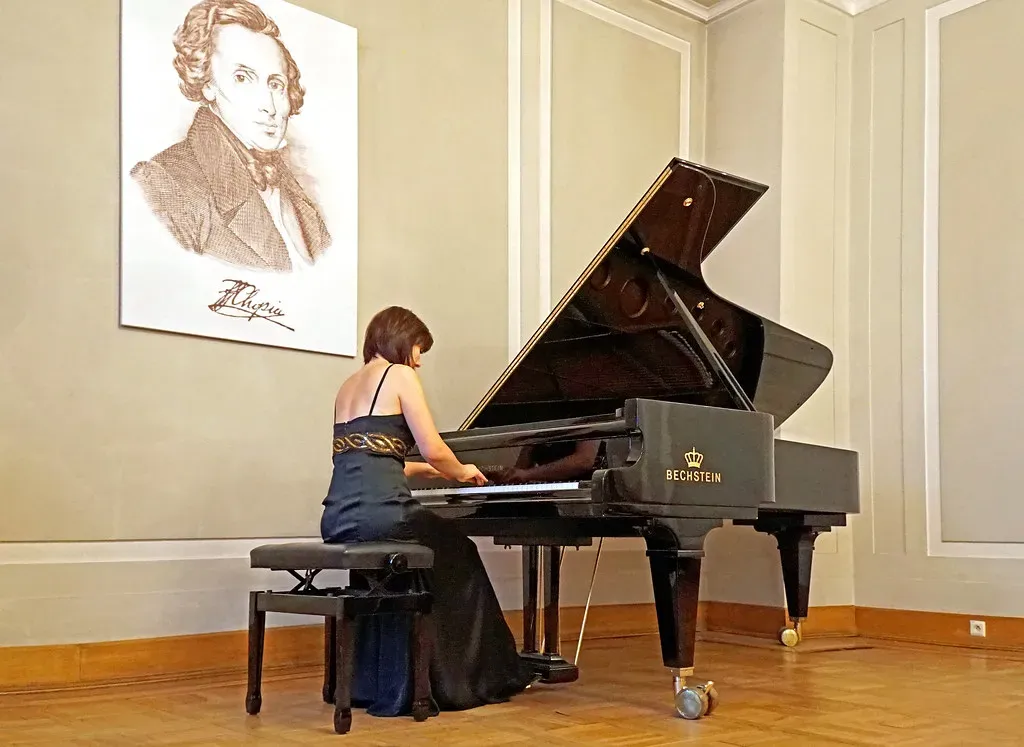
If there is one piano piece that feels like it carries the weight of the entire human condition in just a few minutes, this is it. This solo piano piece was composed by Frédéric Chopin in 1830 and was published posthumously in 1875, after Chopin arrived in Vienna. The fact that Chopin himself never published it makes it feel even more intimate, like reading someone’s private diary.
Composed in 1830 and published after Chopin’s death, this piece pours longing and melancholy directly into each note, with a gentle, flowing melody that weaves around subtle harmonies, giving pianists room to express their deepest emotions. Chopin’s use of rubato – the art of stretching and compressing time – invites a personal touch, so no two performances ever sound exactly alike. Honestly, I think that is what makes this nocturne feel so alive every single time you hear it.
The piece carries extraordinary real-world weight: it was played by Holocaust survivor Natalia Karp for a Nazi concentration camp commandant, who was so impressed with her playing that he spared her life. It was also featured in Roman Polanski’s film “The Pianist.” A piece of music that literally saved a life deserves every bit of its legendary status.
2. Claude Debussy – Clair de Lune
Few piano pieces have achieved anything close to the cultural saturation of Clair de Lune, and yet somehow it never loses its magic. The popularity of the third movement, Clair de lune, has made it one of the composer’s most famous works for piano, as well as one of the most famous musical pieces of all time. That is not an exaggeration. It is genuinely one of those pieces.
Debussy began composing the Suite Bergamasque around 1890, at the age of 28, but significantly revised it just before its 1905 publication. Its title means “moonlight” in French and is taken from Verlaine’s poem “Clair de lune.” The piece is the most downloaded piano score in Piano Street’s sheet music library – a stat that tells you everything about its enduring relevance.
One of the features of Clair de Lune is the instruction from Debussy for it to be played with “tempo rubato,” meaning the pianist is allowed the freedom to speed up and slow down at their discretion. Debussy felt strongly that the performer should have “a general flexibility” rather than playing too strictly in time. A classical piece that will stir the hearts of anyone who hears it, it evokes moonlight with moments of stillness, chiming chords and graceful arpeggios.
3. Ludwig van Beethoven – Moonlight Sonata (Op. 27, No. 2)
Here’s the thing about the Moonlight Sonata – everyone knows it, yet it still manages to stop you cold. The “Sonata quasi una fantasia,” now commonly known as the Moonlight Sonata, was Ludwig van Beethoven’s 14th piano sonata, Opus 27, Number 2, written and published in 1801 to 1802 during the Classical music era. Beethoven wrote this masterpiece at a difficult time when his hearing had begun to deteriorate seriously.
Although known throughout the world as the Moonlight Sonata, it was not Beethoven who named it so. The title was proposed in 1832, after the composer’s death, by the poet Ludwig Rellstab. Many sources say the nickname arose after Rellstab likened the effect of the first movement to that of moonlight shining upon Lake Lucerne. The name stuck, and honestly, it suits the music perfectly.
The overall style of the Moonlight Sonata was also innovative, as indicated by the subtitle “Sonata quasi una fantasia” appended to the work by the composer himself. The subtitle reminds listeners that the piece, although technically a sonata, is suggestive of a free-flowing, improvised fantasia. Beethoven dedicated the Moonlight Sonata to his 16-year-old lover and student, Giulietta Guicciardi, whom he had fallen in love with at around that time.
4. Erik Satie – Gymnopédie No. 1
If melancholy had a sound, it might be this. Gymnopédie No. 1 drifts into a room the way fog drifts over a harbor – slowly, softly, and with an inexplicable sense of something beautiful being lost. Composed in 1888, it is a masterclass in simplicity: a slow, steady rhythm and a melody that drifts like a gentle breeze. Satie’s unusual choice of time signature and open, unresolved harmonies set this piece apart from traditional classical works, and it sounds modern even today, with a sense of timelessness that feels both fresh and familiar.
Gymnopédie No. 1 is a favorite for its calming, introspective mood, often used in films and commercials to evoke tranquility. There is something almost paradoxical about the piece – it is so still, so sparse, and yet so emotionally full. Think of it like an empty room that somehow feels occupied.
Erik Satie’s Vexations has a very mysterious, eerie quality about it, especially when you listen to one of the elongated versions of it. That same spirit of quiet mysticism runs through all of his Gymnopédies. Satie was a composer who operated in his own universe, and Gymnopédie No. 1 remains his most perfect invitation inside it.
5. Arvo Pärt – Für Alina
Some music asks you to feel. Für Alina asks you to stop. Just stop, sit, and listen. Für Alina by Arvo Pärt is a piece of astonishing simplicity and emotional depth, composed in 1976, marking the beginning of Pärt’s “tintinnabuli” style, where every note rings out like a bell. The music is sparse, with long stretches of silence that invite the listener to reflect and meditate. Despite its simplicity, Für Alina holds a haunting power, as if every note contains a world of feeling.
The “tintinnabuli” technique – from the Latin word for “little bells” – was Pärt’s way of stripping music down to its bones. No decoration, no flourish. Just notes and the silence between them. It sounds easy to write, but I think it is actually one of the most difficult things imaginable. Anyone can add notes. Knowing which ones to leave out is true mastery.
6. Franz Schubert – Impromptu in G-flat Major, Op. 90, No. 3
Schubert had an extraordinary gift for making music that sounds like memory itself. The Impromptu in G-flat Major is one of his most breathtaking achievements – a seamless, flowing stream of melody that feels as though it could go on forever without you minding at all. Franz Schubert captured a haunting beauty in compositions that uniquely explore the themes of life and death, reflecting his own intimate relationship with these universal aspects of human existence.
The piece is structured around a melody so simple a child could hum it, yet it carries a depth that professional pianists spend careers trying to fully express. It moves through keys like light moving through water – subtly, continuously, always changing yet always the same. Schubert composed the four Impromptus Op. 90 in 1827, the year before his death at just 31 years old.
Listening to this piece, it is genuinely hard not to feel something shift inside you. It has the quality of watching sunlight fade on a winter afternoon – you know it will get dark, but you can’t quite bring yourself to look away. Schubert poured a lifetime’s worth of feeling into music he knew he may never hear performed.
7. Frédéric Chopin – Prelude in E Minor, Op. 28, No. 4
Chopin appears twice on this list because, frankly, leaving him out even once felt like a disservice to the entire history of the piano. Chopin’s Prelude in E Minor is a masterpiece of sorrow and beauty, capturing the feeling of heartbreak in just a few short minutes. Written in 1839 as part of his set of 24 preludes, this piece is famous for its simple, plaintive melody and deep, resonant harmonies.
Frédéric Chopin wrote 21 nocturnes for solo piano between 1827 and 1846, and they are generally considered among the finest short solo works for the instrument, holding an important place in contemporary concert repertoire. Composers such as Mendelssohn, Schumann, and Liszt described the genius that lay within Chopin’s nocturnes. The Prelude in E Minor carries all that genius in concentrated, devastating form.
It is barely two minutes long. That is the shocking thing. In less time than it takes to boil a kettle, Chopin manages to create one of the most emotionally complete experiences in all of music. It is the musical equivalent of a single perfect sentence that somehow says everything.
8. Philip Glass – Metamorphosis Two
Not everyone is immediately won over by Philip Glass. His minimalism can feel, to unfamiliar ears, like music that refuses to go anywhere. Give it time. Sit with it. Metamorphosis Two by Philip Glass is a hypnotic journey into the world of minimalism. Composed in 1988, this piece builds its haunting atmosphere through repetitive patterns that slowly evolve, like ripples on water that gradually change shape. Glass’s music often feels like a meditation, and Metamorphosis Two is no exception. The listener is drawn into a world where time seems to stand still, allowing emotions to surface and shift gently.
This connects to Glass’s 1981 release “Glassworks,” which was a huge success and introduced him to a wider audience. Its haunting repetition showcases his trademark minimalist style. Glass’s influence on contemporary classical music is profound, with many younger composers looking to his work for inspiration. Metamorphosis Two in particular has become one of those rare modern compositions that already feels timeless.
9. Johannes Brahms – Intermezzo in A Major, Op. 118, No. 2
Brahms saved some of his most intimate and heartbreaking music for his very last piano works. The Intermezzo in A Major, composed in 1893 during his final creative period, is widely considered one of the most emotionally profound short piano works ever written. It has the quality of a private conversation, something whispered rather than announced.
Brahms makes wonderful use of the bass in the piano, and his music has a certain intensely thick quality that carries deep emotional weight. The Intermezzo in A Major is the perfect expression of that quality – warm yet aching, tender yet complicated. It is the musical equivalent of holding something precious while knowing you are about to let it go.
Brahms composed this piece late in life, fully aware his health was failing. There is a farewell quality to it that is almost unbearable once you know that. The piece never shouts or demands attention. It simply opens itself up and trusts the listener to step inside. That quiet confidence is part of what makes it so extraordinary.
10. Sergei Rachmaninoff – Piano Concerto No. 2 in C Minor, Op. 18 (Opening)
Technically a concerto, but the famous opening of Rachmaninoff’s Second is so dominated by the solitary piano – building from near silence into a shattering, heartbreaking crescendo – that it earns its place here without question. It is one of the most emotionally overwhelming openings in all of music. Nothing else quite prepares you for it.
Rachmaninoff composed the concerto between 1900 and 1901, following a severe creative crisis and period of depression. The piece became both his comeback and his masterpiece. Rachmaninov’s Isle of the Dead is one example of his broader musical world – vast, emotionally raw, and deeply atmospheric. The Second Concerto channels all of that rawness directly through the piano keys and into the listener’s chest.
The opening sequence – those slow, tolling single notes that build into surging chords – is the musical equivalent of watching a storm gather on the horizon. You know it is coming. You cannot stop it. You would not want to. It is one of those rare musical experiences that leaves you feeling both devastated and incredibly, inexplicably alive.
A Final Note on Beauty That Haunts
What all ten of these pieces share is something beyond technical brilliance. They each reach past the ear and into something deeper – a part of you that recognizes grief, wonder, longing, or peace without needing words to explain why. That is the real miracle of piano music at its highest level.
The piano is an absolute classic when it comes to instruments worth mastering, and its versatility in creating rich melodies and captivating rhythms has kept composers hooked for centuries. These ten pieces are proof of that. From Chopin’s private whispers to Rachmaninoff’s storms, the piano has never stopped finding new ways to break your heart beautifully.
Which of these ten pieces moves you the most – and is there one you think belongs on this list that didn’t make it? Tell us in the comments.