
There is something almost embarrassing about the fact that humans walked on the moon before anyone thought to put wheels on a suitcase. Or that a glue too weak to hold anything together sat on a shelf for years before becoming one of the most beloved office products ever made. These are not edge cases. These are the rule.
Some of the most important inventions in history did not solve urgent, screaming problems. They solved invisible ones. The kind of discomfort you had simply accepted as part of life. Once you see them, though, you cannot unsee them. So let’s dive in and take a proper look at eight inventions that quietly revealed problems the world did not even know it had.
1. The Post-it Note: A Failed Glue That Became an Office Essential


In 1968, Spencer Silver, a scientist at 3M, set out to develop a super-strong adhesive. Instead, he accidentally created a low-tack, reusable, pressure-sensitive adhesive. For five years, Silver promoted his “solution without a problem” within 3M, both informally and through seminars, but failed to gain any real support. Think about that. A genuinely novel invention, sitting unused for half a decade, because nobody could figure out what problem it solved.
In 1974, a colleague named Arthur Fry, who had attended one of Silver’s seminars, came up with the idea of using the adhesive to anchor his bookmark in his hymn book. Fry then used 3M’s “permitted bootlegging” policy, which allowed employees to spend some of their work time on personal projects, to develop the idea further. Today, 3M produces over 50 billion Post-it Notes annually, with more than 600 variations sold in over 100 countries. A forgotten glue. Fifty billion pieces a year. Honestly, that never gets old.
2. The Windshield Wiper: Nobody Asked, But Everyone Needed It


Mary Anderson noticed streetcar drivers in New York having to stop repeatedly to clear snow off their windshields in 1902. She invented the manual windshield wiper, solving a problem most drivers had simply accepted as part of bad weather driving. Her invention seems obvious today, but it represented a breakthrough in thinking about visibility during inclement weather. Before Anderson made this connection, drivers just… dealt with it. They stopped. They wiped. They carried on.
Mary Anderson patented windshield wipers in 1903 after observing trolley drivers struggling to see during bad weather. Her patent was initially considered commercially unviable, and manufacturers rejected it outright, claiming the wipers would actually distract drivers. Today, of course, you cannot legally drive most vehicles without them. It is one of those rare cases where a single observation by one person changed every car that followed.
3. The Rolling Suitcase: Humanity’s Most Embarrassingly Late Innovation


Let’s be real for a second. The wheel is among humanity’s oldest inventions, dating back thousands of years. Although it is ubiquitous now and seems like an obvious innovation in retrospect, it wasn’t until 1970 that anyone added wheels directly to suitcases rather than carry them by hand or put them on rolling carts. American tourist Bernard Sadow came up with the idea while dragging his bags through customs after a vacation in Aruba. When he returned home, he took four rolling casters from a wardrobe trunk and strapped them onto a suitcase.
Sadow spent months attempting to sell his wheeled suitcase to various New York City department stores but was met with resistance. Most department stores, according to him, refused to sell his invention due to a “macho feeling” that men would consider rolling their luggage “wimpy” and that women who travelled would have their husbands around to carry their suitcases for them. The addition of wheels to the suitcase has since been called one of the most significant innovations in travel. All of this drama, for something that now seems as natural as breathing in an airport terminal.
4. Velcro: Inspiration From a Walk in the Woods


Swiss engineer George De Mestral didn’t set out to invent a fastener that would someday be ubiquitous on spacecraft. In 1941, he returned from a walk with his dog to notice that they were both covered in the tiny barbs of the cocklebur plant. On closer inspection, De Mestral saw that the burrs were shaped like tiny hooks, which snagged on the loops of his clothing and his dog’s fur. Fascinated, he began trying to create his own hook-and-loop fabric, an endeavor that would ultimately take him more than ten years.
In 1955, he patented Velcro, a name that combines the French words velours and crochet, meaning velvet and hook. Despite the moniker, De Mestral’s creation was made from nylon. It took a while for the fashion world to catch on, but NASA was an early adopter, using Velcro on space suits and shuttles. Nobody woke up in 1940 thinking the world needed a fabric that mimicked a plant burr. De Mestral just paid attention to an annoying inconvenience on a Sunday afternoon, and it ended up on the International Space Station.
5. The Pacemaker: Born From the Wrong Resistor

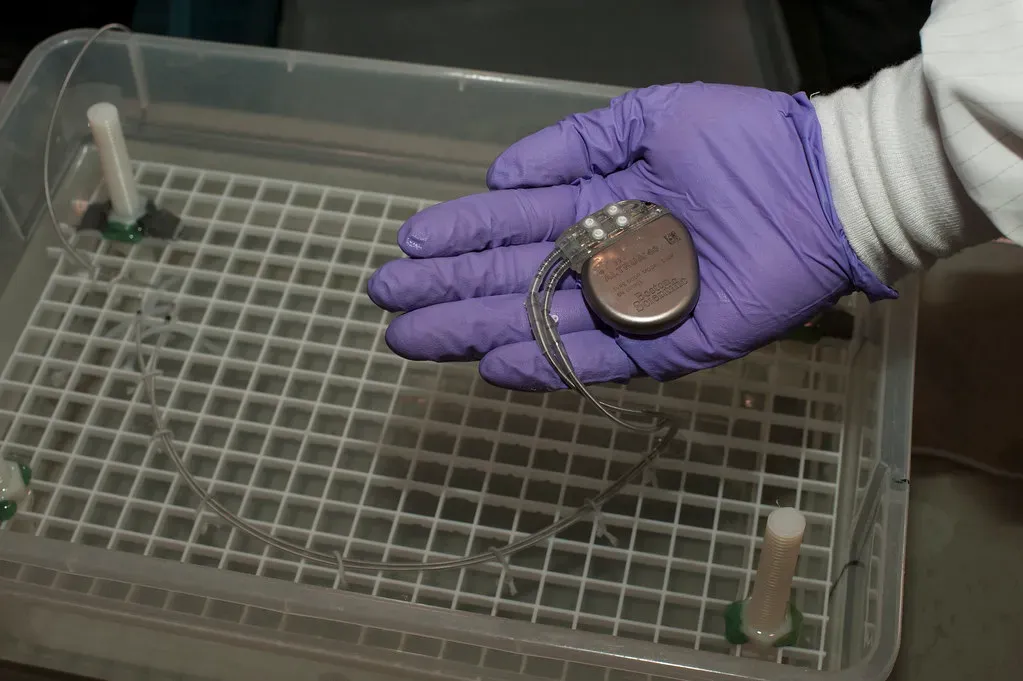
Here is a story that genuinely sounds like it belongs in a film. In 1956, engineer Wilson Greatbatch was attempting to build a heart rhythm recording device when he accidentally used the wrong resistor. This caused the circuit to emit electrical pulses, which mimicked the function of a heart’s natural rhythm. Greatbatch’s mistake led to the creation of the implantable pacemaker, a life-saving device that has kept millions of people’s hearts beating for decades.
Before the pacemaker, irregular heart rhythms were a largely unmanageable condition. The problem existed, of course, but nobody had conceived of a small, implantable electrical device as the answer. An adjunct professor of engineering at the University of Buffalo, Wilson Greatbatch accidentally invented the pacemaker in 1956. When working on building equipment intended to record heart sounds, the scientist used the wrong transistor and discovered that instead of recording sounds, his device gave off an electrical pulse, mimicking that of the heart. One wrong component on one afternoon changed cardiac medicine permanently.
6. Noise-Canceling Headphones: The Problem You Just Accepted on Every Flight


Engineer Dr. Amar Bose conceived the idea for noise-canceling technology during a flight in 1978 when he couldn’t enjoy the airline’s audio program due to engine noise. Before this invention, most people accepted background noise as an unavoidable annoyance. The technology uses microphones to detect ambient sound and produces opposing sound waves to cancel it out, solving a problem many had resigned themselves to living with.
Think about how thoroughly we had normalized that problem. Millions of people flew for decades, straining to hear their music over a roaring engine, and nobody treated it as a solvable problem. It was just flying. It was just loud. The most remarkable aspect of these inventions isn’t just their cleverness but how they revealed problems hiding in plain sight. From communication to comfort, navigation to cleaning, these innovations exposed gaps in our daily experience that we hadn’t fully recognized. Noise-canceling technology is perhaps the cleanest example of exactly this dynamic.
7. Safety Glass: A Dropped Flask That Protected Millions

It is hard to say for sure which accidental inventions have saved the most lives, but laminated safety glass must be somewhere near the top. In 1903, French chemist Édouard Bénédictus accidentally dropped a glass flask that had been coated with a plastic film. Instead of shattering into pieces, the glass cracked but remained in one piece. This accident led to the invention of laminated safety glass, which is now used in car windshields, skylights, and more to prevent dangerous glass shattering.
Before this moment, nobody had articulated “glass that stays together when it breaks” as a need. Regular glass worked perfectly well, right up until it shattered and sent fragments flying. The problem only became visible once the solution appeared, which is precisely what makes it so fascinating. Today, safety glass is so deeply embedded in modern infrastructure that imagining cars, office buildings, or even smartphone screens without it feels almost impossible.
8. Super Glue: A War-Era Mistake That Stuck Around


Back in 1942, Harry Coover was looking for materials he could use to build clear plastic gun sights for the war, but what he discovered instead was a chemical formulation that stuck to everything it touched. His discovery was rejected because researchers didn’t see a need for such a sticky formula, and it wasn’t until 1951 that the same formula was embraced and repurposed by Coover and fellow Eastman Kodak researcher Fred Joyner. A substance that bonded instantly to virtually any surface was treated, at first, as an industrial nuisance.
In medicine, cyanoacrylate-based adhesives evolved into surgical-grade products used for closing incisions and lacerations, reducing the need for stitches. Super Glue’s impact on everyday life cannot be overstated. From quick household fixes to high-stakes industrial applications, it has become a ubiquitous tool that exemplifies the power of serendipity in innovation. Something rejected as a failed experiment during wartime ended up closing wounds in operating rooms. What makes these inventions truly special is how quickly they transition from novel curiosities to essential parts of our routines. They demonstrate the unique human ability to not only solve known problems but to discover entirely new ways of improving life that we couldn’t have articulated before seeing the solution.
The Bigger Picture: Problems We Didn’t Know We Had


Looking at these eight inventions together, a clear pattern emerges. Accidental inventions in science refer to innovations that occur unintentionally while scientists are pursuing other goals. Often, these inventions arise from serendipity, where the creator recognizes the potential usefulness of something they did not originally set out to create. The key word there is “recognizes.” Most people would have swept the moldy petri dish, tossed the wrong resistor, or brushed the burrs off their jacket without a second thought.
Often, the best products are born out of necessity, they solve problems we all face every day. But then there are the true geniuses who spot issues most of us overlook and create solutions that make life unexpectedly easier. That is the real gift these inventors had. Not just curiosity, but a willingness to pause and ask the question most of us skip entirely: “Why do we put up with this?” What everyday frustration in your own life might already have an answer hiding somewhere, waiting for the right moment of attention?