Ever belted out a song at full volume, only to discover later that what you’d been confidently singing was completely, hilariously wrong? You’re far from alone. Misheard song lyrics are such a widespread phenomenon that they even have their own name: mondegreens. These slip-ups have been delighting and embarrassing music lovers for decades, and with the rise of streaming platforms and social media, these lyrical mishaps have become more visible than ever.
The Science Behind Why We Mishear Lyrics
Your brain does something fascinating when it hears unclear words in music. It automatically substitutes unfamiliar sounds with words that seem familiar and make some sort of sense to you personally. Think about it. When you’re listening to a song with heavy production effects, compressed audio, or an unusual accent, your mind is constantly trying to fill in the gaps.
These mix-ups happen for a variety of reasons: unfamiliar accents, tricky vocabulary, words that sound alike but have different meanings, unclear pronunciation, or if the song is sung too quickly. Sometimes, background music or audio effects can also obscure the lyrics. Your brain wants things to make sense, so it opts for what feels most logical in the moment. The problem is, what sounds logical to your ears isn’t always what the artist actually wrote.
From Scotland to Stadiums: The Birth of “Mondegreen”
The term “mondegreen” was coined in 1954 by American writer Sylvia Wright, who recalled mishearing a Scottish ballad as a child. She wrote about it in Harper’s Bazaar in November 1954, recalling how she misheard the line from an old poem that went “They have slain the Earl o’Moray / And laid him on the green,” hearing the last line instead as “And Lady Mondegreen.” Wright imagined a tragic romantic story where both the Earl and Lady Mondegreen perished together, a far more dramatic tale than the reality.
The word “mondegreen” was officially added to the Random House Webster’s College Dictionary in 2000, the Oxford English Dictionary in 2002, and Merriam-Webster’s Collegiate Dictionary in 2008. What started as one woman’s childhood confusion became the official term for a universal human experience.
“There’s a Bathroom on the Right” – Bad Moon Rising

As an inside joke, John Fogerty of Creedence Clearwater Revival usually sings the refrain in the chorus as it’s commonly misheard: “there’s bathroom on the right” instead of “there’s a bad moon on the rise.” Some musicians love getting in on the joke. During his 1998 Premonition concert taping, Fogerty actually sang the incorrect lyric on stage, and it’s been reported that during other concerts he’d point to the closest bathroom whenever he got to the line.
The original line refers to ominous danger approaching, apocalyptic imagery warning people to stay indoors. Instead, countless listeners heard what sounded like helpful directions to the nearest restroom. Fogerty has said the song is about “the apocalypse that was going to be visited upon us.” It’s hard to imagine bathroom directions fitting into that vision.
“Hold Me Closer, Tony Danza” – Tiny Dancer

Topping the list as the most misunderstood artist of all time is the legendary Elton John, with a staggering 2,569 mondegreens recorded across his songs. One of his most beloved hits, Tiny Dancer, alone accounts for 214 of those submissions. The most famous mishearing? Turning the romantic plea “hold me closer, tiny dancer” into a bizarre demand to embrace actor Tony Danza.
This Elton John blooper has spawned a life of its own. The single, which went three-times platinum in April 2018, even spawned a joke on an episode of Friends, when discussing the most romantic songs, with Phoebe saying it’s “the one that Elton John wrote for that guy on Who’s the Boss.” Honestly, once you’ve heard it as Tony Danza, it’s nearly impossible to unhear.
“Wrapped Up Like a Douche” – Blinded by the Light

Taking the crown as the most misunderstood song is Blinded By The Light by Manfred Mann. Despite its relatively slow pace, it ranks as the least readable in analysis, and when AI was tested, it only accurately transcribed 63 percent of its lyrics. Bruce Springsteen’s hot rod reference “revved up like a deuce” became the infamous “wrapped up like a douche,” and this particular mondegreen has been called the most misheard lyric of all time.
What’s a deuce, anyway? It’s 1950s hot rod slang for a 1932 Ford Deuce Coupe, a classic American muscle car. Modern ears just aren’t primed to catch obscure automotive references. In 1993, a Canadian sketch-comedy show, The Vacant Lot, included a Blinded by the Light sketch that poked fun at the various incorrect renditions out there.
“All the Lonely Starbucks Lovers” – Blank Space

In the 2014 song Blank Space by Taylor Swift, listeners widely misheard the line “got a long list of ex-lovers” as “all the lonely Starbucks lovers.” Swift’s line became “Got a lot of Starbucks lovers” for countless listeners. This one’s particularly funny because the mishearing kind of makes sense in a modern context. Who hasn’t encountered lonely people nursing lattes?
Taylor Swift is one of the few artists to appear twice in top misheard lyrics rankings. Her clear enunciation and catchy hooks mean millions of people are singing along, and inevitably, millions are getting it wrong in the exact same creative ways.
“Excuse Me While I Kiss This Guy” – Purple Haze
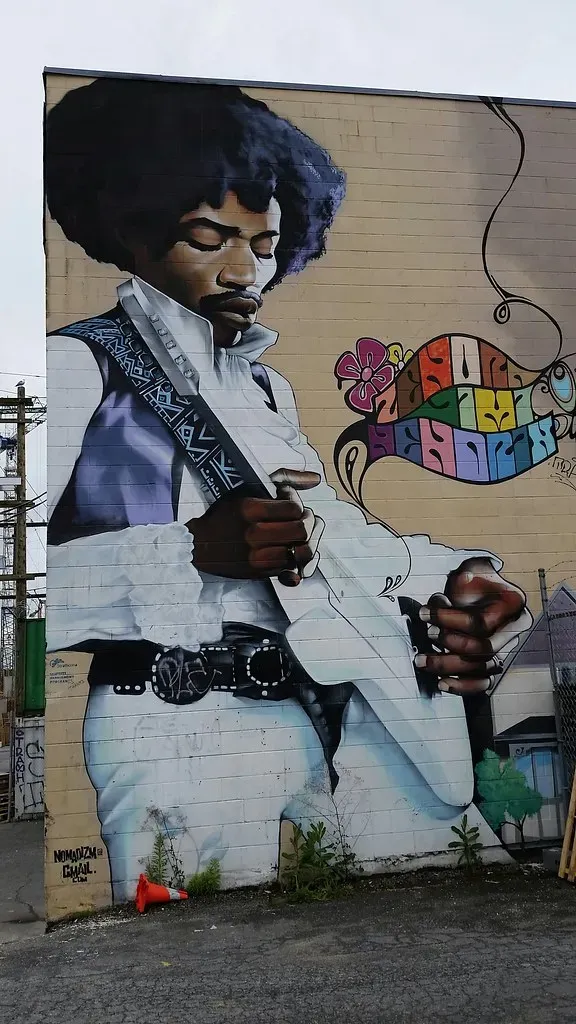
Perhaps the most famous misheard lyric of all time was Jimi Hendrix’s “Excuse me while I kiss the sky,” which was surmised to have been “Excuse me while I kiss this guy.” Jimi himself was known to have some fun with the mondegreen, often singing the incorrect lyrics on stage, occasionally even accompanied by a mock make-out session.
There’s even a Website, KissThisGuy.com, dedicated to collecting user-generated stories of misheard lyrics. Hendrix embraced the mishearing with humor rather than frustration, turning an accidental mondegreen into part of his live performance mystique. That’s the spirit.
How Streaming Services Changed the Game
For over a year, Spotify tested its Apple Music-style live lyrics feature before expanding it to the US at the beginning of 2021, then rolling it out globally using lyrics provided by Musixmatch. In 2024, Spotify confirmed it would be expanding lyrics availability for free users so more people can enjoy viewing lyrics globally.
Apple Music sources lyrics from Musixmatch, a user-contributed community that functions surprisingly well. They also provide lyrics to Spotify, Shazam, Vevo, Instagram and others. This massive expansion of synchronized, real-time lyrics means that in 2026, fewer people are confidently singing nonsense than ever before. You can now double-check those questionable lines instantly, right there on your screen as the song plays.
When Social Media Makes Mondegreens Go Viral
The internet age has transformed misheard lyrics from private embarrassments into shared cultural moments. Even with instant lyrics access on every streaming platform, mondegreens persist. Platforms like TikTok have created entire communities dedicated to documenting and celebrating these mishearings. Content creators make videos acting out the misheard versions, often with hilarious results.
Recently, Justin Timberlake of NSYNC clarified on a Hot Ones episode that the pronunciation of “Me” as “May” in the band’s hit single “It’s Gonna Be Me” was due to a specific request from Swedish songwriter-producer Max Martin. The meme “It’s Gonna Be May” has become an unavoidable internet tradition every spring, proving that sometimes the misheard version becomes more famous than the correct one.
Why We Stick with the Wrong Words
Here’s the thing. Even after you learn the correct lyrics, there’s something weirdly stubborn about the brain. You’ve probably experienced this yourself: someone corrects you, you acknowledge they’re right, and yet the next time that song plays, out comes the wrong version again. This isn’t just stubbornness.
Steven Pinker has observed that mondegreen mishearings tend to be less plausible than the original lyrics, and that once a listener has “locked in” to a particular misheard interpretation, it can remain unquestioned, even when that plausibility becomes strained. Your brain creates a pathway, and that first version you learned gets priority. It’s the musical equivalent of muscle memory.
Let’s be honest, sometimes the misheard version is just more entertaining. Who really wants to sing about tambourines when you could be singing about tangerines? The beauty of music lies partly in its openness to personal interpretation, even when that interpretation is completely, objectively incorrect. What did you think you were singing all these years?