Salvador Dalí is far more than the sum of his melting clocks and bizarre dreamscapes. He was a Spanish surrealist painter celebrated for his striking and dreamlike creations, born in 1904 in Figueres, Catalonia, whose works are characterized by bizarre imagery, meticulous detail, and deep symbolic meaning. Yet behind every distorted watch and spindly-legged elephant lies a carefully constructed visual language – one rooted in psychology, personal trauma, politics, and even quantum physics. Dalí’s inner world is vast and complex, and his surreal symbols are hints to unpacking his creative mind and soul. To stand before one of his canvases without understanding the layered intentions behind it is to miss the conversation entirely.
The Freudian Foundation: Dreams as Raw Material

Salvador Dalí was heavily influenced by Sigmund Freud’s psychoanalytic theories, particularly the concept of the unconscious mind, and he incorporated Freudian psychology into his artwork, using it as a source of inspiration and exploring the depths of the human psyche. This was not a passing intellectual fascination. Deeply influenced by Sigmund Freud’s work “The Interpretation of Dreams,” the Spanish artist explored the irrational and his dreams at the beginning of his career. Freud’s ideas gave Dalí a kind of permission – a framework for treating the irrational as a legitimate subject of serious art.
Obsessive themes of eroticism, death, and decay permeate Dalí’s work, reflecting his familiarity with and synthesis of the psychoanalytical theories of his time. Drawing on blatantly autobiographical material and childhood memories, Dalí’s work is rife with often ready-interpreted symbolism, ranging from fetishes and animal imagery to religious symbols. Another aspect of Freudian psychology that influenced Dalí was the concept of sexual symbolism. Freud argued that many seemingly unrelated objects and images could have hidden sexual meanings. These hidden meanings were not accidental, but deliberate provocations embedded within technically masterful canvases.
The Paranoiac-Critical Method: Controlled Madness
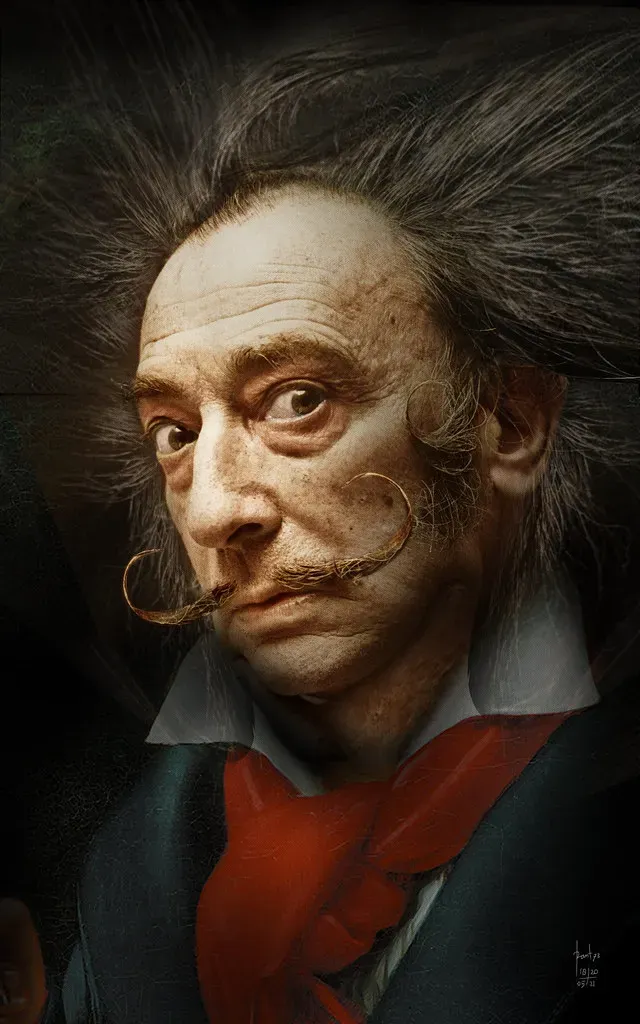
The paranoiac-critical method is a surrealist technique developed by Salvador Dalí in the early 1930s, which he employed in the production of paintings and other artworks, especially those that involved optical illusions and other multiple images. The aspect of paranoia that Dalí was interested in was the ability of the brain to perceive links between things which rationally are not linked. Dalí described the paranoiac-critical method as a “spontaneous method of irrational knowledge based on the critical and systematic objectivity of the associations and interpretations of delirious phenomena.”
The technique consists of the artist invoking a paranoid state, and the result is a deconstruction of the psychological concept of identity, such that subjectivity becomes the primary aspect of the artwork. After his self-induced paranoid state, Dalí would then paint what he had witnessed, creating what he referred to as “hand-painted dream photographs.” André Breton hailed the method, saying that Dalí’s paranoiac-critical method was an “instrument of primary importance” and that it had “immediately shown itself capable of being applied equally to painting, poetry, the cinema, the construction of typical Surrealist objects, fashion, sculpture, the history of art.”
The Persistence of Memory: Time, Decay, and the Self
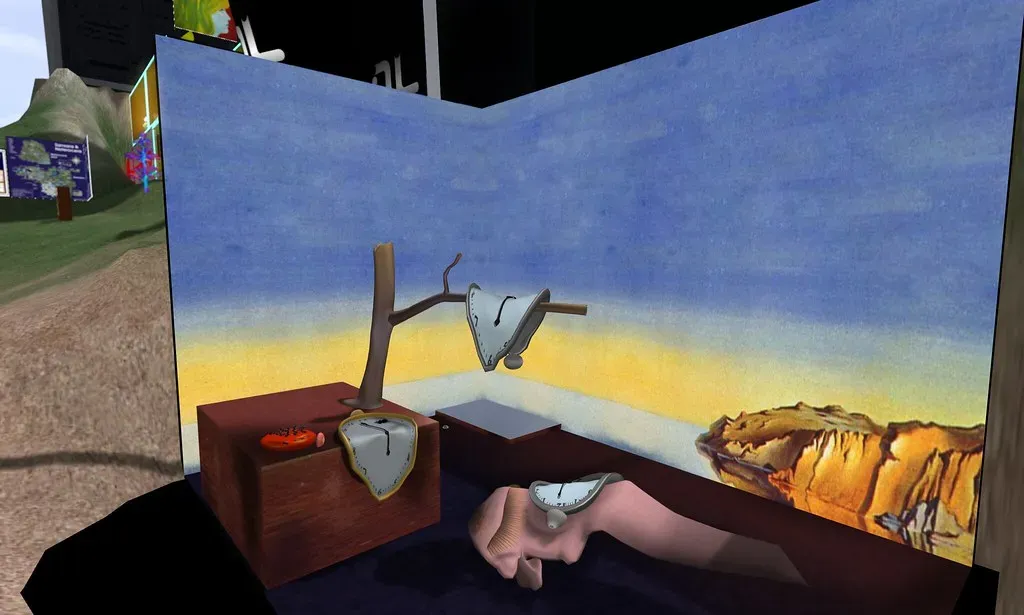
The Persistence of Memory is a 1931 painting by Salvador Dalí and one of the most recognizable works of Surrealism. First exhibited at the Julien Levy Gallery in 1932 and sold for $250, it was donated to the Museum of Modern Art (MoMA) in New York City two years later in 1934 by an anonymous donor, where it has remained ever since. Central to the piece is the iconic image of soft melting pocket watches, described by Dalí as inspired by a surrealist perception of Camembert cheese melting in the sun. The distinction between hard and soft objects highlights Dalí’s desire to flip reality, lending his subjects characteristics opposite their usually inherent properties – an un-reality often found in dreamscapes.
The monstrous, fleshy creature draped across the painting’s center is at once alien and familiar. It is an approximation of Dalí’s own face, elevating the piece from pure abstraction into something of a self-portrait. The orange watch at the bottom left of the painting is covered in ants and does not melt. Its firmness contrasts with the dreamlike mutability of the others, offering a grounded counterpoint in an otherwise warped landscape. The usage of ants to symbolize decay is a recurring theme throughout Dalí’s artwork. Time was one of Dalí’s obsessions, because the passing of time leads to death, and he was terrified of death. He was a second child, born after the death of the first child and named after that dead baby.
Recurring Symbols: Elephants, Eggs, and Ants

Salvador Dalí represents elephants carrying heavy obelisks, likely inspired by the Italian Baroque artist Bernini’s works, evoking power, strength, and dominance, and sometimes also the idea of the future. Their surrealist touch is their legs – long and thin like insect legs – offering an impossible contrast with the elephants’ heaviness. This surreal representation of spindly-legged elephants symbolizes a paradox of power and fragility. You see them in works like “The Elephants” and “Dream Caused by the Flight of a Bee,” each time carrying that same layered charge of grandeur undercut by impossibility.
Other recurring motifs across Dalí’s paintings include the grasshopper, a consistent beacon for sexual anxiety in his work; ants, an allusion to decay and death; and an egg, representing fertility. Life starts from an egg, but you need life to create an egg – and in the end, eggs are an ultimate symbol of life. In the painting “Metamorphosis of Narcissus,” as explained by Dalí himself, the image of Narcissus is suddenly transformed into a hand which rises out of his own reflection, holding an egg, a seed, a bulb about to give birth to the new Narcissus – the flower. Each symbol functioned as a personal lexicon that Dalí deployed across decades.
War, Politics, and the Burning Giraffe
The chest of drawers seen in the two blue female figures depicted by Dalí in “The Burning Giraffe” is a reference to the study of Sigmund Freud, one which claims that the human body is filled with secret drawers only to be opened through psychoanalysis. The female figures, which Dalí later described as “Femme-coccyx,” are in part stripped of their skin down to the muscular tissue, while the protagonist of the painting, the giraffe, stands in the background with a fire burning on its back. The Surrealist painter described this image as “the masculine cosmic apocalyptic monster” and believed it to be a premonition of war.
During the tumultuous period of the mid-1930s, Dalí began constructing his compositions around ambiguous, two-way imagery – pictures that offer multiple and equally valid ways of perceiving what is being depicted. (Think of the famous duck-rabbit optical illusion, which can be found in the lower left-hand corner of Dalí’s “Apparition of a Face and Fruit Dish on a Beach.”) Dalí increasingly explored the notion of paranoia as a productive way of seeing, generating a proliferation of rational or irrational visions that might be harnessed by the mind. Created after fleeing Spain due to civil unrest, Dalí’s vivid imagery confronts the fragility of life and the turmoil of war.
Nuclear Mysticism: Science, Religion, and the Cosmos
Dalí hoped that the emerging theories of physics and molecular biology could reveal the mysteries of religion, and in 1950 he created the term “Nuclear Mysticism” to describe this new phase of his work. Nuclear Mysticism examined the link between the energy of the mind and the physical matter of the body, and the unbreakable energy-bond between all things on earth. After the mass destruction seen during World War Two, Nuclear Mysticism offered a reunifying resolution. It was as though Dalí had traded the anxious chaos of surrealism for the clean, almost spiritual geometry of science.
The Sacrament of the Last Supper is a striking reinterpretation of the iconic biblical scene, blending Renaissance-inspired composition with Dalí’s surrealist vision and interest in geometry. The painting depicts Christ and his apostles seated around a translucent table, positioned within a dodecahedron, a twelve-sided geometric figure symbolizing divine order. This work reflects Dalí’s deepening spirituality during his “nuclear mysticism” phase, where he merged religious themes with scientific concepts, particularly those related to atomic theory and mathematics. The painting stands as Dalí’s visual thesis: the belief that religion, science, and art are not separate disciplines, but different languages for describing the same miracle of existence. The outlandish and iconoclastic artist Salvador Dalí was famous for his bizarre imagery and distinctive Surrealist vision, but he was also deeply rooted in tradition. Dalí studied, emulated, and revered his European predecessors from centuries past, embracing influences from Spain, the Low Countries, and Italy throughout his long career.