


Open almost any shelf of literary classics and you’ll find names that were never printed on a birth certificate. Some were chosen to dodge prejudice. Others protected a day job, a family’s reputation, or a private life that Victorian society wouldn’t have forgiven.
The motives differ more than most people expect. Here are six well known novels and the practical reasons their authors stepped behind a different name.
Jane Eyre and the Problem of Being a Woman Writer


When Charlotte Brontë published Jane Eyre in 1847, the title page credited Currer Bell. She and her sisters Emily and Anne had all taken androgynous names, each keeping the initials of their real ones and using the surname Bell.
Charlotte later explained the choice herself. She wrote that the sisters didn’t want to announce themselves as women because they suspected female authors might be judged unfairly. The book was a hit anyway, and speculation about who Currer Bell really was spread quickly through literary London.
Wuthering Heights and a Name Among Three Sisters


Emily Brontë’s only novel, Wuthering Heights, appeared in 1847 under the name Ellis Bell. It was published by Thomas Newby, in a set that also included Anne’s Agnes Grey, released under the name Acton Bell.
The shared surname made the trio look like brothers, which suited the sisters’ wish for privacy. Emily died in 1848, and it was Charlotte who revealed the true identities in the 1850 edition of the book. For Emily, the pseudonym lasted almost her entire short career.
Middlemarch and the Making of George Eliot

Mary Ann Evans began publishing fiction as George Eliot with Adam Bede in 1859, and Middlemarch followed in 1871 and 1872. She was already a respected translator and editor, so she knew how the literary world sorted writers by gender.
Her reasons were partly professional. She wanted her novels judged as serious work rather than dismissed as the light romances often linked to women writers of the day. Her unconventional relationship with the writer George Henry Lewes, who was married, also made a separate public identity useful.
Partner offer

Alice in Wonderland and the Oxford Mathematician


Alice’s Adventures in Wonderland came out in 1865 under the name Lewis Carroll. Behind it was Charles Lutwidge Dodgson, a mathematics lecturer at Christ Church, Oxford, who also published academic work under his own name.
Keeping the two lives apart made sense for a scholar in a formal college setting. The pen name was built by turning Lutwidge into Ludovicus and Charles into Carolus, then translating them back into English as Lewis and Carroll. Reportedly, the publisher’s editor chose it from a short list Dodgson supplied.
Huckleberry Finn and the River Behind Mark Twain


Samuel Clemens had been writing as Mark Twain for over two decades when Adventures of Huckleberry Finn arrived in 1884 in Britain and 1885 in the United States. He first used the name in 1863, while working as a journalist.
It’s a riverboat term. Mark twain was a call used on the Mississippi to signal water two fathoms deep, which was safe for passage. The name gave him a recognizable persona, and it tied his writing directly to the river life he drew on.
Nineteen Eighty Four and the Writer Called Orwell
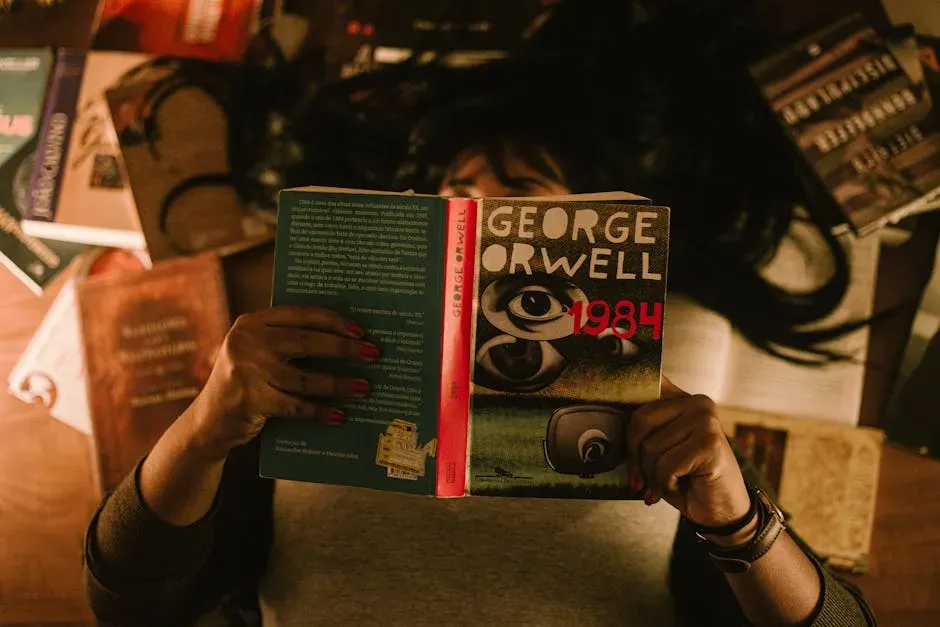
Eric Arthur Blair published Nineteen Eighty Four in 1949, but he’d been George Orwell since his first book, Down and Out in Paris and London, in 1933. He reportedly wanted to spare his family any embarrassment over the account of poverty it contained.
Blair took the surname from the River Orwell in Suffolk, a place he knew well. The name stuck so completely that it became the one readers, critics, and publishers used for the rest of his career.
Names That Outlived Their Purpose

Each of these pseudonyms began as a practical tool, whether to avoid gender bias, protect an academic post, or shield relatives. Once the novels succeeded, the names became more famous than the people behind them.
Today the books sit on library shelves under Bell, Eliot, Carroll, Twain, and Orwell, while the birth names appear mostly in biographies and reference notes.
Partner offer
Planning a trip to Vegas?
Compare hotel rates and show tickets on VEGAS.com.


