
There is something almost magical about discovering a secret no one else has noticed. Album covers are not just packaging. They are canvases, codes, cryptic love letters from artists to their most devoted listeners. Some of these secrets sat in plain sight for decades before anyone caught them. Others required sunlight, mirrors, or a blacklight to reveal. Let’s dive in.
1. The Beatles – Abbey Road (1969): A Funeral in Broad Daylight
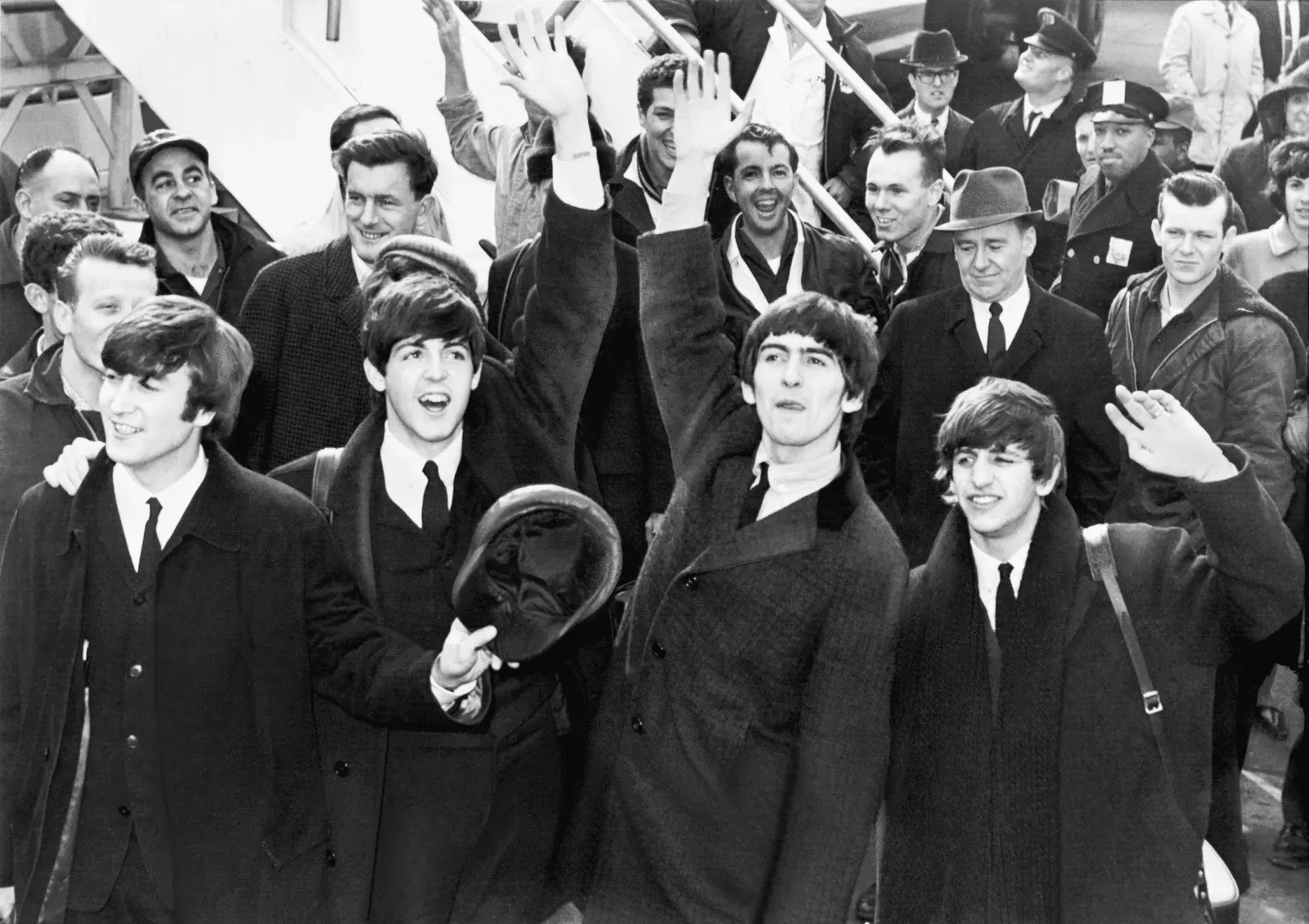
The cover of Abbey Road simply shows the four musicians walking across the zebra crossing outside Abbey Road Studios in North London, and the famous shot was one of six taken by photographer Iain Macmillan at 10am on August 8, 1969, while a policeman held up the traffic and Macmillan balanced on a stepladder with just 10 minutes to get the shots. Straightforward enough, right? Honestly, it looked like four guys out for a stroll.
Some fans have suggested that their outfits represent funeral attire, with John Lennon in white symbolizing the clergy, Ringo Starr in black signifying the undertaker, George Harrison in denim representing the gravedigger, and Paul McCartney barefoot and out of step signifying a corpse. The white Volkswagen Beetle in the background also intrigued many, with some suggesting that the license plate ‘LMW 28IF’ hinted at McCartney’s age if he had lived, with ‘IF’ suggesting an alternative reality.
The Abbey Road album cover remains the only original Beatles cover to completely omit the actual album title or band name. That omission alone was a bold, almost arrogant move, and the kind of confidence that only the world’s biggest band could pull off.
2. The Beatles – Sgt. Pepper’s Lonely Hearts Club Band (1967): A Crowd Full of Secrets

The Sgt. Pepper’s Lonely Hearts Club Band album cover is arguably one of the most recognizable images in music history. Released in 1967, it is a vibrant tapestry of pop culture, art, and symbolism that continues to fascinate fans and critics alike. Beyond its visually striking design, the cover is laden with hidden meanings, celebrity cameos, and artistic choices that reflect the band’s evolving creative vision.
John Lennon wanted Hitler and Jesus in the crowd. As the band voted for famous faces, Jann Haworth said Hitler was John’s misguided choice and they actually made the figure, but removed him before the shoot. In the end, the Beatles only selected about one third of the heads on the cover, so Peter Blake and Haworth chose the rest.
Near the top right corner, there is James Joyce, the prolific Irish author, who is obscured by Bob Dylan’s image. Then slightly further over, Bette Davis and Timothy Carey are mostly obscured by the Beatles themselves. The album won the Grammy Award for Best Album Cover in 1968.
3. David Bowie – Blackstar (2016): Light Reveals Everything

On January 8, 2016, Bowie released his final work, the experimental rock album Blackstar. Just two days later, he died of liver cancer. Many fans consider Blackstar Bowie’s parting gift to the world. The cover, on first glance, looks almost insultingly simple.
The biggest Easter egg comes when you leave Blackstar’s vinyl gatefold out in the sun. With enough exposure to light, the album’s iconic black star is replaced by an image of a starry galaxy. Some fans also found that reflecting light off one side of the Blackstar vinyl record projects an image of a star onto the opposite wall, while another fan discovered that shining a blacklight on Blackstar makes it shine bright blue.
Designer Jonathan Barnbrook hinted that there are more secrets to the iconic artwork that fans have yet to discover. As well as the star field which emerges in sunlight, Barnbrook confirmed that there are actually a few other things hidden in the artwork as well. The Guardian also pointed out that “black star” is a term used for cancer lesions. The layers here are genuinely breathtaking once you know what you are looking at.
4. Iron Maiden – Somewhere in Time (1986): 30+ Secrets in One Painting
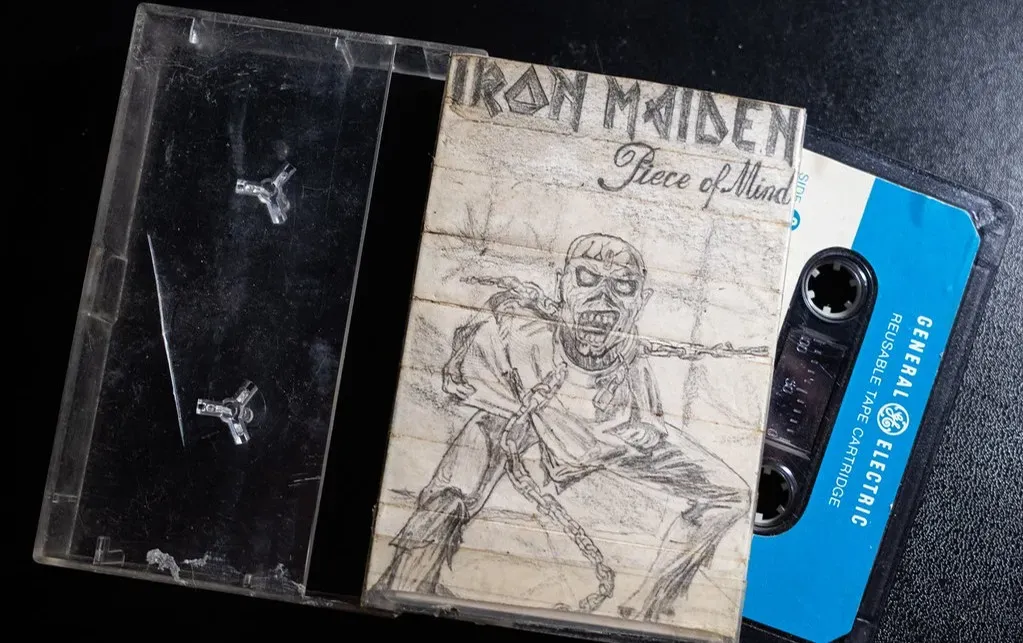
Iron Maiden released Somewhere in Time in 1986, and it is one of their most intricately detailed album covers, layered with many in-jokes and nods to their past. Artist Derek Riggs spent weeks on the 32-inch by 15-inch painting. Let’s be real, this is not an album cover. It is a hidden object game dressed up as heavy metal artwork.
The street is named “Acacia,” much like the Number of the Beast track “22 Acacia Avenue,” and a poster shows Eddie from the band’s debut album with graffiti that reads “Eddie lives.” The soccer score shown on the cover reads “West Ham 7, Arsenal 3,” a nod to bassist Steve Harris, who is a big fan of West Ham United Football Club.
In the bottom left corner, a banner is hung in a shop behind the future-Terminator Eddie, and if you reverse it, you see the message “THIS IS A VERY BORING PAINTING.” That kind of self-aware humor buried in a place almost no one would ever look is exactly what makes this cover legendary among superfans.
5. Nirvana – Nevermind (1991): More Than a Baby in Water

Inspired by Kurt Cobain’s fascination with underwater births, the record label’s art director Robert Fisher hired photographer Kirk Weddle to shoot a conceptually related image. It was Fisher’s idea to doctor the image and include the famous dollar bill hooked to a fishing line, an enigmatic and playful reworking of a fishing scene that is clearly open to multiple readings, with one popular interpretation being that it is a critique of corporate capitalist society and the principles of consumerism.
Partner offer
The image of a baby swimming towards a dollar bill seems a blatant form of self-mockery while the band knowingly operated in the highly commercial context of the mainstream US music industry, and it is the addition of the sardonic title “Nevermind” that suggests some kind of awareness of the identity-based issues the band faced. The irony goes deep, arguably deeper than the pool the baby is swimming in.
6. The Beastie Boys – Licensed to Ill (1986): Read the Tail Number Backwards

The cover to the trio’s 1986 debut Licensed to Ill features a visual joke of a plane crunching into the side of a mountain. Look closer, and hidden in plain sight is the plane’s serial number: 3MTA3. You might stare at that number for hours without thinking much of it.
What happens if you reverse it? You get EATME. Honestly, that is exactly the kind of juvenile, poke-you-in-the-ribs humor that defined the Beastie Boys in their early years. It flew past censors, parents, and pretty much everyone except the most curious and eagle-eyed fans who actually stopped to look twice.
7. New Order – Power, Corruption and Lies (1983): A Cover That Talks Back

On the back cover of New Order’s Power, Corruption and Lies, there is a wheel design made up of various colored sections. The outer two rings of this design form a “decoder ring” to decipher messages hidden elsewhere on the cover. This code is also used on the 12-inch singles for “Blue Monday” and “Confusion,” and on New Order’s official website.
Like some other coded covers, there is no new explosive information revealed if you take the time to decode it, with the hidden text mostly containing catalog numbers or titles of the releases. Still, the process is its own reward. There is something genuinely satisfying about the idea of a band trusting their fans enough to embed a working code into their packaging and simply wait.
8. Paul McCartney – Ram (1971): A Secret for Linda

Not long after the “Paul Is Dead” rumor gripped hippies in the US in 1969, McCartney left a real hidden message on the cover of his 1971 album Ram. The initials L.I.L.Y. stand for “Linda I Love You.” After years of conspiracy theorists projecting doom and death onto his every move, McCartney quietly slipped something warm and personal into his record sleeve.
It is the kind of detail that rewarded the attentive and the obsessive over the casual listener. You had to care enough to look. The message was always there, just waiting for someone devoted enough to find it. Superfans who spotted it essentially got a private love note that the rest of the world walked right past.
9. The Velvet Underground – White Light/White Heat (1968): The Invisible Skull

It is well known that David Bowie was a huge Velvet Underground fan, and some of the shenanigans surrounding his Blackstar artwork pay homage to this classic album. The original artwork to the 1968 album White Light/White Heat appears to be pure black, but if you look closely you can see a very faint image of a skull tattoo. It belonged to the actor Joe Spencer, who was one of Andy Warhol’s “discoveries,” and it is thought the black-on-black design was a Warhol idea.
Think about that for a second. A skull hidden in a black cover, using black ink, designed so that the casual buyer would never even see it. You genuinely have to hold the record at the right angle under the right light. Most people owned this album for years without ever knowing the skull was there. That is arguably the most committed hidden detail in this entire list.
10. Imagine Dragons – Smoke + Mirrors (2015): GPS Coordinates That Led to Real Treasure

One of the most involved and entertaining examples of hidden details comes from Imagine Dragons. In late 2014, the band teased the upcoming Smoke + Mirrors album on Twitter with an image of the album cover and some cryptic clues. One enterprising superfan, a 13-year-old named Lindsea Taylor, discovered GPS coordinates hidden in the artwork.
She was in Florida and the coordinates were in Las Vegas, but she had family in Utah not far from Vegas and convinced her grandparents to take her on a literal treasure hunt. The buried treasure included signed drumsticks and Polaroids, a signed acoustic guitar, and a pass for free admission to any concert on the Smoke + Mirrors tour. I know it sounds crazy, but a teenager in Florida cracked a code that thousands of adults missed entirely.
Conclusion: The Art of Looking Closer

Here is the thing about hidden album cover details. They are not accidents. Artists and designers spend enormous effort planting them, trusting that somewhere out there, someone obsessive enough will care to look. That relationship between creator and dedicated fan is genuinely special.
From Bowie embedding a star field that only sunlight could reveal to Iron Maiden filling an entire futuristic cityscape with over thirty inside jokes, these details reward patience and passion. The casual listener misses them entirely. The superfan finds them and feels, for a moment, like they were let in on something private.
It makes you wonder. How many secrets are sitting in your record collection right now, completely unnoticed? What would you find if you looked just a little closer?
Partner offer
Planning a trip to Vegas?
Compare hotel rates and show tickets on VEGAS.com.