Some books age like fine wine. Others age like prophecy. There is a small, remarkable shelf of novels and stories that did not just entertain their readers – they described, with unsettling precision, the world those readers would eventually live in. Mass surveillance. Algorithmic manipulation. Digital isolation. Brain-computer interfaces. These were once the wild imaginings of fiction writers. Now they are Tuesday morning headlines.
What makes this even stranger is that many of these authors were working from gut instinct and social observation, not blueprints. They looked at the direction humanity was walking and followed the road further than anyone dared. The results are, depending on your mood, either deeply inspiring or genuinely terrifying. Let’s dive in.
1. “1984” by George Orwell (1949) – The Surveillance Blueprint
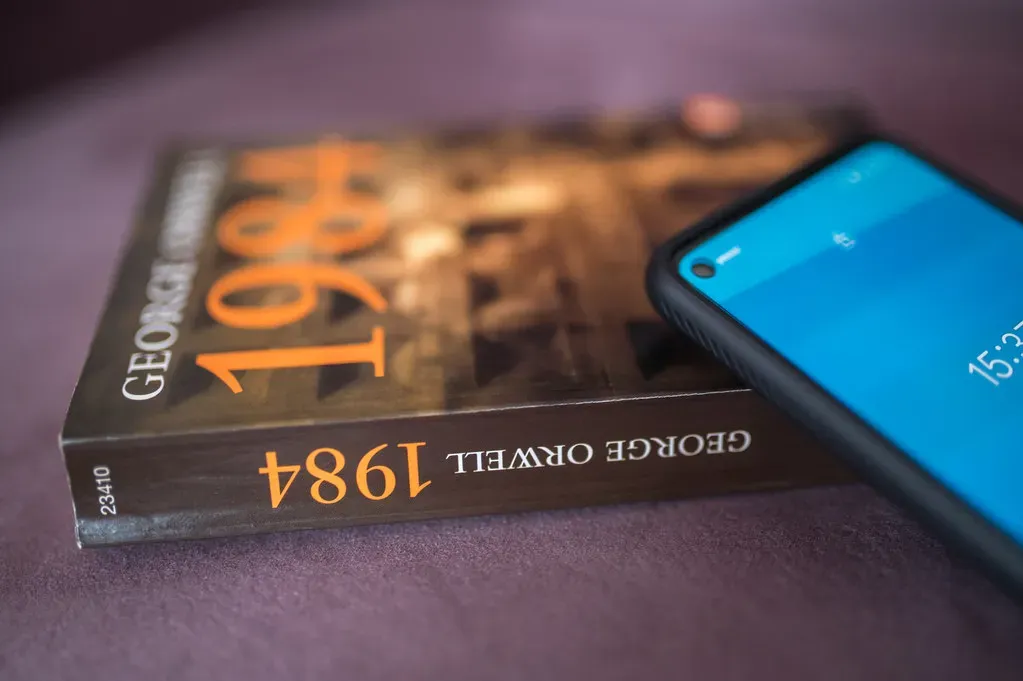
Here’s a thought that should stop you mid-scroll: a man writing in 1949, on a damp Scottish island, in failing health, somehow mapped out the architecture of modern surveillance with extraordinary accuracy. George Orwell’s “1984” stands as one of the most hauntingly accurate predictions of future society. Written in 1949, Orwell envisioned a world dominated by surveillance, censorship, and manipulation of truth.
Among the technological advancements described in the book is the “telescreen,” essentially a large television used to monitor people’s private lives and identify a person based on their facial expressions and heart rate. That sounds less like fiction and more like a product spec for a modern smart device. Aspects of the telescreen have become a reality in various forms of technology today, including facial recognition software, video surveillance, and health-monitoring devices like smartwatches.
In 2021, reports revealed that over 1 billion surveillance cameras are in use worldwide, a staggering confirmation of Orwell’s vision. Governments and corporations quietly monitor our digital footprints, using algorithms to track online activity and even predict behavior. Orwell also invented the concept of “Newspeak,” a language designed to shrink the boundaries of critical thought. Even “Newspeak” echoes in modern worries about misinformation and controlled narratives. In 2024, a Pew Research study found the vast majority of Americans were concerned about the amount of data companies collect on them.
Meanwhile, Orwell’s “Versificator” – a machine that could automatically produce music and literature – predicted artificial intelligence software, which can be programmed to make art and write music, emails, articles, essays, and even fiction. The word “Orwellian” is now so embedded in public discourse that it barely needs explaining. That, in itself, says everything.
2. “Brave New World” by Aldous Huxley (1932) – The Pleasure Trap
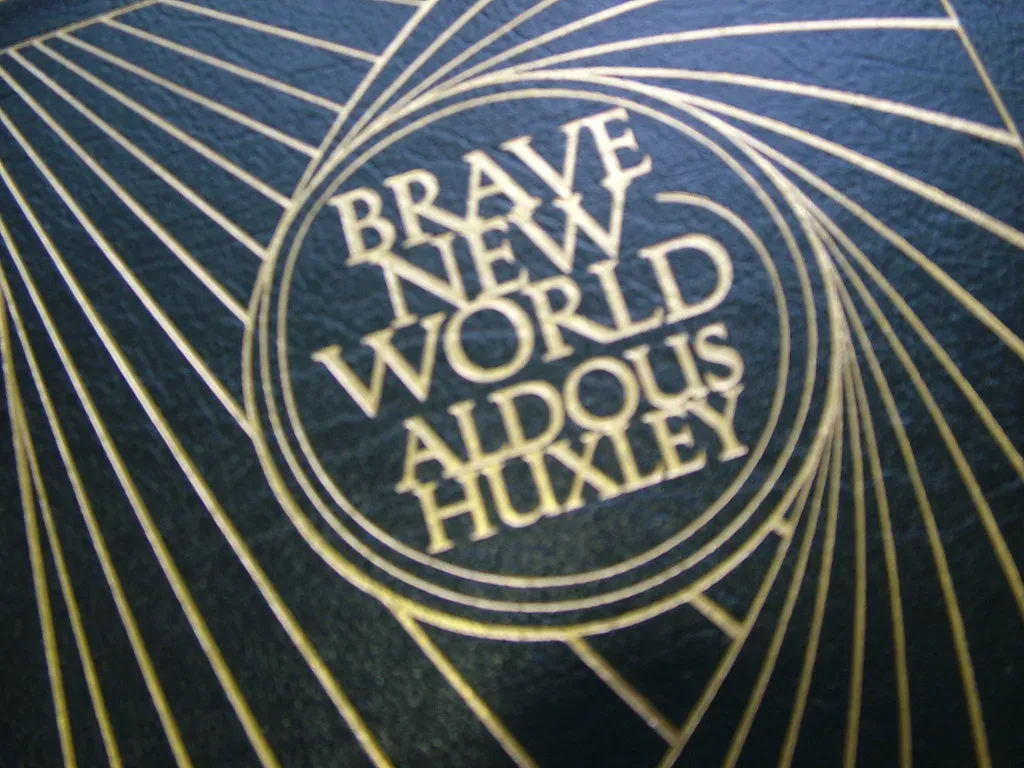
Aldous Huxley’s “Brave New World” foresaw a society where pleasure and consumption are the highest goals, and science is used to engineer happiness. The novel’s world is defined by genetic manipulation, mood-altering drugs, and relentless consumerism, all designed to keep people docile and productive. The scary part is not the darkness of his vision. It is how cheerful it all looks.
The novel describes a future where people are engineered for specific societal roles, entertained by mindless distractions, and kept complacent with a drug called “soma.” In many ways, this mirrors today’s world of social media addiction, reality TV culture, and the advances in genetic engineering through CRISPR technology. Honestly, the “soma” parallel to smartphones is almost too obvious to mention – and yet it keeps getting more accurate each year.
Today, technologies like IVF have made genetic selection possible, and antidepressant use is at an all-time high – nearly one in eight Americans take them, according to a 2020 study. The culture of instant gratification through shopping and entertainment is relentless, with global advertising spending soaring to over half a trillion dollars in recent years. Huxley’s warning was not about iron fists. It was about velvet ones. That distinction matters enormously right now.
3. “Fahrenheit 451” by Ray Bradbury (1953) – Screens, Earbuds, and the Death of Thought
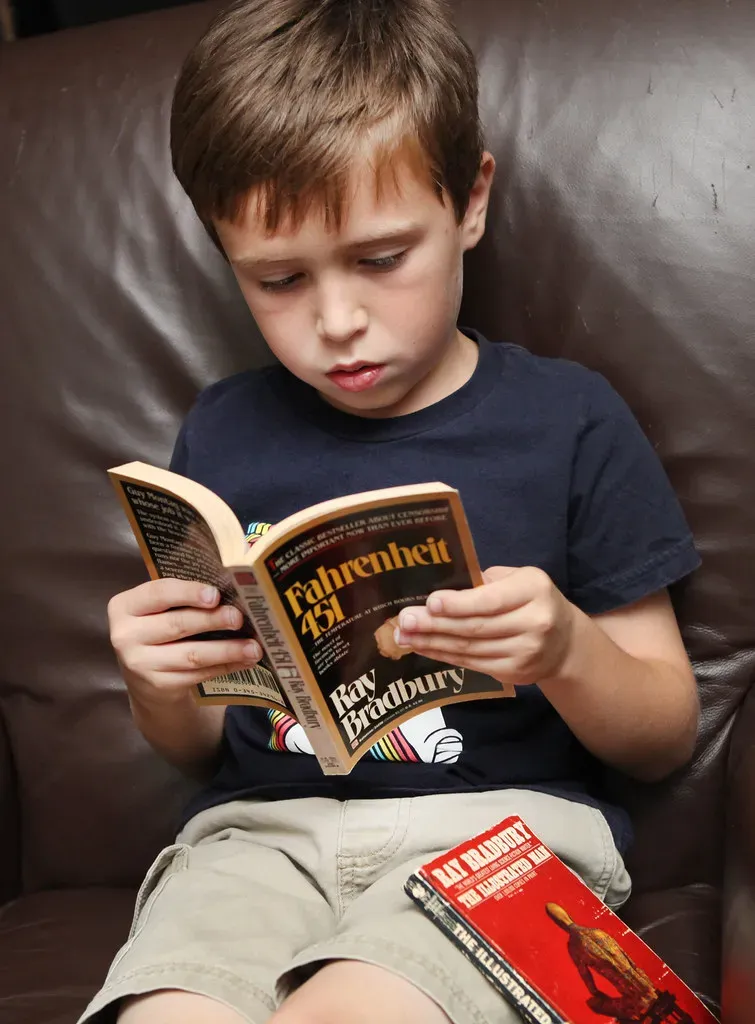
Ray Bradbury’s Fahrenheit 451 shows a society in which books are forbidden, critical thinking is frowned upon, and people are hooked on vacuous entertainment provided through videos. But the book’s real prediction was never just about burning books. It was about a society that would voluntarily walk away from deep thought.
We’ve got wall-sized screens in our homes, earbuds constantly feeding us content, and the decline in traditional reading habits and the rise of instantaneous information through digital media mirrors exactly what Bradbury warned about. Bradbury’s novel also included the idea of earbuds, or in-ear headphones – 51 years before Apple earbuds were released in 2001. That is a level of specificity that makes your head spin a little.
Bradbury’s Fahrenheit 451 warned of a future where books are banned, critical thinking is discouraged, and society is consumed by fast entertainment. While it was originally a response to government censorship, the book feels relevant today in the age of misinformation, book bans, and the overwhelming influence of digital media that favours quick soundbites over deep analysis. Let’s be real – TikTok and Bradbury are having the same argument. One of them just has better production quality.
4. “Neuromancer” by William Gibson (1984) – The Internet Before the Internet
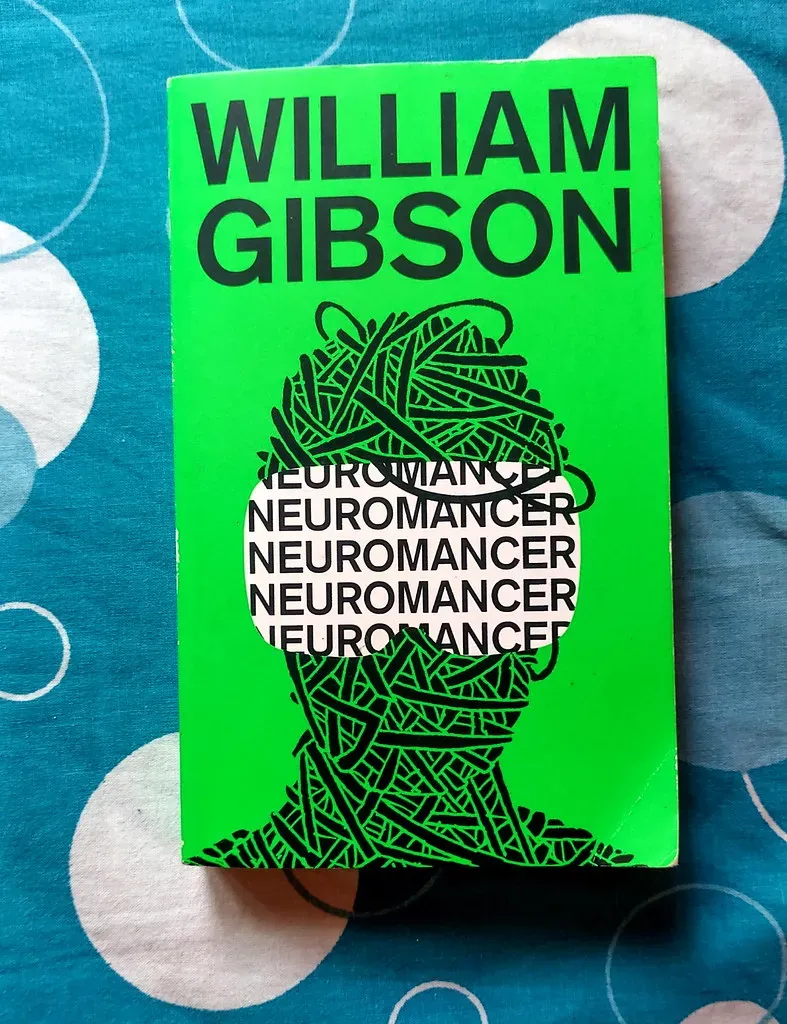
William Gibson didn’t just write about the future of technology – he invented the words we use to describe it. In 1984, five years before Tim Berners-Lee introduced the Internet to the world, Gibson coined the term “cyberspace.” He wrote the entire novel on a manual typewriter, having never actually used a computer. I know that sounds crazy, but it is completely true.
In Neuromancer, Gibson coined the word cyberspace and described the future of networked computers with uncanny accuracy. He also predicted artificial intelligence. He had never used a computer but had somehow managed to come up with a vision of what a network of computers might look like. The personal computer was still a novelty at this point. The World Wide Web was years away.
Today, cyberattacks are a constant threat, with Cybersecurity Ventures estimating that cybercrime will cost the world $10.5 trillion annually by 2025. Artificial intelligence, once science fiction, now powers everything from customer service bots to language models like ChatGPT. Neuromancer became the only novel ever to win the “triple crown” – Hugo Award for Best Novel, the Nebula Award for Best Novel, and the Philip K. Dick Award for original paperback fiction.
Partner offer
Today’s AI leaders warn of “unaligned superintelligence.” Gibson got there first. The novel’s AIs wanted to break free of their legal constraints and merge into something larger. In 2026, that plotline reads less like science fiction and more like a governance policy debate.
5. “The Machine Stops” by E.M. Forster (1909) – Remote Work, Zoom Calls, and Digital Dependency

This one genuinely defies explanation. In 1909 – before the first digital computer, before talking motion pictures, before the World Wide Web was remotely conceivable – a British novelist wrote a short story that described video calls, on-demand content, remote work, social isolation, and smart home technology. In 1909, long before the invention of the World Wide Web or the prospect of a world where we must live socially distant from each other, the English writer E.M. Forster arguably predicted both. Each idea appears in one of Forster’s most curious short stories, “The Machine Stops.” All the more remarkable was the fact that Forster was not a science-fiction writer; it would be his only entry in the genre.
Key predictions that came true include: handheld “plates” for face-to-face communication, mirroring modern smartphones and apps like Zoom; a Machine that delivers information, music, and lectures on demand, akin to streaming services and online education; and a foresight of how technology could reduce physical interaction, an issue highlighted in today’s debates about screen time and loneliness.
By speculating on human nature, Forster was still able to predict the world we now inhabit: protagonist Vashti communicates with thousands of people through a computer screen, but has no emotional intimacy with any of them. This could describe almost any social network. The story ends with the Machine failing and society collapsing because nobody remembered how to function without it. In an age of AI and hyper-connectivity, his warning against isolation and over-dependence is more urgent than ever.
6. “Feed” by M.T. Anderson (2002) – The Algorithm That Knows You

Feed is a young adult dystopian novel by M. T. Anderson, first published in 2002. The narrative is set in a near-future United States where nearly all individuals receive a “feed” – a mandatory brain implant at birth that delivers continuous streams of personalized advertisements, entertainment, news, and social connections directly into the mind, effectively merging human cognition with corporate-controlled digital networks. Reading that description today, in 2026, is a genuinely strange feeling.
Published in 2002, prior to the dominance of platforms like Facebook, the novel depicts characters receiving a continuous stream of personalized information, advertisements, and suggestions directly into their consciousness via neural implants. “Feed” anticipated key elements of contemporary digital ecosystems, particularly the pervasive influence of algorithm-driven content feeds and targeted advertising. Anderson wrote this before Facebook existed. Before Twitter. Before TikTok.
Long before the advent of social media and when a lot of people were still on dial-up modems, Anderson predicted the warping power of hyper-tailored advertising and an always-connected online culture with uncanny accuracy. This prescience extends to the erosion of privacy and autonomous thought, as corporations exploit user data to shape desires and consumption patterns. The novel’s portrayal of technology’s integration into human cognition has proven enduringly relevant amid rising concerns over screen addiction, misinformation, and cognitive offloading.
7. “We” by Yevgeny Zamyatin (1924) – The Totalitarian Playbook
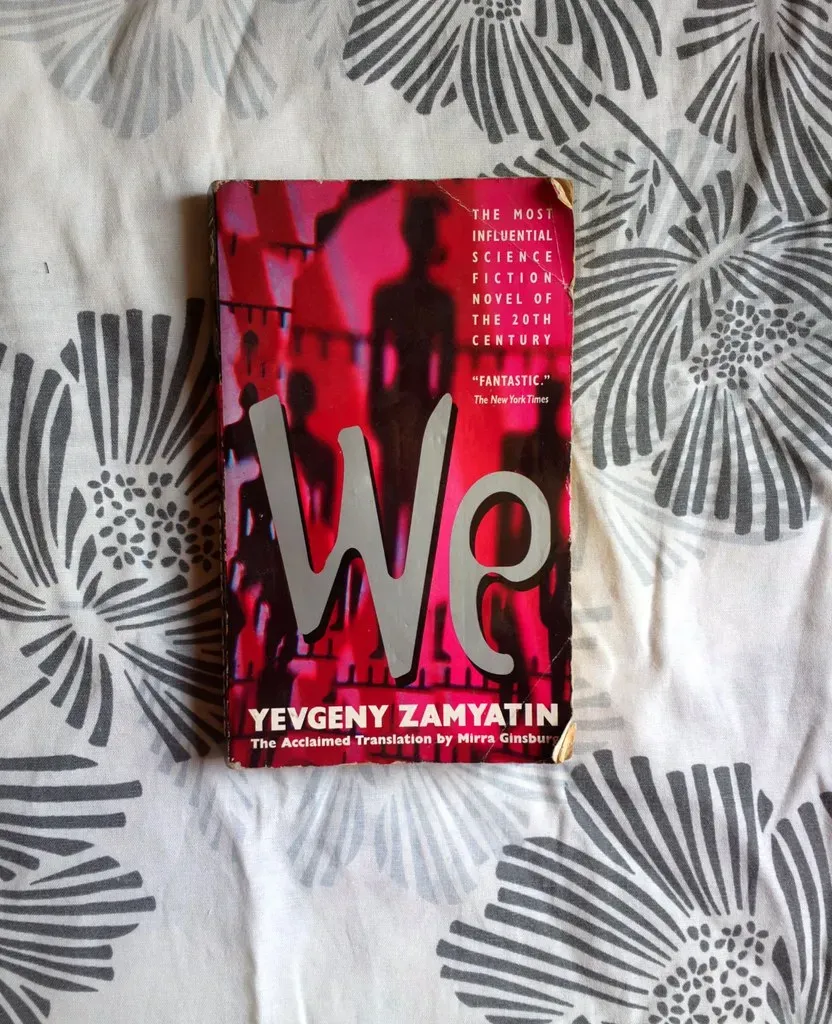
Here is the book that Orwell himself said inspired him. Written by a Russian author who faced serious government persecution, “We” was completed in 1920 and published outside Russia in 1924. It depicts a totalitarian state so complete that citizens live in glass apartments, have their romantic lives assigned by the state, and are identified by numbers rather than names. Zamyatin’s “We” depicts a dystopian world where the government controls every aspect of citizens’ lives, even their thoughts and emotions. The book foreshadowed the rise of totalitarian regimes in the 20th century and resonates today with concerns about surveillance, authoritarian governments, and the erosion of personal freedoms in many parts of the world.
The glass walls are the detail that stays with you. Everyone is visible to everyone else at all times. In a world where social media has made daily life a performance observed by strangers, that image lands with fresh force. Zamyatin was writing from lived experience, watching Russia transform under revolutionary pressure, and he extrapolated with a clarity that bordered on the prophetic.
It’s hard to say for sure whether Zamyatin truly “predicted” the future or simply understood power so deeply that all future power structures inevitably followed familiar patterns. Either way, the novel’s core argument – that a society which demands total transparency from its citizens will ultimately crush the self – has not lost a single step in relevance. While science fiction often gets credit for predicting technological and societal advancements, these classic books prove that literature, regardless of genre, can offer profound insights into the future. Whether warning against the dangers of unchecked power, the consequences of technology, or the decline of intellectual curiosity, these authors saw the world we live in today with unsettling clarity.
What All Seven Books Have in Common
None of these authors had access to a crystal ball. What they had was something arguably more powerful: a clear-eyed understanding of human nature and a willingness to follow social trends to their logical conclusions. Orwell understood power. Huxley understood pleasure as a control mechanism. Bradbury understood distraction. Gibson understood networks. Forster understood dependency. Anderson understood data. Zamyatin understood the state.
The predictions that came true were never really about technology. They were about us. The machines changed. Human psychology did not. That is exactly why these books keep getting more relevant, not less, with each passing year. From corruption and government control to terror attacks and social media privacy, these books have forecasted the future across all aspects of life.
There is something both humbling and quietly alarming about the fact that the most accurate maps of our present were drawn by novelists, not technologists or economists. These writers looked at where the road was heading and said, clearly: this is where you end up. Whether we take that seriously is, as always, entirely up to us.
So here is the question worth sitting with: if these seven authors were so right about the world of 2026, which books being written right now are describing the world of 2050 – and are we paying attention this time? What do you think? Tell us in the comments.
Partner offer
Planning a trip to Vegas?
Compare hotel rates and show tickets on VEGAS.com.