Pop music has always had a gift for misdirection. A bright melody, a danceable beat, and a smooth vocal delivery can make almost anything feel welcome in the living room or the car. Generations of listeners have sung along, tapped their feet, and requested their favorite tracks on the radio without ever registering what was actually being said.
These eight songs did exactly that. Some disguised their content deliberately, others simply trusted that no one would listen closely enough. Either way, the gap between how they sounded and what they meant was often staggering. Here is what was really playing on your radio.
1. “Every Breath You Take” – The Police (1983)
At first listen, “Every Breath You Take” seems like an unassuming and heartfelt love song with its slow and melodic tone. The new wave track, written by Sting, became The Police’s most successful song, topping multiple charts for several weeks after its release. It ended up on wedding playlists around the world, which is a fact that still unsettles people when they learn what the song is actually about.
The lyrics explore the consuming, stalker-like mentality of a man who refuses to let go of the object of his obsession, with phrases like “I’ll be watching you” and “you belong to me” repeated throughout. Sting intended it to be about obsession and surveillance, and described it as “a nasty little song, really rather evil,” adding that it’s about jealousy, surveillance, and ownership. Even the songwriter was surprised by how sinister it turned out to be.
2. “Pumped Up Kicks” – Foster the People (2011)

Contrasting sharply with the upbeat musical composition, the lyrics describe the homicidal thoughts of a troubled youth named Robert. By 2011, the song had entered the Billboard Hot 100 and held the number three spot for eight consecutive weeks, behind Adele and Maroon 5. Millions of people danced to it at parties without pausing to consider a single word.
When he wrote the song, Mark Foster wanted to get into the mindset of an isolated, psychotic kid who had been bullied to the point of violence, intentionally setting the dark lyrics to more upbeat music. Due to the song’s dark lyrics, it was temporarily pulled from circulation on certain U.S. radio stations in response to the Sandy Hook Elementary School shooting. The cheery melody had done its job a little too well.
3. “Strange Fruit” – Billie Holiday (1939)

Written and composed by Abel Meeropol, “Strange Fruit” was recorded by Billie Holiday in 1939. The lyrics were drawn from a poem published in 1937, and the song protests the lynching of African Americans with imagery that compares the victims to the fruit of trees. The song was described as “a declaration of war” and “the beginning of the civil rights movement” by Atlantic Records co-founder Ahmet Ertegun.
Meeropol was inspired to write “Strange Fruit” after seeing a photograph of the 1930 lynching of two Black teenagers in Marion, Indiana. Billie Holiday was apprehensive about performing it because she worried that nightclub patrons would not want to hear a political song, and she feared harassment and violence by racist listeners. Time magazine named it the song of the century in 1999. The distance between that honor and what the song describes is almost impossible to hold in the mind at once.
4. “Semi-Charmed Life” – Third Eye Blind (1997)

Third Eye Blind released “Semi-Charmed Life” as the lead single from their self-titled debut album in 1997. It peaked at number four on the Billboard Hot 100 and topped the Modern Rock Tracks and Mainstream Top 40 charts. The song is endlessly catchy and still gets airplay, but the upbeat instrumentation hides a dark meaning.
Frontman Stephan Jenkins described the 1997 hit in blunt terms as a song about snorting crystal meth, bright and seductive on the surface and pulling you under once you pay attention to the lyrics. The band mentions the drug by name in the lyrics, though the radio edit of the song distorts those words. Generations of listeners hummed along to the “doo doo doo” hooks without ever registering the slow collapse playing out beneath them.
Partner offer
5. “Jeremy” – Pearl Jam (1992)

Pearl Jam released “Jeremy” in 1992 as the third single from their 1991 debut album Ten, and it became a number five hit on what are now the Mainstream Rock and Alternative Airplay charts. While most listeners know that “Jeremy” is a dark song, some may not know it’s a true story. Eddie Vedder was inspired to write it after reading an article in the Dallas Morning News about Jeremy Wade Delle, a student who took his own life in front of his second-period English class at Richardson High School in Texas. The tragic event took place in front of the teacher and approximately 30 high school sophomores.
The song did not disguise its weight the way many others on this list did. The music itself is heavy and angular, and yet it became a mainstream radio staple nonetheless, which says something about how normalized grief had become in early nineties rock. It received heavy airplay on rock radio, and the video was on heavy rotation on MTV in the early nineties. A real teenager’s real death became a chart entry.
6. “Born in the U.S.A.” – Bruce Springsteen (1984)
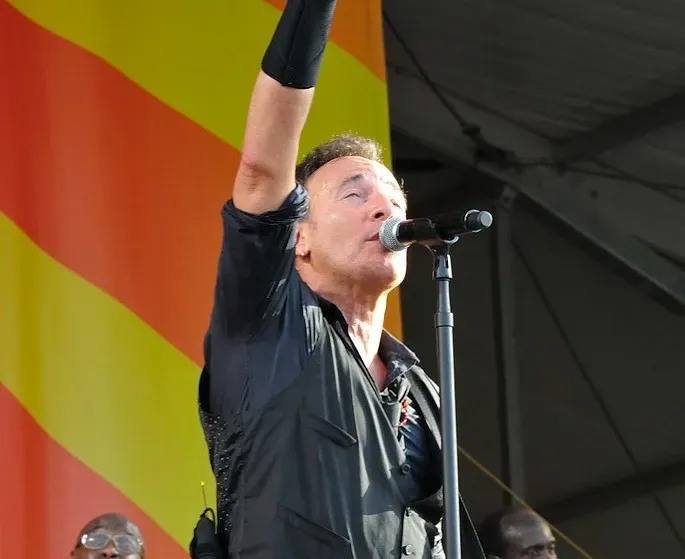
Ronald Reagan attempted to use it as a 1984 campaign song, which prompted Springsteen to publicly demand he stop, because the track is not a patriotic anthem but a portrait of a working-class man discarded by his own country. The narrator ships off to Vietnam to avoid jail, watches his friends die, and returns home to find nothing waiting for him. The triumphant synth-rock production did most of the misdirecting, with the lyrics always telling a story of institutional abandonment dressed in red, white, and blue.
While many people foolishly thought it was a patriotic song, “Born in the U.S.A.” casts a shameful eye on the treatment of veterans when they returned home from the war. The song is explicitly anti-war and questions the point of wars fought by a country that then turns its back on its own people. The irony that it became a fist-pumping anthem is almost too on the nose. It remains one of the most misread songs in the history of popular music.
7. “Escape (The Piña Colada Song)” – Rupert Holmes (1979)

The cheerful 1979 hit is built entirely around a man who places a personal ad to cheat on his partner, only to discover that the woman who responds is his actual partner, who was doing the exact same thing. The song frames this as a happy ending and invites listeners to feel charmed by the coincidence, glossing entirely over the fact that both people in the relationship were actively seeking someone new at the same time.
The song hit number one in the U.S. and became a holiday radio staple, which is a remarkable cultural outcome for a song whose premise is mutual infidelity presented as romantic destiny. The whole premise is that both parties are super bored and unhappy in their relationship, so they both attempt to cheat, and when their date turns out to be the person they were trying to cheat on, they think it’s funny and stay together. Decades of listeners absorbed this as warmth and whimsy.
8. “Hey Ya!” – OutKast (2003)

While credited to OutKast, “Hey Ya!” is mostly a creation of André 3000 and was an enormous success, becoming the duo’s most popular song. According to André, the song was meant to comment on the cold and rather emotionless relationships developing in the early 21st century. He told MTV that the lyrics reflect a romantic couple who are staying together simply out of expectations, deeply unhappy but remaining together because people want them to and they are expected to do so for life.
Somehow OutKast got the whole country grooving to some of the saddest lyrics ever written. The brass fanfare, the shake-it chant, the sheer exuberance of the production made it one of the most jubilant-sounding songs of its decade. The clash between the dark lyrics and the poppy music is even referenced within the song itself, with André acknowledging that audiences don’t want to hear him, they just want to dance. That self-awareness didn’t slow the song down for a single second. It was number one anyway.
What runs through all eight of these songs is the same fundamental truth about how popular music works. The melody arrives first. The beat settles into the body before the brain has a chance to catch up. By the time a listener might stop to ask what a song actually means, they’ve already loved it for months. Radio understood this perfectly, even when it probably shouldn’t have.
Partner offer
Planning a trip to Vegas?
Compare hotel rates and show tickets on VEGAS.com.