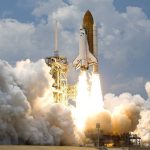
The Journey and Unloading of a Rocket Giant (Image Credits: Pixabay)
Kennedy Space Center, Florida — A massive segment of the rocket destined for NASA’s next major Artemis mission docked at this Florida launch site on April 27. The top four-fifths of the Space Launch System core stage traveled 900 miles aboard the Pegasus barge from NASA’s Michoud Assembly Facility in New Orleans.[1][2] Technicians offloaded the component the following day and maneuvered it into the Vehicle Assembly Building, marking a key step in preparations for the 2027 flight.[3]
The Journey and Unloading of a Rocket Giant
The core stage segment arrived at Kennedy’s Complex 39 turn basin wharf despite challenging weather conditions. This orange, cylindrical structure includes the liquid hydrogen tank, liquid oxygen tank, intertank, and forward skirt. When fully assembled with its previously delivered boat-tail and engine section, the complete core stage will measure 212 feet in height.[1][4]
Teams transported the piece horizontally into the Vehicle Assembly Building’s transfer aisle on April 28 before lifting it upright into High Bay 2. NASA provided a livestream of the operation, which highlighted the precision required for such large-scale handling. This process represented the first time core stage assembly occurred directly at Kennedy, building on earlier integrations of the engine section from August 2025.[2]
The stage’s tanks will hold more than 733,000 gallons of super-chilled liquid propellant to power four RS-25 engines during ascent. Flight computers, or avionics, within the structure will manage the rocket’s initial flight phase.
Artemis III: Shifting Focus to Orbital Docking Tests
NASA redesigned Artemis III as a demonstration of rendezvous and docking in low Earth orbit. Astronauts will launch aboard the Orion spacecraft atop the SLS rocket to connect with one or both commercial human landing systems from SpaceX and Blue Origin. These tests prepare for actual lunar surface missions on Artemis IV, targeted for 2028.[5][3]
The mission launches from Kennedy Space Center in late 2027, according to NASA Administrator Jared Isaacman. Neither the SpaceX Starship Human Landing System nor Blue Origin’s Mark II lander has flown with crew yet, making these validations essential. Blue Origin advances its uncrewed Mark I Endurance lander, while SpaceX pursues orbital refueling for Starship reusability.[4]
Partner offer
Broader Hardware Momentum at Kennedy
Progress extends beyond the core stage. The first shipment of solid rocket booster motor segments arrived on April 13 via rail from Northrop Grumman in Utah. These components crossed eight states in specialized containers and now undergo inspection in Kennedy’s Rotation, Processing and Surge Facility.[2]
A second booster shipment follows this summer. Once processed, the segments will stack into twin 17-story boosters that provide over 75 percent of liftoff thrust. Combined with the core stage and engines, the full SLS will generate 8.8 million pounds of thrust. Meanwhile, Orion’s crew module for Artemis III completed heat shield installation with 186 Avcoat blocks, along with thermal testing and solar array checks.[2]
At the same facility, technicians began de-servicing the Artemis II Orion capsule on April 28. That spacecraft carried NASA astronauts Reid Wiseman, Victor Glover, and Christina Koch, plus Canadian Space Agency astronaut Jeremy Hansen on a successful 10-day lunar flyby mission launched April 1. Data from the flight, which covered 694,481 miles, will refine procedures for upcoming Orions, including heat shield analysis and propellant management.[4][2]
Key Components of SLS for Artemis III:
- Core Stage: 212 feet tall, 733,000+ gallons propellant, 4 RS-25 engines.
- Solid Rocket Boosters: Twin 17-story structures, 75%+ liftoff thrust.
- Total Thrust: 8.8 million pounds.
- Orion Spacecraft: Tests docking with commercial landers in orbit.
Building Launch Cadence Amid Rapid Program Pace
The core stage rollout came just weeks after Artemis II lifted off from Launch Pad 39B. NASA emphasizes increasing SLS production rhythm despite the rocket’s complexity. Isaacman noted the involvement of five prime contractors and numerous subcontractors working with decades-old designs. “You need muscle memory to do that,” he said.[3]
Kennedy buzzes with activity. Blue Origin tests its New Glenn rocket from nearby Cape Canaveral, while SpaceX advances Starship at local sites. Private investment distinguishes this era from Apollo, Isaacman observed, with leading companies contributing to sustained U.S. space leadership.
Full integration of the Artemis III SLS proceeds in the VAB, setting the stage for rigorous ground testing. As hardware converges, the program edges closer to validating technologies for sustained lunar presence and eventual Mars exploration. Each arrival reinforces NASA’s methodical push forward.
Partner offer
Planning a trip to Vegas?
Compare hotel rates and show tickets on VEGAS.com.