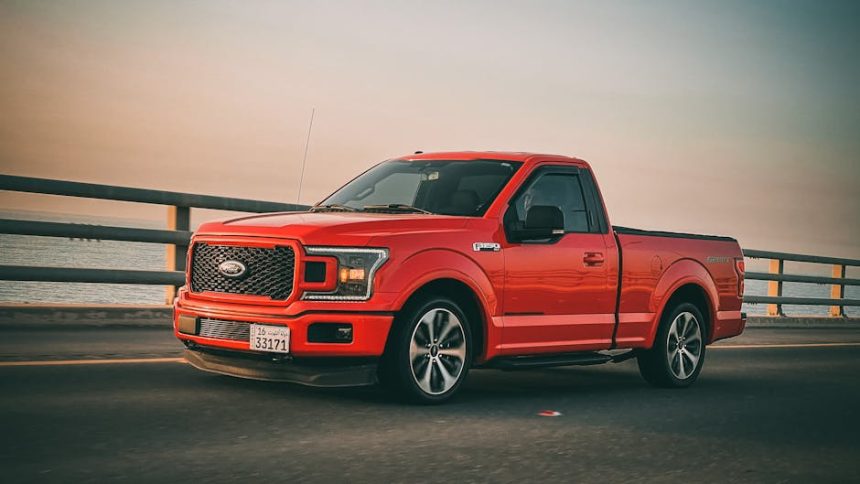


Ford says an affordable electric pickup truck is still coming next year – Image for illustrative purposes only (Image credits: Pexels)
Ford engineers in a sprawling California facility meticulously test 3D-printed parts in wind tunnels, chasing efficiency gains measured in millimeters. This hands-on work underscores the company’s determination to deliver an affordable electric midsize pickup, even after recording a staggering $19.5 billion charge on prior EV investments late last year.[1][2] The vehicle, priced around $30,000, represents a cornerstone of Ford’s renewed focus on accessible electric trucks set for a 2027 launch.
A Costly Pivot in the EV Arena
Ford disclosed the $19.5 billion writedown in December 2025, attributing it largely to softening demand for electric vehicles and shifts in federal policies under the Trump administration. The charge encompassed $8.5 billion tied to canceled models, including a next-generation electric F-150 Lightning and a heavy-duty truck project known as T3.[1] Additional costs stemmed from dissolving a battery joint venture with SK On and other program expenses.
CEO Jim Farley explained that rapid market changes prompted the decision, stating the company would redirect resources toward higher-return opportunities. Ford scrapped plans for large battery-powered vehicles lacking a clear profitability path, opting instead for hybrids, extended-range EVs, and smaller pure electrics. The automaker raised its 2025 adjusted EBIT guidance to $7 billion following the announcement, with shares ticking up in after-hours trading.[1]
The Universal EV Platform Takes Shape
At the heart of Ford’s affordable EV push lies the Universal Electric Vehicle platform, or UEV, designed to underpin a range of models from subcompacts to vans. The midsize electric pickup will debut as the first UEV-based offering, with production slated for Ford’s Louisville Assembly Plant in Kentucky, retooled from Escape SUV assembly.[3] A skunkworks team, starting with one employee and expanding to about 450 in Long Beach, California – bolstered by 200 more in Silicon Valley – drives the development under former Tesla executive Alan Clarke.
This platform slashes parts by roughly 20 percent compared to typical Ford programs, requiring 25 percent fewer fasteners and 40 percent fewer workstations on the assembly line. Prismatic lithium iron phosphate batteries, free of nickel and cobalt, will assemble at Ford’s BlueOval plant in Marshall, Michigan, prioritizing cost and durability – chemistry that powers 80 percent of China’s EV market.[3][4] Ford positions the UEV as one of its most ambitious undertakings, aiming for profitability on EVs under $40,000 by 2029.
Partner offer

Cost-Cutting Innovations Power the Truck’s Edge
Ford’s team pursued relentless optimization, drawing half its aerodynamics experts from Formula 1 racing. The result: a design 15 percent more aerodynamic than any current pickup, delivering nearly 50 extra miles of range versus gas counterparts with equivalent batteries – even 30 percent better at highway speeds.[4][3] Subtle tweaks, like a teardrop roofline or smaller side mirrors with single actuators, translate to tangible savings – a millimeter roof adjustment alone cuts battery costs by $1.30.
Unicastings replace 146 Maverick parts with just two major structural components, lightening the truck by 27 percent over rivals and easing manufacturing. Zonal architecture condenses 30 electronic control units into five modules, trimming wiring by 4,000 feet and 22 pounds. A 48-volt system handles ancillaries for faster charging and longevity, while “cutlines” on castings enable targeted repairs.[2]
- Aerodynamic “bounty targets” reward efficiency gains with range boosts.
- LFP batteries shrink size and weight, freeing interior space exceeding a Toyota RAV4.
- In-house prototyping at the 250,000-square-foot Long Beach center accelerates iteration.
- Expectations hover above 300 miles of range, though exact figures remain under wraps.
These measures not only hit the $30,000 target but promise lower total ownership costs than a Tesla Model Y, Clarke noted, attracting buyers from SUVs, cars, and even used vehicles.[3]
Market Positioning and Road Ahead
The truck echoes the Ford Maverick in size but offers a traditional pickup profile – vertical cab back, elevated bed sides – potentially reviving the Ranchero name. It arrives as full-size EV trucks like the F-150 Lightning and Chevrolet Silverado EV start above $50,000, filling a gap for budget-conscious buyers.[2] Ford eyes a 50 percent electrified mix by 2030, blending this UEV lineup with hybrids.
Recent previews, including prototype reveals, signal progress toward the 2027 rollout. Future UEV models could include SUVs, sedans, and vans, broadening Ford’s affordable EV footprint. As the company navigates EV market headwinds, this pickup stands as a test of its ability to blend innovation with pragmatism, potentially echoing the Model T’s transformative legacy.
“The best part is no part; the second best part is the one that does multiple functions.”
– Vlad Bogachuk, Ford chief engineer of advanced vehicle structure architecture[2]
Partner offer
Planning a trip to Vegas?
Compare hotel rates and show tickets on VEGAS.com.