Some careers are measured in albums. Quincy Jones’s career is better measured in eras. He worked with big band leaders in the 1950s and was still shaping modern pop conversations decades later, a stretch of relevance that few people in any creative field ever manage. What makes his story worth revisiting isn’t just the sheer number of hits attached to his name, though there are plenty. It’s the way he kept adapting, genre after genre, decade after decade, without ever losing his own musical fingerprint. Understanding how that happened means looking at the individual decades themselves, one stretch of work at a time.
The 1950s: Learning the Trade Among Jazz Giants
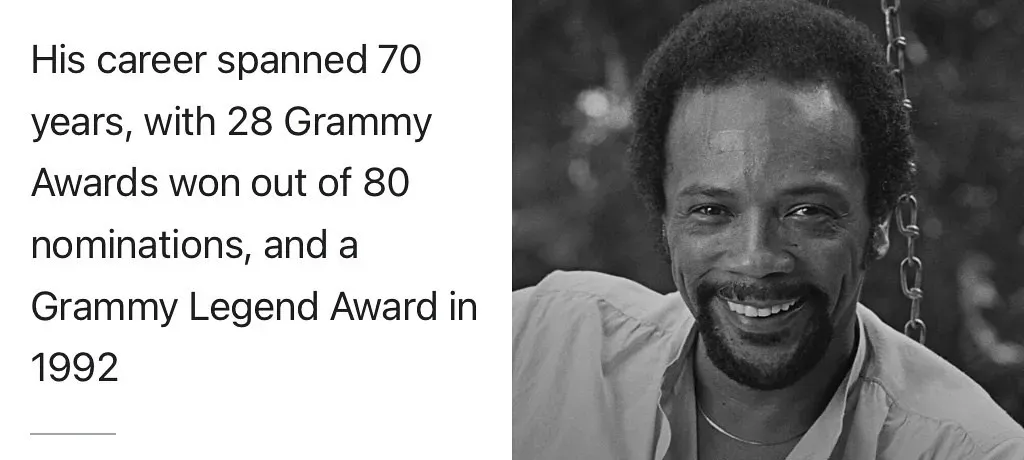
Quincy Jones began as a jazz trumpeter, and he worked his way up to a spot in Dizzy Gillespie’s band while honing his chops as a producer, composer, and arranger for everyone from Count Basie to Duke Ellington and Ray Charles. This was the foundation decade, the one where he learned orchestration and arrangement from people who were already legends. It wasn’t glamorous work by pop standards, but it built the musical vocabulary he’d draw on for the rest of his life.
He was also present at a surprising turning point in American music history. He was even in on the ground floor of rock and roll, conducting and arranging Big Maybelle’s 1955 record “Whole Lotta Shakin’ Goin’ On,” two years before Jerry Lee Lewis recorded his hit version of the song. Few people realize a jazz arranger had a hand in something that predates one of rock’s defining anthems.
The 1960s: From Arranger to Hitmaking Producer
The 1960s is where Jones stopped being purely a sideman to jazz royalty and started building his own reputation as a hitmaker. Jones’s breakthrough on the Billboard Hot 100 came as the producer of Lesley Gore’s Billboard Hot 100 No. 1 hit “It’s My Party” in 1963. That single wasn’t a one-off either.
“It’s My Party” was a smash hit like many of the other 18 singles Jones produced with Gore during the early to mid 1960s. He was also arranging for the biggest crooner in the business during this stretch, work that would later be cited alongside his Sinatra collaborations as some of his most enduring output. By the end of the decade, Jones had proven he could translate his jazz instincts into commercial success, a skill that would define the rest of his career.
The 1970s: Building a Behind-the-Scenes Empire
The 1970s were quieter in terms of chart-topping singles under his own name, but this was the decade where Jones expanded into film scoring and television work, broadening his reach well beyond the recording studio. He kept working as an arranger and producer for a wide range of artists while establishing himself as a trusted name in Hollywood circles. This groundwork mattered enormously, because it positioned him as someone label executives and artists alike saw as versatile rather than confined to one genre or medium.
It’s also worth noting that Jones was quietly breaking barriers during this period. He became one of the first African Americans to hold a top executive position at a major American record label, a role that gave him influence over decisions far beyond his own productions. That kind of institutional access is rarely discussed alongside his hit records, but it shaped the opportunities that came next.
The 1980s: Thriller, Off the Wall, and a New Level of Fame
If one decade defines Quincy Jones in the popular imagination, it’s this one. Producing Michael Jackson’s “Don’t Stop Til You Get Enough” in 1979 kicked off one of the most successful partnerships in music history, with collaborations that yielded Off the Wall, Thriller and Bad, helping Jackson become the King of Pop. Thriller in particular became a cultural phenomenon that went beyond ordinary chart success.
Jones stands as one of the most successful and admired creative artists and executives in the entertainment industry, in large part because of Thriller, the best selling album of all time with over forty six million copies sold. He didn’t stop with Jackson either. In 1985, he recorded the charity single “We Are the World” as producer and conductor with a supergroup that included Lionel Richie, Stevie Wonder, Paul Simon, and dozens of others, a single that sold 20 million copies and remains the eighth best selling single of all time.
The 1990s: Executive, Entrepreneur, and Media Mogul
By the 1990s, Jones had shifted much of his energy toward building institutions rather than chasing singles. In 1991, he founded Vibe magazine, devoted to R&B and hip hop music and culture, giving him a platform to shape how those genres were covered in the press. That same year, he helped launch NBC-TV’s hit series The Fresh Prince of Bel Air, for which he served as an executive producer.
He didn’t abandon the studio entirely, but his focus had clearly widened. In 1994, he formed Qwest Broadcasting, one of the largest minority owned broadcasting companies in the United States. This decade shows a different side of the same restless ambition, someone who had already conquered the record charts turning his attention to media ownership and cultural infrastructure instead.
The 2000s and 2010s: Documentaries, Honors, and Continued Relevance
Jones kept working well into his seventies and eighties, though the nature of his output shifted again. His later solo releases included “Q’s Jook Joint” in 1995 and “Q Soul Bossa Nostra” in 2010, the former featuring a host of seasoned R&B and jazz veterans alongside young hip hop stars. He also turned toward storytelling about his own legacy, producing documentaries and writing about his craft.
He produced the award winning 2014 documentary Keep On Keepin’ On, the story of jazz legend Clark Terry, the same mentor who had taught him trumpet decades earlier. Recognition kept arriving too. In 2016, when he received a Tony Award for Best Revival of a Musical for the Broadway production of The Color Purple, it made him a rare EGOT winner, the exclusive club of artists who have received Emmy, Grammy, Oscar, and Tony Awards. Two years later, in 2018, Jones won his 28th Grammy Award for the Netflix documentary Quincy.
The Final Chapter and a Legacy That Spanned Seven Decades
Quincy Jones died on November 3, 2024, at his home in the Bel Air neighborhood of Los Angeles. He was 91 years old, and died in Los Angeles of pancreatic cancer. By the time of his passing, most obituaries and tributes were describing his career as spanning seven decades rather than six, a testament to just how long he kept working.
Known to many as ‘Q,’ he was revered as a record producer, songwriter, composer, arranger and performer through his seven decades in the business, racking up 80 Grammy nominations and 28 wins. His influence reached artists who came of age long after his commercial peak. Jones inspired countless artists, including much younger artists like Kendrick Lamar, who credited Jones as the inspiration for combining hip hop and jazz in the 2018 documentary Quincy.
Why His Range Still Stands Out Today

What separates Jones from most producers who enjoy long careers is that he never settled into one sound and rode it out. He moved from big band jazz to girl group pop to disco influenced funk to stadium sized charity anthems to hip hop adjacent late career work, each time absorbing something new rather than repeating himself. That kind of stylistic flexibility is rare, and it’s part of why his catalog still gets studied by producers and musicians working today.
He also understood, earlier than most, that a producer’s job extended beyond the mixing board. Founding a magazine, executive producing television, building a broadcasting company, none of that is typical resume material for someone known primarily for hit records. Jones treated the music business as one interconnected ecosystem, and that broader view is arguably as influential as any single song he ever touched.
Final Thoughts