There’s a peculiar kind of nerve required to open a novel with its own conclusion. Most storytelling wisdom says you should earn the ending, that readers need to travel the whole road before they get to see the view. Yet some of the most compelling fiction ever written tears that rulebook apart, dropping you right into the aftermath, the death, the reveal, or the wreckage before you’ve even learned anyone’s name.
The technique has ancient roots. The narrative technique of beginning a story in medias res has origins in oral tradition and is a stylistic convention of epic poetry, exemplified in Western literature by the Iliad and the Odyssey. Modern novelists have taken the idea even further, beginning not just in the middle of things but at the very end, forcing readers to ask not “what happens next?” but “how on earth did we get here?” These ten books do exactly that – and somehow, they still manage to surprise you.
Slaughterhouse-Five by Kurt Vonnegut (1969)
Vonnegut’s anti-war masterpiece announces its own ending in its opening pages. The narrator tells us plainly that the story he’s about to tell is true, that Billy Pilgrim has come unstuck in time, and that it ends with a bird going “Poo-tee-weet?” The scaffolding is visible from the start. Kurt Vonnegut’s Slaughterhouse-Five illustrates time as a dimension experienced discontinuously by the protagonist.
Vonnegut’s novel, based on the author’s experience of the destruction of Dresden in 1945, is a postmodern literary work that follows a broken narrative line, striving to assemble fragments of past and present into a unifying whole. Knowing that Dresden burns, that Billy survives, that war is senseless – none of it dulls the emotional impact. The surprise isn’t the outcome. It’s how ordinary the catastrophe feels by the time you get there.
The Book Thief by Markus Zusak (2005)
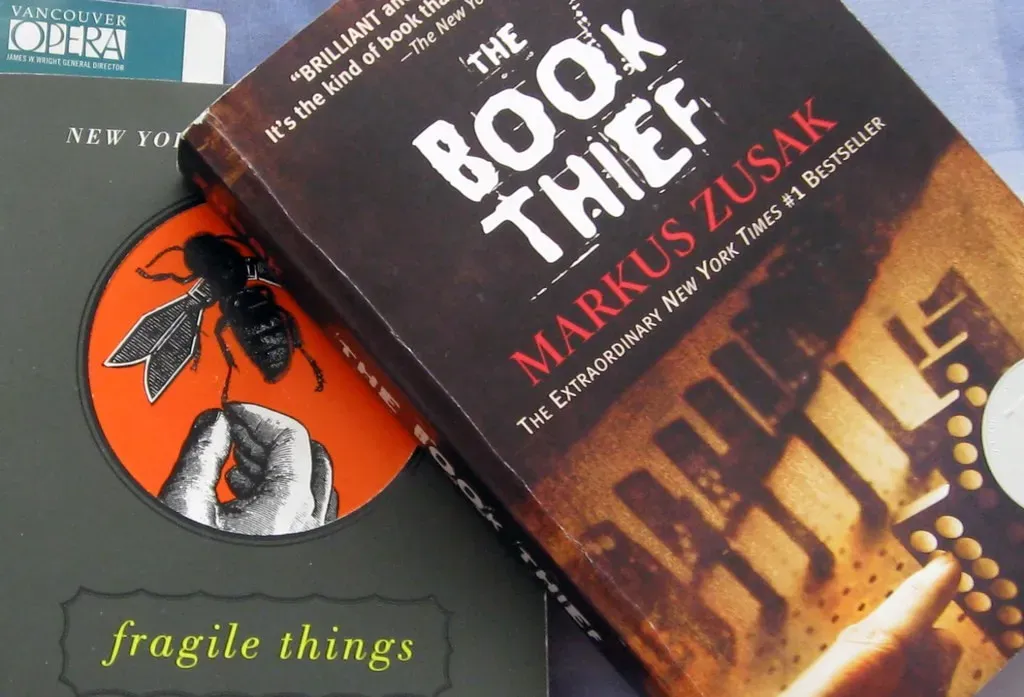
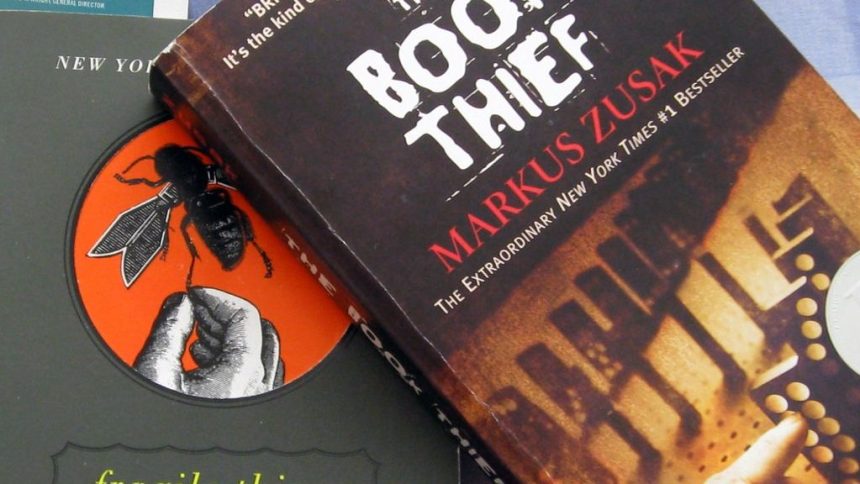
The Book Thief is a 2005 novel by Markus Zusak, focusing on Liesel Meminger, a young girl living in Germany during World War II, and her new life with an adoptive family as they shelter a man from the Nazis. What makes its structure so unusual is the narrator: Death itself, who introduces the story by revealing the key moments of Liesel’s life before the main narrative even begins. In the Prologue, Death establishes the main events of the story, identifies the book thief, and the moments during which he sees her throughout the course of her life, providing glimpses of the story’s future without narrating in detail.
With Death as the unconventional narrator of The Book Thief, the novel immediately establishes that the story will mix elements of fantasy with historical fact. Rather than being stereotypically grim or creepy, Death presents himself as sensitive to color and light, and rather regretful about his unfortunate line of work. He has feelings for the souls he collects, and the humans left behind. Even when you know the deaths are coming, Zusak makes each one land with full force. That’s the novel’s quiet genius.
Time’s Arrow by Martin Amis (1991)

Time’s Arrow: or The Nature of the Offence (1991) is a novel by Martin Amis, shortlisted for the Booker Prize in 1991. It is notable partly because the events occur in a reverse chronology, with time passing in reverse and the main character becoming younger and younger during the novel. The novel recounts the life of a German Holocaust doctor in reverse chronology. It opens at the end of the doctor’s life, with his death, and then winds methodically backward toward his crimes.
The story is told from the perspective of an undefined entity inhabiting a German-American doctor’s body. The entity gains awareness at the moment of the doctor’s death and observes the events of the man’s life unfold backwards. A highly experimental work, Amis uses the novel to explore the themes of the nature of time and the impact of evil. It has been argued that Amis borrowed the concept of travelling backwards in time as a plot device from Kurt Vonnegut, who used it in Slaughterhouse-Five, and Amis recognised that Vonnegut’s 1969 novel served as inspiration for Time’s Arrow. The result is profoundly unsettling – and surprisingly moving.
The Lovely Bones by Alice Sebold (2002)

Alice Sebold’s debut novel opens with its narrator already dead. Fourteen-year-old Susie Salmon tells us in the first lines that she was murdered, where, and by whom. The mystery is not whodunit. Sometimes novels go in full reverse chronological order, rewinding all the way to the beginning. This is a fascinating way to tell a story, because yes, you know the ending, but do you know how it came to be? The story still has a chance to slowly reveal why this thing happened, or who’s responsible, deliberately leaving details out that the narrative fills in as you rewind the clock until it all makes sense.
The Lovely Bones by Alice Sebold is narrated by Susie Salmon from the afterlife. What Sebold withholds isn’t the fact of the crime but the emotional texture of its aftermath – how the living grieve, fracture, love, and endure. Watching Susie’s family from above, she discovers what she missed in life. The real surprise is how fiercely alive the whole book feels, despite beginning in death.
Gone Girl by Gillian Flynn (2012)
Flynn’s thriller is careful about what it reveals and when, but the novel’s structure is built around the tension between two timelines: Nick’s present-day account of his wife’s disappearance, and Amy’s diary entries running up to it. The novel opens on the fifth wedding anniversary of Nick and Amy Dunne, with Amy mysteriously missing. The narrative unfolds through alternating perspectives and timelines, gradually revealing the complexities of their relationship and the events leading up to her disappearance. The reader is thrown into a mystery without knowing the full context, and the truth is unveiled piece by piece through flashbacks and unreliable narrators.
Flynn essentially gives you the end state first – a missing woman, a suspected husband – and then dismantles your every assumption about who to believe. The diary entries you think you’re reading as backstory turn out to be anything but straightforward. Even readers who guess the twist early rarely anticipate the full, controlled brutality of the novel’s final act.
Partner offer
Fight Club by Chuck Palahniuk (1996)

Fight Club opens with a man named Tyler Durden sticking a gun down an unnamed narrator’s throat in a skyscraper that is about to explode. As readers, we’re late to the party and the stakes are already through the roof. We don’t know how the characters got to this point and we’re ushered along before we find out whether Durden pulls the trigger. It’s a deliberately disorienting opening that gives everything away while explaining nothing.
As we flashback to the beginning of the story, these questions will pull the reader inexorably towards the novel’s twisty conclusion. Palahniuk’s gamble is that knowing the endpoint doesn’t spoil the journey – and he’s right. The revelation about Tyler Durden’s true nature hits just as hard even when you’re primed for it, because the novel earns it through every strange, escalating chapter that precedes that moment.
How the García Girls Lost Their Accents by Julia Alvarez (1991)

The novel begins when the four García girls are grown women, with homes and children of their own, coming together to celebrate Papi’s birthday. Then it turns back time to the García girls in their teens, trying to figure out who they are after leaving the Dominican Republic and coming to America, caught between two worlds. Alvarez structures her story so that you meet the women first and the girls second, which makes each chapter feel like an act of archaeology.
By the time the final section returns to the family’s earliest years in the Dominican Republic, readers carry the full weight of what these girls will become. The losses – of language, identity, homeland – feel specific and earned precisely because you’ve already seen the adult aftermath. Starting with the climax or inciting incident entices the reader to want to know the back story, and because they’ve been drawn in by the drama-filled opening, they are now invested in learning more about it. Alvarez makes this effect feel not like a literary trick, but like memory itself.
The God of Small Things by Arundhati Roy (1997)

The novel begins long after the death of Sophie Mol, when the disastrous events that occurred after her arrival in Ayemenem have already unfolded, when Rahel and Estha have already grown up and returned to the place where their childhood blew apart and their mother’s love story ended in tragedy. Then the narrative reverses to the beginning, tracing back to the events of Rahel and Estha’s youth, when they and their mother moved back in with her family to disastrous consequences.
Roy’s prose is lush and circular, circling back to key images and phrases the way grief circles back to its origin. Knowing Sophie Mol dies, knowing the lovers are doomed, knowing Ammu will not survive – none of it robs the story of its suspense. If anything, the foreknowledge sharpens it. You read not to find out what happens, but to understand why the world was arranged in such a way that these things had to happen.
To Kill a Mockingbird by Harper Lee (1960)
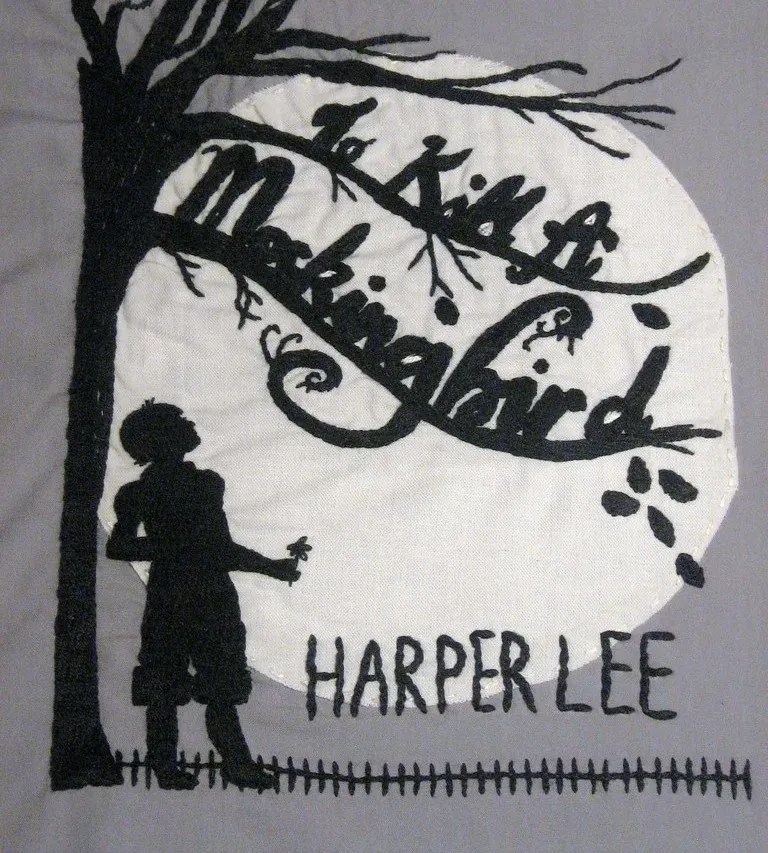
Lee’s classic opens with its narrator, Scout Finch, looking back on the summer that broke something in her brother Jem’s arm and, more permanently, in his sense of how the world works. The first page tells you the injury happened; it tells you roughly who was involved. The story then unspools through the eyes of young Scout, years before the moment she’s narrating from. To Kill a Mockingbird’s first sentence is in the present, and the rest of the book tells how Jem broke his arm.
What Lee understands is that adult Scout’s framing voice gives the childhood scenes a quality of elegy that a purely present-tense account couldn’t achieve. You know something was lost. The novel’s task is to show you exactly what it was, and how innocence doesn’t disappear all at once but in slow, accumulating shocks. By the time Jem’s arm breaks, it means something almost unbearable.
Laughter in the Dark by Vladimir Nabokov (1938)
Nabokov is famously playful with structure, and this early novel is perhaps the most audacious example of his willingness to spoil his own story. Laughter in the Dark is one of his earliest novels, and he tells you right off the bat what’s going to happen. The opening paragraph summarizes the entire plot in blunt, matter-of-fact sentences: a man, a woman, a betrayal, a catastrophe. Everything. Before chapter one truly begins.
What follows is Nabokov’s demonstration that knowing is irrelevant when the telling is this precise. The novel’s cruelty operates at the level of detail and texture, not surprise. When you drop someone into a moment without a full explanation, their brain starts trying to fill in the gaps – what’s happening, how did things get here, what did I miss. That small amount of uncertainty is usually enough to keep them reading, as long as they feel like they’re getting closer to understanding instead of drifting further away. Nabokov reverses even that instinct: he gives you full understanding upfront and then makes the journey itself the source of dread.
What links all ten of these novels is a shared conviction that suspense isn’t the same thing as secrecy. Some novels turn the linear story progression on its head. Some deliver spoilers to you on a platter by serving them up in the first few pages – these are the novels that begin at the end, that lay out the cards early and reveal all the sordid or dramatic details of how the story ends. The real question a book asks isn’t “what happens?” – it’s “why does any of this matter?” These novels answer that question from the very first page, and spend the rest of their pages proving they were right to do so.
Partner offer
Planning a trip to Vegas?
Compare hotel rates and show tickets on VEGAS.com.