Most of us pick up vocabulary from friends, headlines, and group chats. We rarely stop to ask where a word started. Sometimes the answer is a single author, working alone, who needed a term that didn’t exist yet.
Fiction has quietly stocked the dictionary for centuries. Some of these inventions are obvious in hindsight, while others have drifted so far from their source that the original book surprises people. Here are five novels whose made up words ended up in ordinary speech.
Snow Crash and the Metaverse

Neal Stephenson’s 1992 novel Snow Crash introduced the word metaverse. In the book, it’s a shared virtual world where people appear as customizable digital bodies. Stephenson also used the word avatar for those bodies, and that sense of the word has since become standard in computing.
The term spent decades mostly inside science fiction and gaming circles. Then in 2021, Facebook’s parent company renamed itself Meta, and the word went mainstream almost overnight. Companies, investors, and headline writers have used it ever since, usually without a nod to the novel.
Stranger in a Strange Land and Grok

Robert A. Heinlein’s 1961 novel Stranger in a Strange Land follows a human raised by Martians. To explain how the character sees the world, Heinlein invented the word grok. In the story it’s a Martian term with a literal link to drinking, and it came to mean understanding something so completely that you become part of it.
Programmers and hacker culture took to it early, and it spread through tech writing from there. Major dictionaries now list grok as an English verb. It meant something different on the page, but today people mostly use it to mean grasping an idea thoroughly.
Catch-22 and the Impossible Bind

Joseph Heller published Catch-22 in 1961, a satirical novel about American airmen in the Second World War. The title names a military rule that traps people in a loop. A pilot can be excused from flying only if he’s insane, but asking to be excused proves he’s sane.
Heller’s working title was reportedly Catch-18, which he changed to avoid confusion with another novel about the war, Leon Uris’s Mila 18. The new number stuck, and people now use catch-22 for any situation where the rules defeat themselves. You’ll hear it in job hunting, bureaucracy, and healthcare, usually from people who’ve never read the book.
Ivanhoe and the Freelancer

Sir Walter Scott’s Ivanhoe appeared in 1819 and is set in medieval England. In it, Scott used free lance to describe a mercenary knight whose spear was available to whoever paid. The phrase was his coinage for the story, and the Oxford English Dictionary credits him with it.
The word wasn’t about work yet. Later in the nineteenth century, writers began using it figuratively for independent workers who sold their services to different clients. Today freelance is a common noun, verb, and adjective, and few people picture a lance when they use it.
Nineteen Eighty-Four and Its Vocabulary of Control
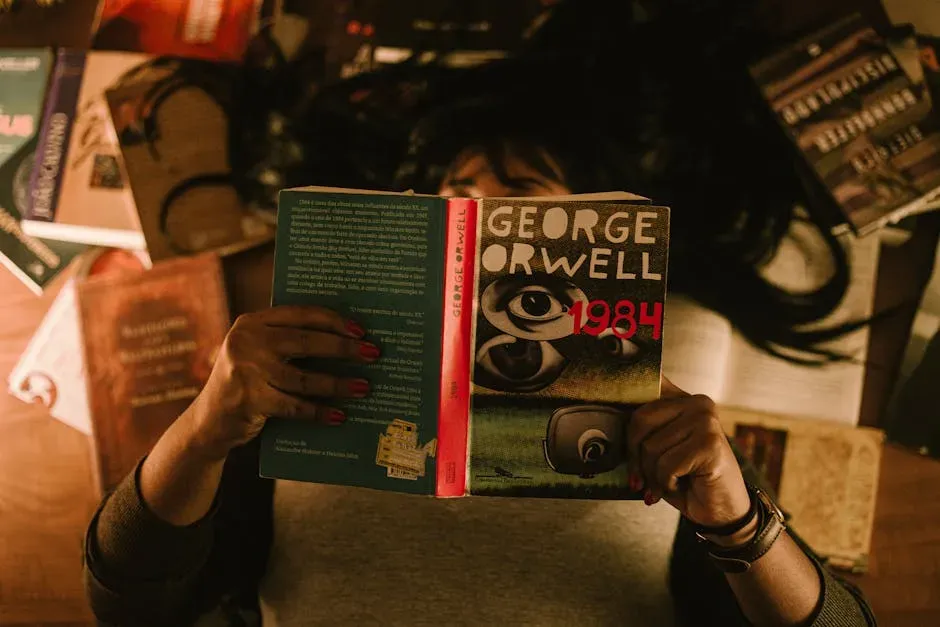
George Orwell’s 1949 novel Nineteen Eighty-Four supplied an unusually large set of terms. Big Brother, doublethink, thoughtcrime, Newspeak, and memory hole all come from its pages. Room 101 is also Orwell’s, though it’s a place rather than a coined word.
These terms have outlived the Cold War context that shaped them. Big Brother became the name of a long running television franchise, and Orwellian is a standard adjective for surveillance or manipulative language. Orwell’s own name is now a word, which is a rare outcome for any author.