


Not every artist wants to live inside their biggest hit forever. Some songs become so inescapable, so tied to a version of the artist they’ve outgrown, that the very people who wrote them start dreading the moment a crowd screams for it. Whether it’s fatigue, embarrassment, a bitter legal fight, or a change of faith, these seven musicians all reached a point where playing their most famous song live simply wasn’t worth it anymore.
What makes these stories interesting isn’t just the refusal itself, but the reasoning behind it. Some artists came back around eventually, easing back into old setlists once time healed the wound. Others never fully did. Either way, each case says something honest about what it’s like to watch a song you wrote take on a life you never intended.
1. Radiohead – “Creep”

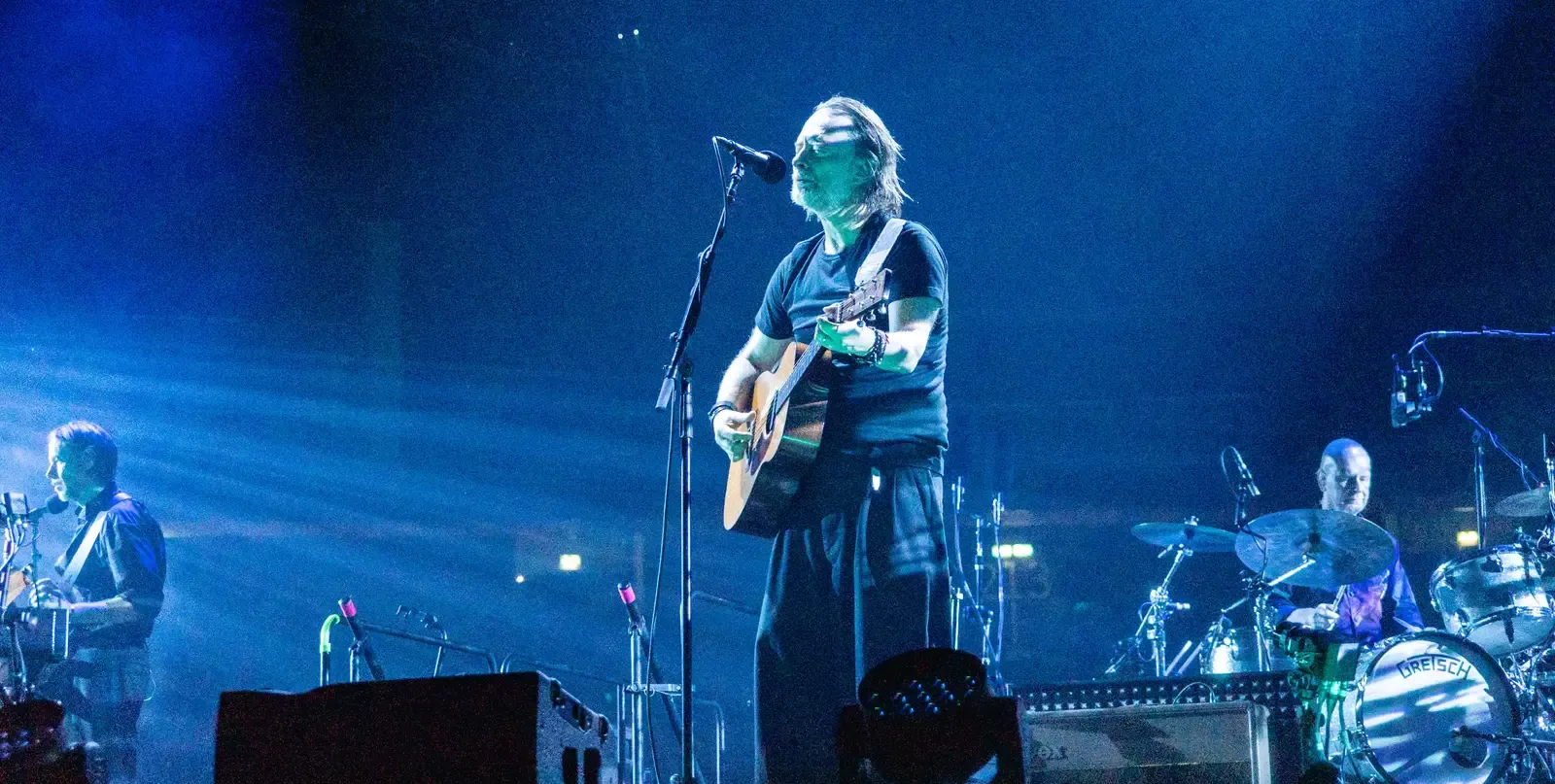
Thom Yorke wrote “Creep” as a college student wrestling with obsession and self-loathing, and the song eventually became Radiohead’s most well-known single to date, notching up over 2.3 billion streams. Ironically, the track flopped on its initial UK release, with BBC Radio 1 refusing to play it, calling it “too depressing”, before it exploded internationally the following year.
Success came at a cost. For a long stretch of their career, the band didn’t perform “Creep” at all, with Yorke openly saying “I’d rather be known as the band that did The Bends rather than the band that did ‘Creep'”. Guitarist Jonny Greenwood later explained that Yorke just doesn’t like playing it, and it’s like he’s not in that emotional space anymore so he doesn’t like playing it. The band has softened over the years and occasionally revives it, but it has never returned as a permanent setlist fixture.
2. R.E.M. – “Shiny Happy People”


Written for the 1991 album “Out of Time” and featuring the B-52’s Kate Pierson on vocals, “Shiny Happy People” became one of R.E.M.’s biggest radio hits. Yet frontman Michael Stipe never warmed to it, later calling it “a fruity pop song written for children” and admitting “I don’t hate it, but I don’t want to sing it”.
The band’s discomfort wasn’t just talk. According to setlist records, R.E.M. only performed “Shiny Happy People” twice, on “Saturday Night Live” and the Spanish music show “Rockopop,” both in 1991. Stipe went so far as to say that if one song had to represent R.E.M. forever, he would not want it to be “Shiny Happy People”, even as he softened slightly toward it decades later during the band’s farewell tour.
3. Creedence Clearwater Revival – “Proud Mary”


John Fogerty wrote “Proud Mary” in 1969, and it became one of the defining rock singles of its era, covered by everyone from Ike and Tina Turner to Elvis Presley. After Creedence Clearwater Revival broke up in 1972, Fogerty found himself locked in a brutal, decades-long legal fight with Fantasy Records over publishing rights to the songs he’d written for the band. He felt so estranged from the material that he stopped performing CCR songs live entirely for roughly twenty years.
It wasn’t until the early 1990s, after settling into a healthier relationship with his own catalog, that Fogerty began reintroducing “Proud Mary” and other CCR staples into his solo shows. He has spoken publicly in interviews and in his memoir about how painful it was to feel disconnected from songs he’d poured himself into, simply because of who controlled the rights to them. The reunion between Fogerty and his own back catalog is now considered one of rock’s more satisfying comeback stories.
4. Guns N’ Roses – “One in a Million”


Released on the 1988 compilation “G N’ R Lies,” “One in a Million” was a commercial success but immediately controversial due to lyrics widely criticized as racist and homophobic. Axl Rose defended the song at the time as a personal reflection of frustration rather than a statement of hatred, but the backlash never really faded, and it became one of the most debated tracks in the band’s catalog.
Guns N’ Roses eventually pulled the song from their live rotation almost entirely, and it has remained absent from the vast majority of their setlists for decades, including their lengthy reunion tours of the 2010s and 2020s. Rose has occasionally addressed the criticism in interviews over the years, acknowledging the lyrics were poorly chosen even while explaining the personal anger that shaped them. The song stands as one of the clearest examples of a band essentially retiring a hit because of its own words.
5. Yusuf / Cat Stevens – “Peace Train”


Cat Stevens wrote “Peace Train” in 1971, and it became one of the defining anthems of the era’s soft-rock, socially conscious songwriting. After his conversion to Islam in 1977 and his adoption of the name Yusuf Islam, he stepped away from the mainstream music industry almost entirely, selling his guitars and focusing on religious study and charitable work instead.
For close to three decades, Yusuf did not perform his old secular catalog live, including “Peace Train,” viewing that chapter of his life as something he had genuinely left behind rather than a career to maintain. It wasn’t until the 2000s, and more fully after his surprise appearance and later Rock and Roll Hall of Fame induction, that he began reintroducing his classic songs into live performances again. The gap between writing the song and choosing to sing it again publicly remains one of the longest of any artist on this list.
6. Nirvana – “Smells Like Teen Spirit”


Few songs defined a decade the way “Smells Like Teen Spirit” defined the early 1990s, catapulting Nirvana from underground favorites to the most talked-about band on the planet almost overnight. Kurt Cobain, however, grew visibly uncomfortable with the song’s dominance, feeling that it reduced the band to a single moment and overshadowed everything else they were trying to do artistically.
By the final year of Nirvana’s existence, Cobain was reportedly reluctant to play the song with any enthusiasm, sometimes rushing through it or altering it during shows, and he spoke in interviews about resenting how it had become the band’s defining identity. He never fully cut it from setlists the way some artists on this list did, but his visible discomfort performing it became one of the more talked-about tensions of Nirvana’s brief, turbulent run at the top.
7. The Verve – “Bittersweet Symphony”


Richard Ashcroft wrote “Bittersweet Symphony” using an orchestral sample from a Rolling Stones cover, and the resulting legal dispute became almost as famous as the song itself. Because the sample cleared rights to the Rolling Stones’ publishing catalog, Mick Jagger and Keith Richards ended up credited as co-writers, and for years virtually all of the song’s royalties went to the Stones’ former manager rather than to Ashcroft.
The bitterness of that arrangement made “Bittersweet Symphony” a complicated song for Ashcroft to perform for much of his career, since he was essentially singing a song he’d written but didn’t legally own. It wasn’t until 2019, when Jagger and Richards voluntarily signed over their songwriting credit and royalties to Ashcroft, that he was able to reclaim full ownership. Only then did performing the song start to feel, in his own words, like singing something that was truly his again.
Taken together, these seven stories show that a song’s popularity and an artist’s relationship with it are two very different things. A hit can outgrow its creator, turn into a legal battlefield, or simply stop fitting the person someone has become. Whatever the reason, each of these musicians reminds us that writing a song and wanting to live inside it forever are not always the same thing.


