Television executives have been raiding the British schedule for decades, and it’s not hard to see why. A hit format already proven with audiences overseas takes some of the guesswork out of a notoriously risky business. Some of these transplanted shows barely got a season before fading away, while others turned into ratings juggernauts that ran for the better part of a decade. Here’s a look at eight notable examples and exactly how long each one lasted on American screens.
1. The Office (2005-2013)

Ricky Gervais and Stephen Merchant’s mockumentary about a hapless paper company boss became a cult favorite in the UK, but its American cousin turned into something much bigger. Steve Carell played office boss Michael Scott for seven seasons before stepping down, and the show ran for a further two years before drawing to a close. That gave the NBC version nine seasons in total, far outpacing the original’s brief run.
The British Office, by contrast, wrapped up after just two seasons and a Christmas special, with David Brent’s cringe comedy landing as more biting and less warm than Michael Scott’s version. Critics have often noted that David Brent is more offensive and nastier, while Michael Scott is more naive, optimistic and easier for the American audience to get behind. The American adaptation’s longevity turned it into one of the defining sitcoms of its era, with Dunder Mifflin’s Scranton branch becoming as familiar to US audiences as any real workplace.
2. Shameless (2011-2021)

Showtime’s take on the dysfunctional Gallagher family kept William H. Macy’s Frank Gallagher stumbling through eleven seasons, a run that dwarfed almost every other British import on this list. The UK original had already built a devoted following of its own, and this working-class comedy-drama won the BAFTA for Best Drama Series in 2005, and ran for 139 episodes from 2004 to 2013. Both versions shared a similar setup at first, though they eventually charted very different courses.
Many UK shows are known to produce short seasons that air for a few episodes each year, so to have 137 is quite a feat. When it was picked up by Showtime, there was a fear that it would lose some of its grit and shock value. Those fears largely proved unfounded, as the American version leaned into more hope for the future, with the latter seasons focusing on the evolution of the Gallagher children, particularly Fiona, as she takes on the role of family caretaker. The Chicago setting gave the show its own identity even while borrowing heavily from Manchester’s grittier original.
3. Sanford and Son (1972-1977)

Norman Lear had already proven British sitcoms could translate to American living rooms, and he went looking for a second hit after All in the Family took off. He found it in a British show about a junk dealer and his son, and turned it into a vehicle for stand-up comic Redd Foxx. This 1970s sitcom starred Redd Foxx as a cantankerous junk dealer and Demond Wilson as his frustrated son, and the show ran for six seasons, comprising 135 episodes, from 1972 to 1977.
The source material, Steptoe and Son, had a longer British run, with the classic sitcom about a man and his elderly father who run a junk yard running for 57 episodes from 1962 to 1974, comprising eight seasons and two Christmas specials. Despite airing fewer episodes overall, Sanford and Son became a genuine cultural phenomenon in the US, with Sanford and Son debuting on NBC in 1972 and turning into a Top 5 hit, with Foxx’s Fred Sanford becoming a comedy icon.
4. All in the Family (1971-1979)
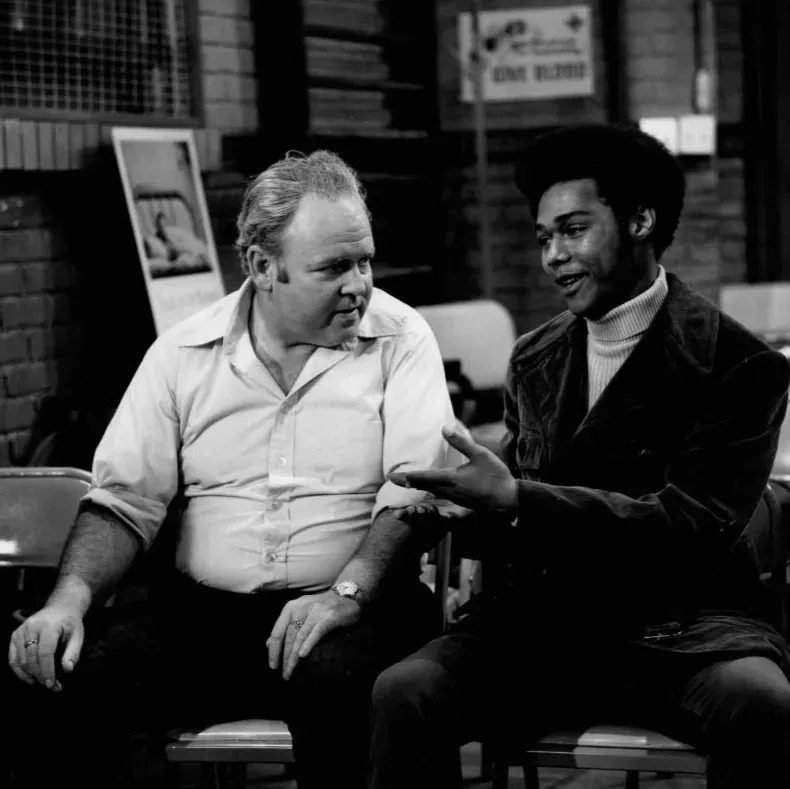
Before Sanford and Son, Norman Lear adapted a different British sitcom that reshaped what American television comedy could tackle. Archie Bunker may seem like a distinctly American creation, but his origins trace back to the U.K. comedy “Till Death Us Do Part,” which aired on the BBC from 1965 to 1975. The American version ran for nine seasons on CBS, spinning off multiple successful series of its own along the way, including Maude and The Jeffersons.
The two shows shared a similar premise but differed sharply in tone. In “Till Death Us Do Part,” the main couple were more insulting towards each other than their American equivalents, and Archie and Edith’s house was also larger and less cluttered, with Archie’s prejudices generally softened. That softening didn’t stop the American version from becoming one of the most talked-about and awarded sitcoms of the 1970s, tackling topics like race, war, and gender that few other shows of the era would touch.
Partner offer
5. Three’s Company (1977-1984)

This farcical roommate comedy became one of the biggest hits of its decade, built on a premise borrowed wholesale from a British sitcom about a chef sharing a flat with two women. The series aired from March 15, 1977, to September 18, 1984, lasting for eight seasons and 172 episodes. John Ritter’s physical comedy as Jack Tripper became the show’s calling card, and its run made it a fixture of American primetime for years.
The British original had a far shorter shelf life. The series was remade in the United States as Three’s Company in 1977, after Man About the House ran until 7 April 1976, after 39 episodes in six series. American producers stretched the concept out considerably, with Three’s Company running for seven and a half years and 172 episodes compared to three years and 40 episodes for the British original.
6. Queer as Folk (2000-2005)

Showtime adapted this groundbreaking British drama about a group of gay friends in Manchester, relocating the setting to Pittsburgh. The American and Canadian production ran for five seasons and 83 episodes total. It became one of the earliest American series to center gay characters and relationships without treating them as a subplot or punchline.
The show’s later seasons continued to explore its ensemble cast in depth, with the third season consisting of fourteen episodes and premiering on Showtime on March 2, 2003. While the British original that inspired it ran for a much shorter stretch, the American version’s five-year run allowed it to develop storylines and characters at a slower, more sustained pace than its source material ever attempted.
7. House of Cards (2013-2018)

Netflix’s political drama about a ruthless congressman clawing his way to the presidency was based on a British miniseries from the late 1980s that told a similarly cynical story about Westminster politics. The American version, starring Kevin Spacey and Robin Wright, ran for six seasons between 2013 and 2018, making it one of Netflix’s earliest flagship original series and a major factor in establishing the streamer’s reputation for prestige drama. The show’s final season was notably restructured after Spacey’s removal from the production following misconduct allegations, shifting the narrative focus onto Wright’s character for the remaining episodes.
The original British House of Cards, by comparison, was a tightly contained four-part miniseries broadcast in 1990, followed by two further limited series that concluded the story within just a few years. Where the British trilogy told a self-contained tale of political ambition and betrayal, the American version stretched the concept across dozens of episodes and multiple presidential terms, trading the original’s compact structure for a much longer serialized drama.
8. Cracker (1997-1998)

This one is a reminder that not every British import finds an audience in the US. Cracker followed a criminal psychologist who helps solve cases while battling his own demons, and the American version cast Robert Pastorelli in the lead role that Robbie Coltrane had originated in Britain. The series ran for one season of 16 episodes from 1997 to 1998, and also starred a young Josh Hartnett and, in the first episode, Mariska Hargitay.
The show’s brief run stands in sharp contrast to the British original, which built a strong reputation over several series and earned lasting acclaim in the UK. American audiences never quite connected with the format in the same way, and ABC pulled the plug after a single season, making Cracker one of the shorter-lived entries among British to American remakes.
Taken together, these eight shows show just how unpredictable the remake process can be. Some formats, like The Office and Shameless, found an even bigger audience once relocated to American soil and ran for years longer than their source material. Others, like Cracker, never quite translated despite strong pedigree, proving that a hit format overseas is no guarantee of success once it crosses the Atlantic.Partner offer
Planning a trip to Vegas?
Compare hotel rates and show tickets on VEGAS.com.