
There’s a moment in a lot of pop songs where something shifts and you feel it before you understand it. The chorus comes back one more time, but it sounds bigger, brighter, almost urgent in a way it wasn’t a minute ago. That’s usually a key change at work, and whether it lands as thrilling or eye-rolling often comes down to details most listeners never consciously notice. Songwriters have leaned on modulation for generations, from Broadway standards to Beyoncé. But the same tool that turns a decent chorus into a euphoric one can also tip a song into cliché territory in about four seconds flat. What separates the two outcomes is worth understanding, because it explains why some choruses feel earned and others feel like a cheap trick.
What actually happens when a key changes

A key change, or modulation, means the tonal center of a song moves from one note to another partway through. Depending on the kind of modulation performed, this can produce various emotional effects on the listener, like raising or lowering the energy level, brightening or darkening the mood, or creating a sense of unease. The ear latches onto a home base early in a song, and every chord afterward gets measured against that center whether the listener realizes it or not.
If a song is in C minor, that means it will predominantly feature the notes C, D, Eb, F, G, Ab, and Bb, and that tonal center grounds the listener, who hears every note and chord in terms of how it relates to that key. Shift that center, even by a single step, and the whole harmonic landscape tilts. That’s why a well placed modulation can feel like a physical lift, and a poorly placed one can feel like the floor moved without warning.
The truck driver’s gear change, for better or worse
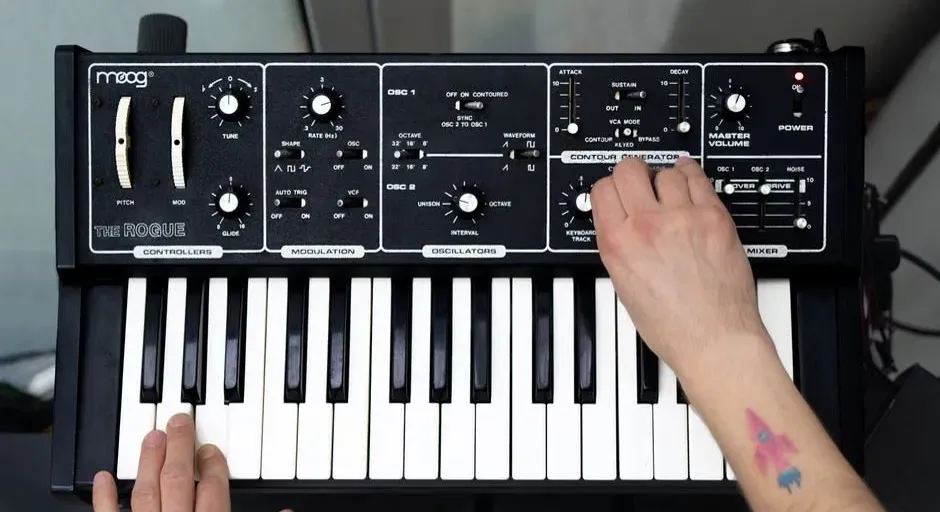
Most people have heard this move without knowing its nickname. It’s a modulation near the end of a song, shifting upwards by some relatively small pitch increment, usually by one semitone or whole tone, though occasionally by other intervals. It typically occurs after a chorus or as part of a bridge and is followed by a repeat of the chorus and often a fade out.
The term was apparently coined by a site comparing the technique to a tired, overworked truck driver performing an unartistic, mechanical function, and it’s become something of a discredited trope, though it still shows up with frequency in certain genres. Michael Jackson’s “Man in the Mirror” is the textbook case, and the song starts in G major before dramatically shifting to G sharp major right on the words “make that change,” a moment where the lyric and the modulation lock together. That kind of alignment between words and harmony is often the difference between a gear change that feels clever and one that feels mechanical.
Why the ear falls for the same trick every time

Even knowing the formula doesn’t blunt its effect much, and there’s a practical reason for that. The trick works because the ear has settled into the original key over three or four minutes, and yanking everything up by a step breaks that settledness and forces renewed attention on a section the listener has already heard twice. That renewed attention is exactly what a chorus needs on its third or fourth pass, when repetition risks turning excitement into background noise.
It is a blunt instrument, and it has become a cliché precisely because it reliably delivers the lift it promises. That’s the paradox of the truck driver’s gear change. Everyone recognizes it, plenty of critics mock it, yet it keeps getting used because it does exactly what it’s supposed to do, almost every time.
The quiet version: minor verse, major chorus

Not every key change announces itself. One of the more common tricks in pop and rock hides in plain sight. A verse in A minor that moves to a chorus in C major is technically a key change, but it barely registers as one, because the emotional shift from dark to bright happens naturally, making it the most common hidden key change in pop and rock, one many songwriters use without realizing they’re modulating.
The Beatles used this exact device decades ago. A classic example is “Girl,” where the melancholy verses sit in E minor and the slightly happier choruses land in the relative major of G, a shift so seamless it almost goes unnoticed. That subtlety is the point. The listener feels lifted without ever consciously registering that the ground underneath them moved.
Building tension before the payoff

Some songwriters don’t just let the minor-to-major shift happen quietly, they lean into it and make sure you feel the seam. Weezer’s “Buddy Holly” is a good example of this approach. The song does the same minor to relative major trick, moving from F sharp minor to A major, but River Cuomo wanted listeners to notice the arrival, so he heightens tension in the pre-chorus by moving the chords from D major to D minor, which adds extra pull toward A major and makes that chorus land harder.
This is really a lesson in contrast. A key change rarely works in isolation. It needs a runway, whether that’s a chord that creates friction right before the shift or a lyric that dramatizes the moment of arrival, so the new key feels like a destination rather than an accident.
Pivot chords, or how to sneak from one key to another

Not every modulation announces itself with a dramatic jump. Plenty rely on a quieter piece of harmonic engineering called a pivot chord. This kind of chord is called a common or pivot chord, and it leads to a smooth transition between two keys, because it belongs to both of them at once.
Dexys Midnight Runners’ “Come on Eileen” is a well documented example of this in action. The chorus is actually the second key change in the song, since the first happens just twenty one seconds into the intro when the key jumps from F major to C major, so listeners are already somewhat off balance by the time the chorus arrives. A pivot chord doesn’t eliminate the sense that something has shifted, but it softens the landing so the new key feels like a natural next step rather than a jolt.
Parallel keys and the emotional split screen

There’s another kind of key change that doesn’t move the tonal center at all, it just flips the mode from major to minor or back again. This is called parallel modulation, and it can create a striking emotional contrast within a single song. The Turtles’ “Happy Together” is a frequently cited case of this technique.
Parallel key modulation happens when a composer stays in the same key but reverses its major or minor orientation, and “Happy Together” starts in F sharp minor for a sad sounding verse before the chorus suddenly turns to F sharp major. The tonic note never moves, but the mood swings completely, which makes this one of the more efficient tricks in a songwriter’s toolkit when the lyric itself is holding two competing emotions at once.
When the shift happens more than once

Some songs don’t settle for a single modulation and instead keep climbing. Beyoncé’s “Love on Top” is probably the most cited modern example of stacking key changes for pure momentum. The song starts in C major, then modulates up a half step to D flat major, then another half step to D major, then another to E flat major, and finally up one more half step to E major.
Partner offer
Michael Jackson pulled off something similar in “Will You Be There.” The tune starts in D major, modulates up a whole step to E major, then up another whole step to F sharp major, and then up another whole step to G sharp major. Stacked modulations like these work because each shift is smaller and more frequent than a single dramatic jump, so the accumulation feels less like a gimmick and more like a slow, steady climb toward a peak.
K-pop and modern pop haven’t abandoned the trick

It’s tempting to assume modulation is a relic of eighties power ballads, but recent chart hits prove otherwise. BTS’s “Dynamite” is a clear counterexample from the past several years. The song modulates up a full step, moving from E major to F sharp major.
This matters because it shows the device hasn’t disappeared, it’s just been redistributed across genres that didn’t exist in the same form when the truck driver’s gear change was first named. K-pop production in particular has embraced dramatic structural shifts, key changes included, as a way to keep listeners hooked through repeated chorus cycles built for maximum replay value on streaming platforms.
Why a badly timed key change collapses a chorus

None of this works automatically. A modulation dropped into a song without preparation can undercut everything that came before it, turning a strong chorus into something that feels arbitrary. The gap before a key change does most of the work, because without it, a direct modulation reads as a mistake, while with it, the ear treats the silence as a reset and accepts the new key as home.
Momentum matters just as much as mechanics. A key change is earned when the song has built enough momentum that the shift feels like a natural escalation rather than an artificial boost, and if the arrangement, dynamics, and lyrics have all been building toward it, the modulation lands. Skip that buildup and even a technically correct modulation can feel bolted on, which is exactly the reputation the truck driver’s gear change earned over decades of lazy use in fading power ballads.
Final thoughts

Partner offer
Planning a trip to Vegas?
Compare hotel rates and show tickets on VEGAS.com.