Most investors understand the basic goal of growing wealth over time. What trips many of them up, though, is knowing when to step back and reset. Rebalancing is one of those concepts that sounds simple on the surface – but in practice, it touches everything from risk tolerance and psychology to taxes and timing. Done well, it’s one of the most quietly powerful tools a long-term investor has.
What Rebalancing Actually Means – and Why It Matters

Rebalancing is the process of realigning a portfolio back to its original, intended mix of assets after market movements cause certain positions to grow disproportionately large or small. Portfolio rebalancing is the practice of realigning a portfolio’s allocation to the percentages originally chosen, by reducing positions that have become an outsized part of the portfolio due to relative outperformance, while increasing positions that have become a smaller part due to underperformance. It’s the discipline of saying “this worked, now let’s not let it take over.”
In doing so, investment managers ensure that the portfolio’s allocation matches their client’s stated risk tolerance. That alignment is the whole point. Without it, the portfolio you hold a few years from now may look nothing like the one you originally designed – and carry far more risk than you ever intended.
Portfolio decisions are affected by the volatility of financial markets and the risk tolerance of investors, making regular adjustment an essential aspect for long-term investors. Think of rebalancing less as a correction and more as a course check. You’re not admitting something went wrong. You’re confirming you still know where you’re going.
How Bull Markets Create the Need to Rebalance
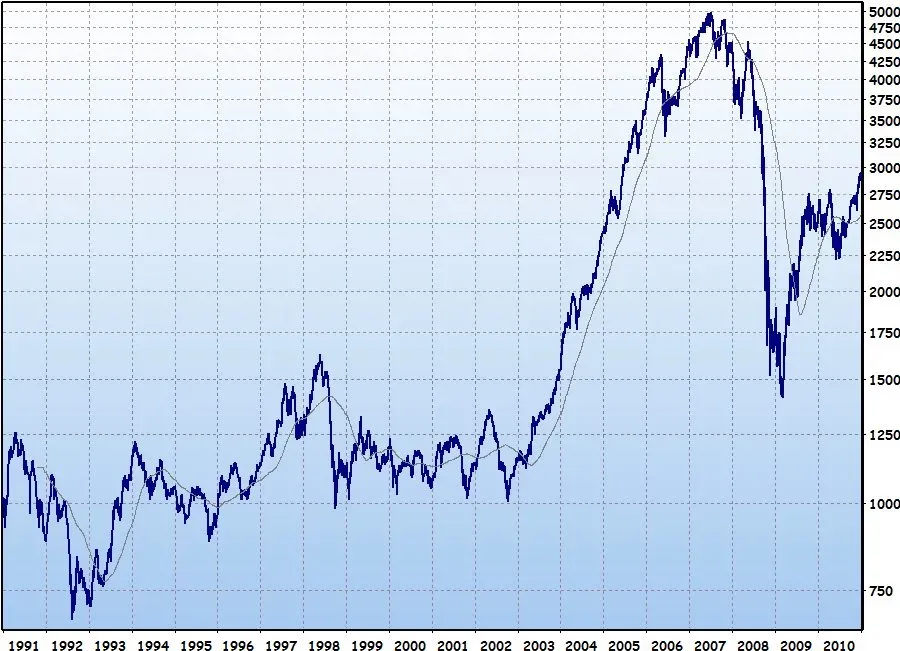
The S&P 500 posted gains of 23.31% in 2024 and 24.23% in 2023, two back-to-back years of exceptional returns that reshaped portfolios across the country. For investors who held a standard mix of stocks and bonds, those gains didn’t just feel good – they silently changed the game.
Strong years like 2024 create portfolio drift. An investor who began 2024 with a 60% stock and 40% bond allocation likely saw their equity return push their allocation to approximately 65% stocks and 35% bonds by year-end. That shift of five percentage points may sound modest, but it represents a meaningful change in the risk profile of the overall portfolio.
That exceptional two-year performance delivered cumulative returns exceeding 58%, transforming a $100,000 investment into approximately $158,000 before taxes. Impressive, without question. Yet the investor who rode that wave without reviewing their allocation likely ended 2024 holding a portfolio weighted far more heavily toward equities than they originally planned – and carrying more exposure to a potential reversal.
The Psychology Trap: Why Selling Winners Feels Wrong

While rebalancing can reduce risk, it can also feel counterintuitive, because it tends to move money out of assets that are outperforming on a relative basis and into assets that are underperforming. For most people, that runs completely against instinct. Selling something that’s been working – and buying more of what hasn’t – triggers a kind of internal alarm that’s hard to override.
This is the core psychological difficulty of the rebalance. Markets reward patience and conviction, but they also punish concentration when the tide turns. Strong S&P 500 returns can tempt investors to shift allocations heavily toward U.S. large-cap stocks. This “performance chasing” typically backfires. Historical evidence shows asset classes rotate leadership, and the best-performing asset class in one period often underperforms in the next.
Recognizing that discomfort – the feeling that rebalancing means giving something up – is the first step toward making better decisions. The investors who rebalance well aren’t necessarily smarter. They’ve just learned to separate emotions from the plan.
Market Concentration and the Hidden Risk in Popular Portfolios

One of the less-talked-about reasons to rebalance right now is how concentrated major indexes have become. As of January 2025, five companies – Amazon, Apple, Google, Microsoft, and Nvidia – represented more than a quarter of the S&P 500 Index and nearly half of the Russell 1000 Growth Index. That’s a stunning level of concentration for a supposedly diversified index.
Heading into 2025, a handful of mega-cap tech companies had tilted U.S. public equity markets meaningfully into growth territory, and recent gyrations revealed the potential risk in such positioning. Investors who assumed they were diversified simply by owning index funds discovered that their exposure was far narrower than they thought.
The top 10 companies’ still-elevated concentration relative to historical levels has real implications: diversification is shrinking, market performance is narrowing, and a small group of firms is increasingly driving overall returns. For anyone relying on passive investing as a path to broad diversification, the current landscape warrants a closer look at what’s actually inside the portfolio.
How Often Should You Rebalance? The Frequency Debate
There’s no universally agreed-upon answer to how often an investor should rebalance, and the research is genuinely mixed. The performance, risk, and rebalancing frequencies of different strategies were studied over 29 years of history, including five bull markets and four bear markets, and the findings show clear pros and cons to each approach. No single schedule dominates all others across every market environment.
On an annual basis, the performance characteristics of different rebalancing strategies appear remarkably similar. The various approaches uniformly produced either positive or negative returns in each of the 29 years, meaning rebalancing neither caused nor prevented a significant performance difference in a given calendar year. What matters more than the specific timing is that a disciplined approach exists at all.
Partner offer
Research comparing rebalancing triggers at 3%, 5%, and 10% portfolio drift has been studied over more than three decades of data, offering a range of practical thresholds investors can adopt. Many financial planners settle on reviewing portfolios at least once or twice annually and rebalancing when any single asset class drifts beyond a predetermined band. Flexibility matters more than rigidity.
The Tax Reality of Rebalancing in Taxable Accounts

Rebalancing isn’t free – especially outside of tax-advantaged accounts. Rebalancing typically involves selling some of the appreciated assets that have become overweighted and using the proceeds to buy into underweighted categories, but the catch is that selling appreciated investments generates capital gains, and unless these assets are housed inside tax-advantaged retirement accounts, the IRS will want a cut of those profits.
If you hold an investment for more than a year before selling, you benefit from the federal long-term capital gains rate, which most individuals pay at 15%, though depending on overall income level that rate could drop lower or rise higher. Timing sales strategically to qualify for long-term treatment rather than short-term rates – which can reach as high as 37% – can make a meaningful difference in the net outcome.
A smarter approach for many investors is to handle rebalancing primarily inside tax-sheltered accounts. By selling appreciated stock held inside retirement accounts first, investors can effectively rebalance their portfolio without incurring any current-year capital gains taxes. For those who must rebalance in taxable accounts, redirecting dividends into underperforming investments – rather than immediately selling strong performers – can help avoid triggering capital gains that would come from those sales.
Robo-Advisors and Automation: Removing Emotion from the Equation

Robo-advisors use algorithms to provide automated investment services, gathering information about investing goals, using an algorithm to determine an appropriate asset allocation, and building a tailored portfolio – with most robo-advisors automatically rebalancing the portfolio on an ongoing basis. For investors who know they’ll struggle to pull the trigger themselves, automation removes one of the biggest barriers to disciplined rebalancing.
Automated rebalancing continuously monitors portfolios and executes trades to maintain target allocations, eliminating emotional decision-making and timing errors, while tax-loss harvesting can potentially boost after-tax returns for high-income investors. These platforms don’t feel the pang of selling a winner. They simply execute. That unemotional consistency is, for many people, exactly the point.
The global robo-advisory market reached roughly $14.7 billion in 2025, and is expected to expand dramatically in the years ahead. That growth reflects a real shift in how everyday investors engage with portfolio management. The barrier between “I know I should rebalance” and actually doing it keeps getting lower.
Target-Date Funds: Built-In Rebalancing for Long-Term Savers

For investors who don’t want to think about rebalancing at all, target-date funds offer a structural solution. Target-date funds provide an easy way to hold a diversified investment portfolio that rebalances over time to become less focused on potential growth and more focused on producing income, with the investment mix shifting more heavily toward fixed-income and cash equivalent investments as the target date approaches. The glide path handles the heavy lifting automatically.
Target-date funds simplify investing by taking care of asset allocation, fund selection, rebalancing, and gradually dialing back risk as retirement approaches – all handled by professionals at a relatively low cost. That combination of automation and professional oversight makes them particularly attractive for people in the accumulation phase of their financial lives.
There’s a caveat worth knowing, though. Multi-asset funds like target-date funds tend to be a poor fit for taxable accounts, better housed in a tax-sheltered account like an IRA or 401(k), because their allocations get more conservative over time as the target date approaches, which can necessitate the sale of appreciated assets like stocks and sock investors with capital gains taxes. Where you hold these funds matters nearly as much as which fund you choose.
Conclusion: Rebalancing Is a Long Game

There’s a quiet irony at the heart of rebalancing: the better your portfolio performs, the more urgently it may need attention. A strong run in equities is wonderful until it quietly doubles your risk without you noticing. Research has shown a significant positive correlation between rebalancing-weighted returns and the Sharpe ratio, indicating that effective rebalancing can enhance risk-adjusted returns.
The real value of a disciplined rebalancing strategy isn’t the extra percentage point here or there. It’s sleeping better when markets turn volatile. It’s knowing your portfolio still reflects your actual goals and risk tolerance, not just the last two years of market performance. Research analyzing mutual fund and ETF cash flows reveals that disciplined fund allocators who rebalance their portfolios regularly behave notably differently from those who ride bull markets without adjusting – and that discipline aligns with stronger long-term outcomes.
Taking chips off the table doesn’t mean giving up on growth. It means making sure the bets you’re carrying are still the bets you actually want to make.
Partner offer
Planning a trip to Vegas?
Compare hotel rates and show tickets on VEGAS.com.