
There was a moment, sometime around 2010, when it felt like everyone was singing a Journey song they hadn’t listened to in decades. That strange cultural detour traces back to one show, a small-town high school choir room, and a group of misfit teenagers who turned into an unlikely commercial juggernaut almost overnight. What happened next is a story with more twists than most scripted dramas could invent. It involves broken chart records, sold-out arenas, and eventually, a string of real-life tragedies that no one saw coming when the curtain first went up.
A choir room phenomenon nobody predicted
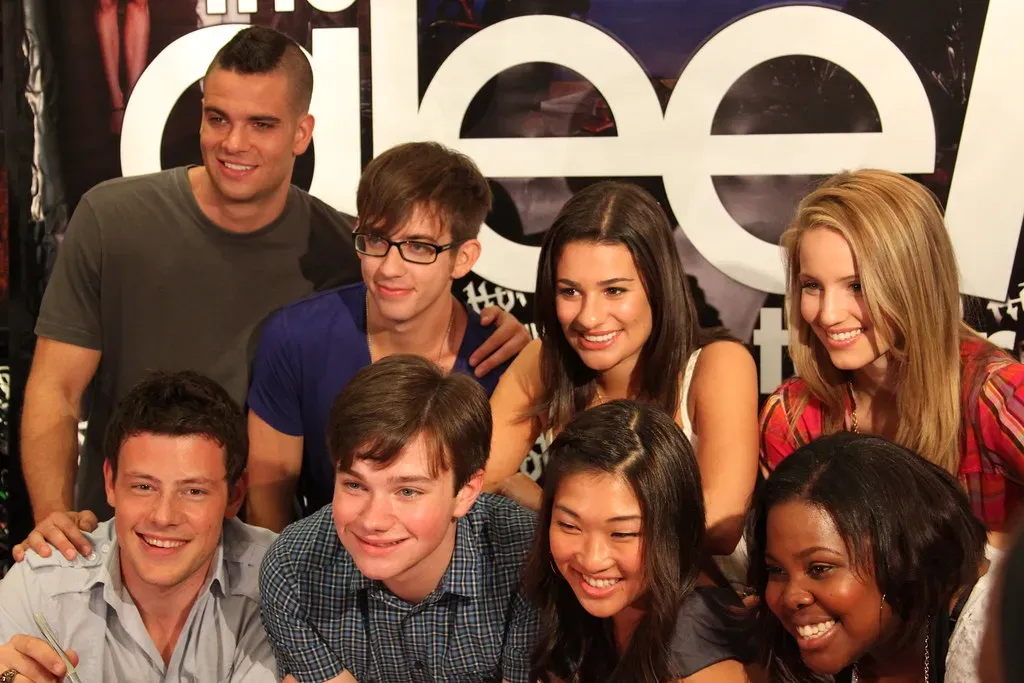
When the pilot aired in May 2009, Fox had no idea it was sitting on a cultural reset button. When the Glee pilot aired on May 19, 2009, it introduced the world to a cast of singing, dancing high school misfits making tentative steps toward the limelight. The premise sounded modest on paper: a Spanish teacher tries to revive a struggling glee club at a fictional Ohio high school.
Created by frequent collaborators Ryan Murphy, Brad Falchuk, and Ian Brennan, Glee was first imagined as a movie before the trio developed it as a series for Fox, following former glee club star Will Schuester as he tried to revive the club through a band of talented social misfits led by Rachel Berry and quarterback Finn Hudson. Fox greenlit the project remarkably fast, and one cast member later recalled how quickly the show found its footing in the writers’ room and on set. Nobody involved seemed to expect the response that followed within weeks of the premiere.
Breaking Beatles and Elvis records on the charts

The show’s connection to music turned out to be its secret weapon, and it happened almost by accident. On June 6, 2009, the Glee cast’s “Don’t Stop Believin'” bowed at No. 4 on the Hot 100, marking the act’s first of a record 207 total entries. That single cover version, lifted straight from the pilot, set off a chain reaction nobody in the music industry had a name for yet.
The pace of new entries was staggering by any historical standard. It didn’t take long for the show to threaten, and then quickly break, a number of long-held Hot 100 records, and in October 2010, just 16 months after its first chart appearance, Billboard announced that Glee Cast had broken the record for most entries in the chart’s history by a group, previously held by The Beatles with 71. Not long after, the show topped an even older mark. The Glee cast accomplished another astounding feat in 2011, when their 113th entry beat Elvis Presley’s record of 108 entries, officially making them the record-holder for most entries in Billboard’s 54-year history, surpassing records held by James Brown, Ray Charles and Aretha Franklin.
Sold-out arenas and a stack of Emmy nominations

Chart dominance was only part of the story. The cast took their act on the road, and the demand was real rather than manufactured hype. The Glee performers grossed $45.9 million over 53 tour dates, all in 2010-11, highlighted by a seven-show run at London’s O2 Arena in which all 103,513 tickets sold out.
Critics and the television industry took notice too, at least early on. The series also received 22 Primetime Emmy Award nominations, winning four, with Jane Lynch honored for outstanding supporting actress in a comedy series and Ryan Murphy winning for outstanding directing, while stars including Chris Colfer, Lea Michele and Matthew Morrison earned nominations. Combined with soundtrack sales that ran into the tens of millions, the show had become something closer to a multimedia franchise than a simple television series.
The first signs of trouble

Success this fast rarely lasts without some strain showing eventually. Glee would start to see some of that success shaken in 2011, when season 3 experienced a rapid ratings decline, and the show lost nearly a quarter of its audience, and more than that in the 18-49 demographic. That kind of drop from such a high perch drew attention across the industry.
The reasons were not mysterious to anyone paying attention. Part of the reason for the sharp decline was critical response, particularly to the series’ shaky writing. Storylines that once felt fresh and irreverent started to feel repetitive, and the show’s tendency to lurch between comedy and after-school-special seriousness became harder to ignore.
A misstep in New York

Season four tried something structurally ambitious by splitting the story between Ohio and New York City as the original cast graduated. Glee was already an aging show after its first few seasons, but beyond narrative hiccups and a dwindling audience, the passing of a lead actor may have hastened the show’s end. Fans and critics alike found the split narrative disjointed, with too much time spent shuttling between two settings that never quite balanced each other.
Partner offer
The commercial numbers reflected the growing dissatisfaction. Season one had debuted to a level that seems almost unbelievable by today’s fragmented television standards. When Glee splashed onto the small screen in 2009, its colorful, melodic spin on high school drama debuted to mostly positive reviews, and its ratings also smashed expectations, debuting to nearly 10 million viewers, a number practically unheard of in today’s TV climate. Watching that audience erode season by season was a visible, public decline rather than a quiet one.
A death that changed everything

Then came the moment that reshaped the show’s final chapters entirely. When Glee returned for its fifth season in September 2013, it did so without star Cory Monteith, who had died from an apparently accidental heroin and alcohol overdose on July 13, 2013. He was only 31 years old, and his character Finn Hudson had been central to the show since the pilot.
The tribute episode that followed became one of the most talked-about hours of television that year. During the very first Glee season without Monteith, viewership fell below three million viewers at one point, down from the series’ tribute episode to the actor and his character, entitled “The Quarterback,” which brought in 7.4 million total live viewers when it aired in October 2013. The episode was praised for its restraint and emotional honesty, but it could not reverse the show’s larger trajectory.
Limping toward a quiet ending

After Monteith’s death, the numbers never recovered in any meaningful way. After the death of Monteith, the show’s ratings went down severely, falling below 4.6 million viewers for the first time, with the final 12 episodes watched by fewer than 3 million viewers per week, falling to fewer than 1.9 million for the final episode, attributed partly to a sharp decline in quality as the writers had to replace much of the season. Fox trimmed the episode order that year, unable to justify the original count following production delays.
By the time cancellation talk turned official, network executives framed it as a graceful exit rather than a failure. Fox Networks Group Chairman-CEO Peter Rice said he thought Glee was one of the great shows in television history, and it was so hot and so big, but noted it had been on for over 100 episodes across six seasons and the network wanted to go out in a way that celebrated it. The series ultimately closed out with a shortened final season built more around nostalgia than new storytelling ambition. After six seasons, 121 episodes, and more than 729 musical performances, the Fox hit took its final bow on March 20, 2015.
Tragedy that extended beyond the screen

The show’s off-camera story turned darker than almost anyone could have predicted while it was still airing. In 2015, cast member Mark Salling was arrested, and after initially pleading not guilty in June 2016, Salling ended up pleading guilty to a federal offense of possessing child pornography involving a prepubescent minor in December 2017, and in January 2018, he was found dead while awaiting sentencing. His death by suicide came just weeks before he was scheduled to be sentenced.
Two years later, the cast lost another one of its own under devastating circumstances. On July 8, 2020, Rivera drowned during a boating trip on Lake Piru in Ventura County, California, while out with her young son, who was later found safe asleep in a life jacket aboard the drifting boat, and Rivera’s body was recovered five days later. She was only 33. The eerie coincidence that both Monteith and Rivera died on July 13, seven years apart, only deepened the sense among fans that the show carried an unusually heavy toll.
Streaming, nostalgia, and a legacy that endures

More than a decade after the finale, the show’s music catalog still generates real, measurable engagement rather than fading into obscurity. In the United States, the catalog amassed 48.3 million downloads and 3.8 billion official streams as of June 2024, underscoring its enduring popularity in the streaming era. That kind of sustained listening long after cancellation is unusual for a soundtrack built almost entirely on cover songs.
Fans have also kept the conversation alive through newer platforms that didn’t exist during the original run. Fifteen years after its premiere, the show’s fandom endures, in part on platforms that didn’t exist when it originally aired. Cast members Kevin McHale and Jenna Ushkowitz even launched a rewatch podcast, revisiting old episodes with the kind of candor and hindsight that only years of distance can provide.
The takeaway

Partner offer
Planning a trip to Vegas?
Compare hotel rates and show tickets on VEGAS.com.