Some albums arrive from tidy sessions, a few weeks in a familiar studio, a producer keeping everyone on schedule. Others come out of something closer to chaos: haunted houses, drug-fueled villas, marriages collapsing in real time while the tape kept rolling. The strange part is how often the mess ended up mattering, shaping the sound in ways a calm, well-organized session never could have. What follows are seven records where the circumstances behind the scenes were nearly as memorable as the music itself. Some of these stories have been polished into legend over the decades, others are backed by firsthand accounts from the people who lived through them, but all of them point to the same odd truth about creativity: sometimes the disaster is the point.
Fleetwood Mac’s Rumours: a band falling apart in the same room
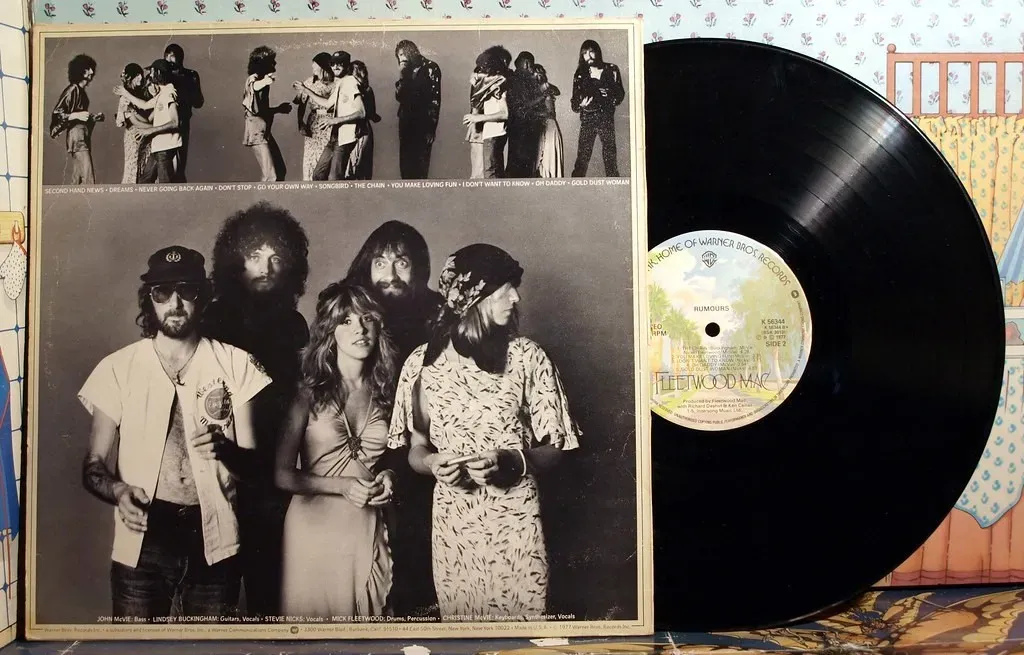
By late 1976, Fleetwood Mac was a band held together by little more than professional obligation. The band, up until then, had consisted of two couples, Stevie Nicks and Lindsey Buckingham, and John and Christine McVie, and at the time both couples were in the process of splitting up. Even drummer Mick Fleetwood wasn’t spared, since he was also going through a divorce while the band tried to make a hit record together.
They ended up doing exactly that, though not without help from a very specific kind of studio culture. The recording sessions took place as the band members dealt with breakups with one another and struggled with heavy drug use, both of which shaped the album’s direction and lyrics. Producer Ken Caillat later admitted plainly that “there were fights, breakups, drinking, drugs … We all indulged in substances.” The finished album, somehow, became one of the best selling records in history despite being written and performed by people who were actively breaking up with each other in the vocal booth.
The Rolling Stones’ Exile on Main St.: a basement in the south of France
In 1971, the Rolling Stones were essentially tax exiles, unable to stay in Britain without losing a fortune to the government. Keith Richards rented a sprawling villa on the French Riviera, and the other members settled in the south of France, and as a suitable recording studio could not be found, Richards’ basement at Nellcôte became a makeshift studio using the band’s mobile recording truck. That basement, damp and cramped, would produce one of rock’s most acclaimed double albums.
The house itself came with a strange history and stranger daily life. It had reportedly served as a Gestapo headquarters during the war, and by the time the Stones moved in, Richards had begun a daily habit of using heroin, with thousands of pounds worth of the drug flowing through the mansion each week alongside a rotating cast of visitors that included William S. Burroughs and Gram Parsons. French police eventually took notice, and the sessions carried on anyway, humidity, chaos, and all.
Bruce Springsteen’s Nebraska: a bedroom, a boombox, and an accident

Nebraska wasn’t supposed to be an album at all. In late 1981, Springsteen asked his guitar technician, Mike Batlan, to set up a no-frills porta-studio in a bedroom of his Colts Neck, New Jersey rental home, and it was in no way a professional environment, with Bruce recording while sat on a chair positioned at the end of the bed. The idea was to make quick demos before bringing the songs to the E Street Band.
The mixing process was almost comically low tech. Springsteen has said that he mixed from the four track cassette to a Gibson Echoplex to a boombox that had once fallen out of his canoe and sat in water and mud. When the full band tried to recreate the sound in a proper studio, something was missing, so Springsteen eventually begged his engineer Toby Scott to work with the original cassette instead. That cassette, carried around in a jacket pocket for weeks, became the master recording for one of the starkest albums of his career.
Radiohead’s OK Computer: recorded in an actual haunted mansion
After touring themselves into exhaustion behind The Bends, Radiohead retreated to St Catherine’s Court, a centuries old manor house near Bath. When the tour finally ended, the band holed up in the massive estate and set about recording and experimenting. It seemed like an inspired change of scenery, right up until strange things started happening.
Guitarist Jonny Greenwood later said that “people were always hearing sounds” in the house, but it was frontman Thom Yorke who had the worst of it. He described the experience bluntly, recalling that “ghosts would talk to me while I was asleep.” Whatever was or wasn’t actually haunting the place, the unease seeped into an album largely about isolation and unraveling technology, and the record went on to sell over four million copies worldwide.
My Bloody Valentine’s Loveless: nineteen studios and a label pushed to the brink
Kevin Shields set out to make Loveless with modest expectations from his label. Creation Records assumed the whole thing would be finished quickly, but it took the band two years to finish all eleven tracks, with many delays caused by Shields’ perfectionism, working with around forty five different engineers across nineteen studios. Sessions would sometimes last a single day at one studio before the band decided it wasn’t right and moved on.
The financial toll was severe enough to become part of the album’s mythology. The recording hired nineteen different studios and several engineers, with its final production cost rumoured to have reached two hundred fifty thousand pounds. Loveless didn’t sell especially well on release, and it nearly bankrupted Creation Records, with the band eventually dropped from the label. Decades later, it’s regularly cited as one of the most influential rock albums ever made, which makes the whole ordeal feel less like a cautionary tale and more like a strange kind of vindication.
The Beach Boys’ Pet Sounds: a sandbox, a piano, and a mind under pressure
Brian Wilson wasn’t touring with the rest of the Beach Boys by 1966, choosing instead to stay home and obsess over arrangements while the other members were on the road. He famously had a sandbox built around the piano in his living room, reportedly so he could feel sand between his toes while composing, a detail that has become shorthand for just how far outside normal studio practice this album’s creation went. Rather than relying on his bandmates for the instrumental tracks, Wilson brought in members of the Los Angeles session musician collective known as the Wrecking Crew, layering unconventional instruments like bicycle bells, dog whistles, and Coca Cola cans into the arrangements.
The result confused his own record label at first and didn’t match the commercial success of earlier surf rock hits, yet it’s now regarded as one of the most influential pop albums ever recorded. Wilson’s mental health was already fragile during this period, and the pressure of chasing an increasingly ambitious sound in his head, without any clear model to follow, foreshadowed the much rockier collapse of the unfinished Smile project that came right after it. Pet Sounds stands as proof that a single person’s obsessive, slightly eccentric vision, built largely alone in a home studio, can end up reshaping an entire genre.
Sly and the Family Stone’s There’s a Riot Goin’ On: paranoia inside a home studio
By 1970, Sly Stone had largely retreated from the outside world, converting a home in Bel Air into a private studio where he recorded for long, erratic stretches, often overdubbing parts himself rather than relying on the full band. The atmosphere around the sessions was reportedly tense and drug heavy, with a rotating cast of visitors passing through the house at all hours. Stone also leaned heavily on an early drum machine, the Maestro Rhythm King, giving the album a strangely mechanical, muffled backbone that stood in sharp contrast to the loose, celebratory funk that had made the band famous only a couple of years earlier.
The finished record sounds almost intentionally worn down, murky and claustrophobic in a way that mirrored both the era’s disillusionment and Stone’s own state of mind at the time. It arrived as a stark departure from the band’s earlier optimism, trading anthemic grooves for something darker and more inward looking. Despite, or maybe because of, its unsettled origins, the album is now widely regarded as one of the most influential funk and soul records ever made, a document of an artist working through personal and cultural exhaustion in real time.
Taken together, these seven records make an odd kind of case for creative disorder. None of these albums followed anything resembling a normal path from idea to finished product, and in most cases, the people involved weren’t entirely sure they’d survive the process, professionally or otherwise. Yet each one ended up defining a genre, an era, or an artist’s entire career, which suggests that the mess isn’t always something music has to overcome. Sometimes it’s simply part of the material.