Now I have solid research. Writing the article.
A monk in hiding with a mission

After his defiant stand at the Diet of Worms, Luther found himself an outlaw of the Holy Roman Empire. He spent ten months at Wartburg Castle, from May 1521 to March 1522, preparing a translation of the New Testament from Latin and Greek and previous German sources. It was a strange, isolated stretch of his life, cut off from the constant activity of Wittenberg.
He worked with astonishing speed. He produced the initial version in eleven weeks, an output that still impresses scholars who study the sheer density of decisions a translator has to make line by line. This wasn’t a leisurely scholarly exercise. It was a race against a hostile political and religious establishment that had already banned his writings.
The word nobody asked for

Buried in Romans chapter three is a line about justification and faith. Luther’s rendering of Romans 3:28 inserted the word “alone,” present in neither the Greek nor the Latin. It was not an accident or a slip. It was a deliberate interpretive move, and Luther knew exactly how controversial it would be.
Theologically, the word “alone” cemented a core Reformation idea, that faith by itself, without accompanying works, justifies a person before God. Luther added the word to capture the verse’s full meaning, rendering it as being justified through faith alone. Critics accused him of tampering with scripture to fit his own doctrine. Luther never denied he added it. He argued instead that the addition was necessary to make the sentence work in German the way the original worked in Greek.
Defending the choice in public

Luther didn’t quietly hope the controversy would fade. In his Open Letter on Translating, written in 1530, he defended the addition of “alone” as conforming to German idiom. This was a translator publicly explaining his reasoning to an audience of critics, something almost unheard of at the time.
His argument boiled down to a simple but radical idea: a translation’s job isn’t to mirror word order or vocabulary, but to make the text sound native. He followed the Renaissance humanist convention of translating a text’s sense rather than its mere letter. That distinction, sense over letter, became the philosophical backbone of his entire approach to the Bible.
Not the first, but the one that mattered

It’s a common misconception that Luther invented the German Bible. He didn’t. Fourteen High German and four Low German translations of the Latin Vulgate had already been published by 1518. Germans had access to scripture in their own language well before Luther picked up his pen.
What set his version apart was the source material and the ear behind it. His German Bible was the first based on the original languages of Hebrew, Aramaic, and Greek, and his creative mind, linguistic genius, and extensive knowledge of the German people helped him produce a highly idiomatic translation that outshone the more wooden translations of the day. Earlier versions read like Latin wearing a German costume. Luther’s read like something a German farmer or merchant might actually say out loud.
Listening before writing

Luther’s method wasn’t purely academic. He treated ordinary speech as a resource worth studying as carefully as any Greek manuscript. He sought to translate as closely to the original text as possible, but his translation was guided by how people spoke in the home, on the street and in the marketplace, aiming to produce a work common people could relate to.
His own later boasts, half proud and half bitter, reveal how seriously he took this work. He claimed that his opponents were learning to speak and write German from his translation, stealing his language from him, and joked that it tickled him to have taught even his enemies how to speak. Whatever else you make of the tone, it captures how central his Bible had become to everyday German speech within his own lifetime.
A meticulous, almost obsessive process
Behind the finished text was a grinding, iterative process that modern translators would recognize instantly. Luther later called his New Testament project the most difficult he had ever undertaken, spending two and a half months grinding out a first draft beginning in December 1521. Difficulty, in his case, meant obsessive revision rather than writer’s block.
He didn’t settle for a first pass. His process was meticulous: for every verse he might do a quick literal translation, then drill down into each Greek word for German synonyms, then start over with a more melodious version incorporating idioms that Germans could understand. That third pass, the melodious one, is where the real transformation happened. It’s the difference between a text that merely explains and one that resonates.
Help from a Greek scholar

Luther gets most of the credit, but he wasn’t working alone. In March 1522 he returned to his home city of Wittenberg and revised the translation with his ally Philipp Melanchthon, a revered Greek scholar, theologian and reformer. Melanchthon’s expertise filled in gaps that Luther, brilliant as he was, couldn’t cover by himself.
A biblical scholar who studies the period has described Luther’s overall tendency in blunt terms. Brooks Schramm, a retired professor of biblical studies at United Lutheran Seminary in Gettysburg, noted that Luther tended toward the idiomatic. That single observation explains why the Luther Bible still reads with a kind of muscular clarity that older, more literal German translations lacked.
Format mattered as much as vocabulary
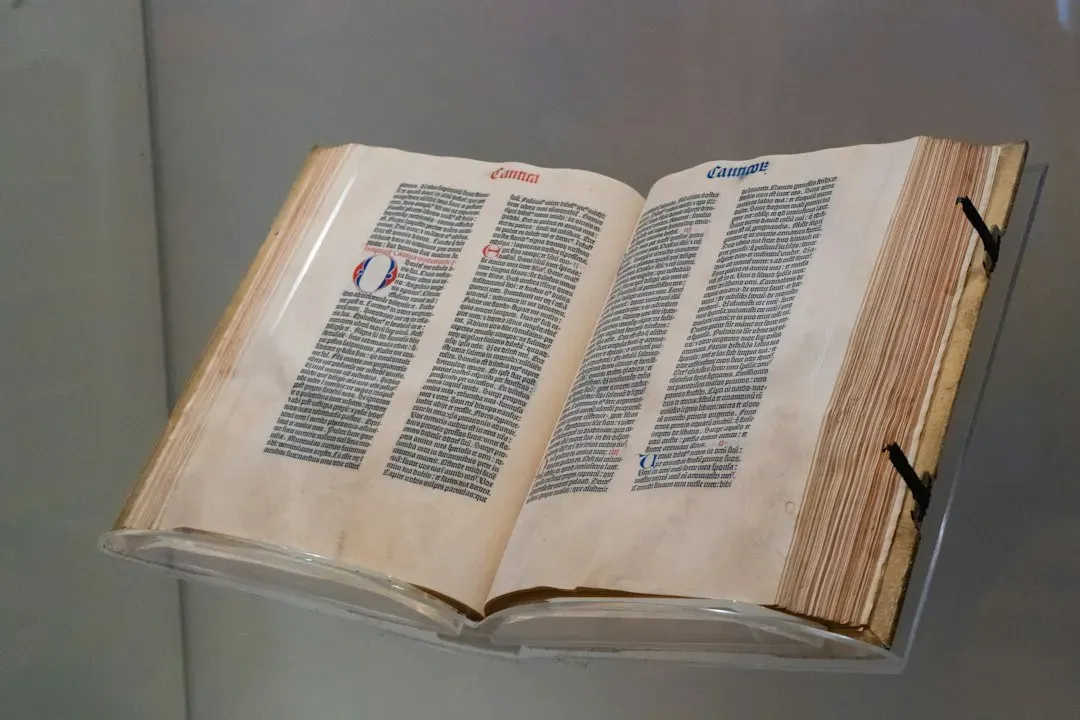
Word choice gets most of the attention, but Luther also changed how the text looked on the page, and that mattered just as much for ordinary readers. Besides introductory prefaces, marginal study notes, and illustrations by Lukas Cranach the Elder, Luther sought to facilitate understanding by introducing a single column format and breaking the text into paragraphs like modern Bible publishers do. Before this, dense unbroken columns of text made reading scripture a chore even for the literate.
Scholarly comparisons of his work against earlier German Bibles back up just how deliberate this readability push was. Luther discarded Jerome’s prefaces in favor of his own and added expository commentaries and paragraph breaks to help the reader, aspiring to more fluent and elegant language than the Koberger Bible while avoiding imported Latin terms in favor of rhetorically powerful German. He wasn’t just translating words. He was redesigning the reading experience itself.
A regional dialect becomes a national standard

Luther didn’t write in some abstract, idealized German. He wrote in the dialect he knew best, and that choice had lasting consequences for the language as a whole. He used a form of the Middle German dialect, drawing in particular from the dialect used by the royal Saxon court, meaning the German found in his Bible is mostly from eastern Germany.
That regional choice, amplified by the printing press, effectively became the template for standard written German. Luther brought harmony out of the linguistic confusion of the time and made the modern High German the common book language. A dialect from one corner of the German-speaking world ended up shaping how millions across many regions would eventually read and write.
Print runs that reached millions

None of this would have mattered without the printing press, and the numbers involved are genuinely staggering for the sixteenth century. Hans Lufft, the Bible printer in Wittenberg, printed over one hundred thousand copies between 1534 and 1574, which went on to be read by millions. For context, most books of that era circulated in the hundreds or low thousands of copies.
Even accounting for the fact that literacy was far from universal, the reach was extraordinary. Luther’s vernacular Bible was present in virtually every German speaking Protestant’s home, and there could be no doubts regarding the biblical knowledge attained by the German common masses. A book that had once belonged to Latin-reading clergy was now sitting on kitchen tables.
Coining words that didn’t exist yet
Sometimes German simply had no equivalent for a biblical concept, and Luther refused to just borrow a Latin term as a shortcut. Unable to find any exact German equivalents for many biblical terms, Luther created numerous new words and idiomatic expressions while translating the Bible. Some of those coinages are still in everyday German use today, largely unnoticed as artifacts of a sixteenth century translation project.
This willingness to invent rather than import is part of why literary giants later admired the work on purely stylistic grounds, separate from theology entirely. This led German writers such as Goethe and Nietzsche to praise Luther’s Bible. That’s a notable endorsement, coming from figures who had no particular stake in Reformation doctrine.
The long shadow on literacy itself

The translation’s influence went well beyond religion into something more structural: it helped teach an entire population how to read. It prompted educational reforms that advanced literacy across German-speaking lands over the following generations.
One striking way researchers have measured this influence is geographic. The book The WEIRDest People in the World charts how you could use distance from Wittenberg in the century after Luther as a measure of literacy in Germany, with populations closer to Wittenberg showing higher literacy. A single translation choice, radiating outward from one small town, left a measurable fingerprint on literacy rates a hundred years later.
An echo across the channel

Luther’s approach didn’t stay confined to German. It rippled outward into other vernacular Bible projects across Europe, most notably in English. Luther’s Bible influenced English translations through William Tyndale, whose own work would go on to shape the King James Version decades later.
Scholars studying the September Testament often draw a direct parallel between its cultural weight and that of a much later English landmark. The influence Luther’s translation had on the development of the German language is often compared to the influence the King James Version had on English. Two different countries, two different languages, but strikingly similar stories about how one translation can quietly rebuild a nation’s relationship with its own words.
Partner offer
Planning a trip to Vegas?
Compare hotel rates and show tickets on VEGAS.com.